Babel Review (2026): Pricing, Features & Honest Verdict
TLDR
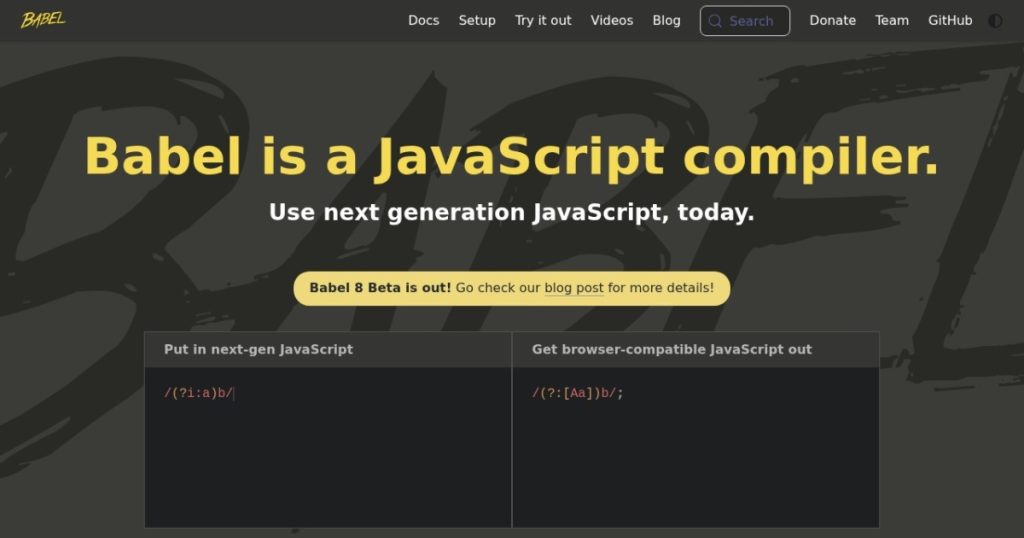
Babel is the original JavaScript compiler that defined modern transpilation. Still the most extensible option with 43K+ GitHub stars, but significantly slower than Rust-based alternatives. Best for: teams needing niche plugins or legacy compatibility. Price: free and open source. Rating: 6.9/10
What is Babel?
Babel is the JavaScript compiler that made it possible to write modern JavaScript before browsers caught up. For years, it was the only practical way to use arrow functions, destructuring, async/await, and other ES6+ features in production. The project transformed how the JavaScript ecosystem approaches language evolution.
Created by Sebastian McKenzie in 2014 (originally called 6to5), Babel grew into the default compiler for nearly every JavaScript project. React, Vue, Angular, and countless frameworks depended on it. Its plugin architecture became a template for extensibility in the JS tooling world.
In 2026, Babel faces a different landscape. SWC and esbuild offer dramatically faster compilation. Next.js has switched to SWC by default. But Babel’s plugin ecosystem remains unmatched, and certain workflows still require it.
Key Features
Presets and Plugins
Babel’s plugin system is its greatest strength. Over 3,000 plugins exist for every conceivable JavaScript transformation. @babel/preset-env automatically determines which transforms you need based on your browser targets. @babel/preset-react handles JSX. @babel/preset-typescript strips types. Custom plugins are written in plain JavaScript, making them accessible to any JS developer.
Polyfills and core-js Integration
Babel integrates with core-js to automatically inject polyfills for features your target browsers do not support. This goes beyond syntax transformation into runtime API compatibility, something SWC and esbuild do not handle as comprehensively.
JSX and TypeScript
Babel compiles JSX for React, Preact, and other frameworks. TypeScript support strips types during compilation (no type checking). Both work through official presets that are well-tested and widely used.
Macro System (babel-plugin-macros)
Babel macros allow compile-time code generation without custom plugin configuration. Libraries like styled-components, preval, and codegen use macros to optimize output at build time. This pattern does not exist in SWC or esbuild.
Performance
This is where Babel struggles in 2026. Being written in JavaScript means it runs on Node.js with its associated overhead. SWC benchmarks at 20x faster for equivalent transformations. esbuild is similarly fast. For small projects, the difference is barely noticeable. For large monorepos with thousands of files, Babel’s compilation step can take minutes where SWC takes seconds.
Memory usage is also higher. Babel’s AST representation and plugin pipeline consume more memory per file than Rust or Go alternatives. On CI machines with constrained resources, this compounds the speed disadvantage.
Pricing
Babel is completely free and open source under the MIT license. The project is funded through Open Collective donations and corporate sponsors. There are no paid tiers or enterprise editions.
| Plan | Price | Plan Features | Best For |
|---|---|---|---|
| Open Source | Free | Full compiler with presets, plugins, polyfills. MIT license. | Everyone |
Who is Babel Best For?
Teams that depend on specific Babel plugins without SWC equivalents still need Babel. Projects requiring complex polyfill strategies benefit from Babel’s core-js integration. Legacy codebases with extensive Babel configurations may find the migration cost to SWC too high. And developers writing custom compiler plugins will find Babel’s JavaScript-based API far more accessible than SWC’s Wasm plugin system.
Drawbacks
Speed is the elephant in the room. Babel is simply slower than modern alternatives, and the gap is widening. The project’s pace of innovation has slowed as core maintainers have limited bandwidth. Configuration can be complex with multiple config file formats (.babelrc, babel.config.js, babel.config.json) and sometimes surprising resolution rules. For new projects in 2026, choosing Babel over SWC requires a specific justification.
Alternatives
SWC
The leading Babel replacement. SWC handles most of Babel’s compilation tasks at 20x the speed. It is the default compiler in Next.js and integrates well with webpack, Vite, and other bundlers. The plugin ecosystem is smaller but covers the most common use cases.
esbuild
Written in Go, esbuild provides extremely fast compilation and bundling. It takes a more opinionated approach with fewer configuration options. For projects that do not need Babel’s extensibility, esbuild offers a simpler, faster alternative.
TypeScript Compiler (tsc)
If your project is purely TypeScript and you do not need JSX transforms or polyfills, tsc can handle transpilation directly. It is slower than SWC but provides type checking in the same step, which can simplify your toolchain.
Verdict
Babel deserves enormous credit for shaping modern JavaScript development. It solved critical problems and its plugin architecture influenced every tool that followed. But in 2026, it is no longer the default choice. SWC and esbuild do the core compilation job faster and with less configuration. Babel remains valuable for its unmatched plugin ecosystem and polyfill integration, but new projects should start with SWC and only reach for Babel when they need something SWC cannot provide.
FAQ
Should I migrate from Babel to SWC?
If you are using standard presets (env, react, typescript) without custom plugins, yes. The migration is usually straightforward and the speed gains are substantial. If you rely on specific Babel plugins, check if SWC alternatives exist first.
Is Babel still maintained?
Yes. The core team continues to release updates and support new JavaScript proposals. The pace is slower than during Babel’s peak, but it remains actively maintained.
Can I use Babel and SWC together?
In some setups, yes. For example, you can use SWC for the main compilation pass and Babel for specific transforms that SWC does not support. This adds complexity but can be a practical migration strategy.
Babel Pros & Cons
What We Like
- Largest plugin ecosystem with 3,000+ plugins for every use case
- Best polyfill integration via core-js for runtime API compatibility
- Custom plugins written in plain JavaScript, very accessible
- Battle-tested in production across millions of projects
- Macro system enables compile-time optimizations unique to Babel
What Could Be Better
- 20x slower than SWC and esbuild, painful on large codebases
- Higher memory usage than Rust or Go-based alternatives
- Configuration complexity with multiple config file formats
- Innovation pace has slowed as the ecosystem shifts to faster tools
Babel FAQ
Should I migrate from Babel to SWC?
If using standard presets without custom plugins, yes. The speed gains are substantial. Check if SWC alternatives exist for any specific Babel plugins you rely on.
Is Babel still maintained?
Yes. The core team continues to release updates and support new JavaScript proposals, though the pace is slower than during its peak.
Can I use Babel and SWC together?
In some setups, yes. Use SWC for the main compilation pass and Babel for specific transforms SWC does not support. This adds complexity but can work as a migration strategy.
What is Babel?
The original JavaScript compiler with the largest plugin ecosystem. Transpiles modern JS/TS with presets, plugins, and polyfill integration. Free and open source.
How much does Babel cost?
Babel pricing starts at Free (open source). A free plan is available.
Is Babel worth it?
Babel shaped modern JavaScript but is no longer the default choice in 2026. Its unmatched plugin ecosystem and polyfill support keep it relevant for specific use cases, but new projects should start with SWC. We rate it 6.9/10.