Storyblok Review (2026): Pricing, Features & Honest Verdict
TLDR
Storyblok is a visual headless CMS that lets content teams edit pages in a real-time visual editor while developers build with any framework. Best for: agencies and dev teams needing a headless CMS that non-technical editors can actually use. Price: Free for 1 space, from $99/mo. Rating: 7.6/10
What is Storyblok?
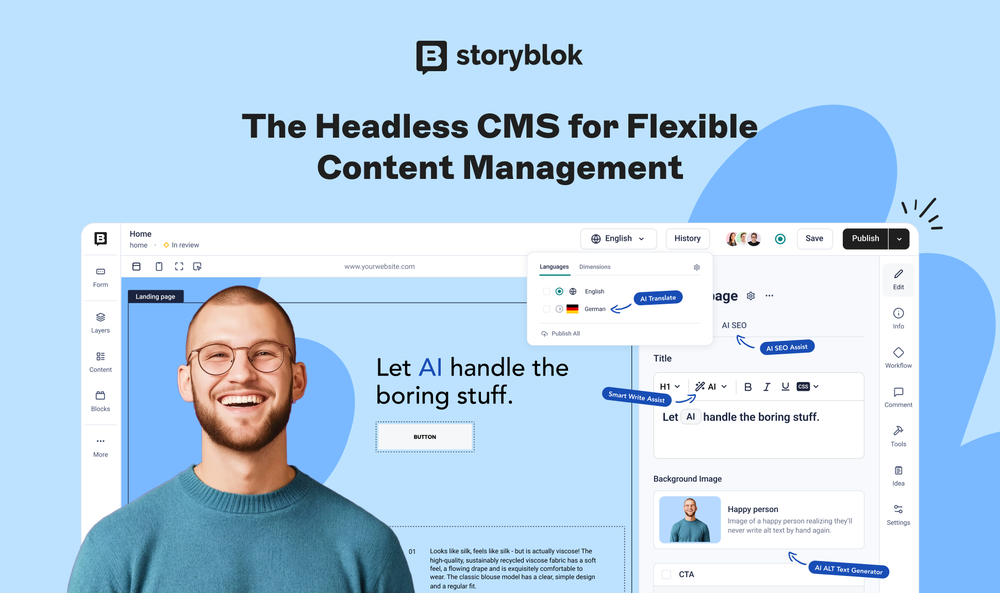
Storyblok is a headless content management system with a twist: it includes a real-time visual editor. Most headless CMS platforms force content editors to work in abstract forms and JSON fields. Storyblok shows editors a live preview of their content as they edit it, overlaid directly on the frontend. This bridges the gap between developer flexibility and editor usability.
Founded in 2017 in Austria, Storyblok has grown into one of the more popular headless CMS options, especially among agencies building sites for clients who need to manage content independently. It works with any frontend framework (React, Vue, Next.js, Nuxt, Svelte) through REST and GraphQL APIs.
Key Features
Visual Editor
The visual editor is Storyblok’s defining feature. Content editors see a live preview of the page and can click on any component to edit it inline. Changes appear in real time. This dramatically reduces the back-and-forth between editors and developers that plagues most headless CMS setups.
Component-Based Architecture
Content in Storyblok is organized into reusable components (called “bloks”). Developers define component schemas, and editors mix and match them to build pages. This approach keeps content structured and consistent while giving editors creative freedom within guardrails.
Multi-Language Support
Storyblok handles internationalization natively with field-level translations. Each content entry can have translations for any number of languages, and the visual editor lets you switch between languages while editing. For multi-market websites, this is a significant time saver.
Workflows and Collaboration
Content workflows let teams set up approval chains with custom stages. Editors can submit content for review, managers can approve or reject with comments, and published content goes through whatever process the team defines. It works, though the workflow builder is not as flexible as dedicated tools like Contentful’s.
Asset Management
The built-in asset manager handles images, videos, and documents with folder organization and search. Images are served through Storyblok’s CDN with on-the-fly transformations (resize, crop, format conversion). It covers basic needs but lacks the advanced DAM features larger teams might want.
Pricing
Storyblok’s free Community plan includes 1 space with 1 user, which is enough to evaluate the platform. The Entry plan at $99/month adds more users and spaces. Business at $449/month unlocks workflows, custom roles, and higher API limits. Enterprise pricing is custom. The jump from free to $99 is steep for solo developers experimenting with headless CMS options.
Pros and Cons
Pros
- Visual editor makes headless CMS accessible to non-technical editors
- Component-based content modeling is clean and flexible
- Works with any frontend framework through REST and GraphQL APIs
- Multi-language support is well-implemented at the field level
- Free tier available for evaluation and small projects
Cons
- Pricing jumps steeply from free to $99/month with limited mid-range options
- Visual editor requires additional setup and iframe configuration to work properly
- Content workflows are basic compared to enterprise CMS platforms
- Plugin ecosystem is smaller than Contentful or Strapi
- Learning curve for developers setting up the visual editor bridge
| Plan | Price | Plan Features | Best For |
|---|---|---|---|
| Community | $0/mo | 1 space, 1 user, 25K API calls/mo | Evaluation and small projects |
| Entry | $99/mo | 5 users, 2 spaces, 250K API calls/mo | Small teams and agencies |
| Business | $449/mo | Custom roles, workflows, higher API limits | Growing businesses with content teams |
Who Should Use Storyblok?
Storyblok is strongest for agencies building websites for clients. The visual editor means clients can actually manage their own content without calling the developer for every text change. Development teams building with modern JavaScript frameworks (Next.js, Nuxt, SvelteKit) will appreciate the clean API and component model.
Solo developers and very small teams might find the pricing hard to justify when free options like Strapi exist. Large enterprises with complex content operations might outgrow Storyblok’s workflow capabilities and need something like Contentful or a custom solution.
Alternatives
Contentful
Contentful is the most established headless CMS with a mature API, extensive integrations, and strong enterprise features. It lacks a visual editor but offers more powerful content modeling and workflow tools. Pricing starts at $300/month for the Team plan, making it significantly more expensive than Storyblok for comparable features.
Sanity
Sanity offers a highly customizable editing experience through its open-source Sanity Studio. Developers can build virtually any editing interface they want. The trade-off is that it requires more development effort upfront compared to Storyblok’s ready-made visual editor. Sanity’s free tier is more generous, with 100K API requests per month.
Strapi
Strapi is an open-source headless CMS you can self-host for free. It provides a solid admin panel for content management but has no visual editing capabilities. For teams comfortable with self-hosting and who do not need a visual editor, Strapi offers the best value. The cloud-hosted version starts at $29/month.
FAQ
Does Storyblok work with Next.js?
Yes. Storyblok provides official SDKs for Next.js, Nuxt, Gatsby, SvelteKit, and other frameworks. The visual editor works with all of them through a bridge script.
Can non-technical users manage content in Storyblok?
Yes, that is its primary selling point. The visual editor lets content editors work with a live preview rather than abstract form fields.
Is Storyblok good for multilingual sites?
Yes. Field-level translations, locale management, and language-specific publishing are built into the core platform.
How does Storyblok compare to WordPress?
Storyblok is a headless CMS, meaning it provides content via API without a built-in frontend. It offers more flexibility for custom frontends but requires more development effort than WordPress.
Verdict
Storyblok solves a real problem in the headless CMS space: making content editing feel intuitive for non-developers. The visual editor genuinely works and sets it apart from competitors like Contentful and Sanity. However, the steep pricing jump from free to $99/month, limited plugin ecosystem, and basic workflow tools hold it back from a higher score. It is the right choice for agencies and development teams building content-managed sites for clients who need hands-on editing capabilities.
Storyblok Pros & Cons
What We Like
- Visual editor makes headless CMS accessible to non-technical editors
- Component-based content modeling is clean and flexible
- Works with any frontend framework through REST and GraphQL APIs
- Multi-language support is well-implemented at the field level
- Free tier available for evaluation and small projects
What Could Be Better
- Pricing jumps steeply from free to $99/month
- Visual editor requires additional iframe setup to work properly
- Content workflows are basic compared to enterprise CMS platforms
- Plugin ecosystem is smaller than Contentful or Strapi
- Learning curve for developers setting up the visual editor bridge
Storyblok FAQ
Does Storyblok work with Next.js?
Yes. Storyblok provides official SDKs for Next.js, Nuxt, Gatsby, SvelteKit, and other frameworks.
Can non-technical users manage content in Storyblok?
Yes, the visual editor lets content editors work with a live preview rather than abstract form fields.
Is Storyblok good for multilingual sites?
Yes. Field-level translations, locale management, and language-specific publishing are built in.
How does Storyblok compare to WordPress?
Storyblok is a headless CMS providing content via API without a built-in frontend, offering more flexibility but requiring more development effort.
What is Storyblok?
Visual headless CMS with a real-time editor, component-based content modeling, and multi-language support for any frontend framework.
How much does Storyblok cost?
Storyblok pricing starts at Free / $99/mo. A free plan is available.