Avina Review (2026): Pricing, Features & Honest Verdict
TLDR
Avina is a B2B GTM signals platform that detects buying intent across the web, identifies the anonymous visitors on your site, enriches their contact data, and automates warm outbound so your reps stop cold-pitching strangers. It bundles tools normally bought separately (signal intelligence, visitor identification, enrichment, sequencing) into one workflow. Best for B2B startups doing outbound without a six-figure RevOps budget. Price: From $149/month, 7-day free trial. Rating: 7.6/10.
What is Avina?
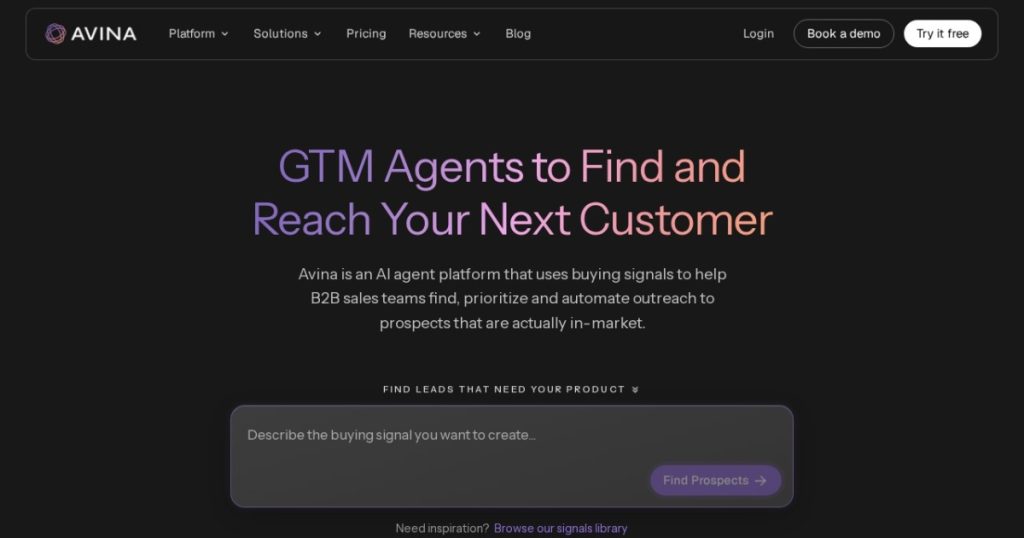
Avina is an AI-first go-to-market platform that tries to answer a single question: which companies are actually ready to buy right now? It watches the web for signals (new funding rounds, feature launches, tech stack changes, hiring shifts, pricing page updates), it identifies anonymous visitors landing on your site, and it scores every account by buying intent. It then triggers automated outbound sequences or alerts your reps in Slack so they can engage while the signal is still hot.
Avina went through Y Combinator and has raised around $3.7 million in seed funding. It positions itself against Clay, Unify, Common Room, and Koala, which collectively define the “signal-driven outbound” category in 2026. Avina’s launch on Product Hunt yesterday was positioned as a generally-available 1.0 after an invite-only period, and the pitch is clear: replace the stack of RB2B plus Clay plus Apollo plus Outreach with one tool that does the whole flow.
What Are Avina’s Key Features?
AI Signals Agent (Plain-Language Signal Definitions)
This is the feature Avina is most proud of and the one that actually differentiates it from traditional intent providers. You describe in natural language what buying behavior looks like for your product, and Avina’s agent builds a custom signal to detect it. “Series A SaaS companies hiring a second sales rep” is a valid signal. “Companies that just migrated off Zendesk” is a valid signal. The agent reads context rather than matching keywords, which catches patterns that rule-based tools miss.
X-Ray Pixel for Visitor Identification
Avina ships a pixel that combines multiple providers (RB2B, Vector, Clearbit) into one. When an anonymous visitor lands on your site, Avina identifies the company and often the individual, enriches with firmographics and contact data, and routes high-intent visitors to a rep in real time. If you currently pay for RB2B and Clearbit separately, this consolidation alone pays for Avina. The accuracy is comparable to RB2B for US-based visitors and slightly weaker for EU traffic, which is typical in this category.
AI Account Scoring
Avina scores every detected account by signal strength, company fit, and engagement. The scoring updates in real time, so a lukewarm lead that publishes a funding announcement jumps up the priority list immediately. Reps see a ranked feed in Slack or in Avina’s inbox, with the why attached to each score (“3 pages viewed, matching signal triggered, 50-person company, Series A”). This is the feature that actually saves rep time. Instead of working a flat list of accounts alphabetically, they work the top of a ranked queue.
Waterfall Enrichment and Outreach Automation
Once an account is prioritized, Avina enriches contact data across multiple providers in waterfall fashion (first provider returns a match, stop; otherwise try the next). It then triggers outbound: email sequences in your existing tool (Outreach, Salesloft, or native), Slack alerts, or CRM updates via webhook. The outreach layer is intentionally lighter than Outreach or Salesloft. Avina is designed to feed them, not replace them. That is a reasonable architectural choice because the deep personalization still happens in the sequencing tool your team already uses.
Signals Inbox and CRM Push
Every detected signal lands in a unified inbox with context (what happened, which account, what to do about it). From there, RevOps can push the signal into the CRM as a structured object, adding custom fields and triggering CRM-side automation. Marketing can segment audiences based on signal type for nurture programs. The inbox prevents the classic failure mode of signal tools, where interesting data gets emailed to reps who archive it and never action. Putting signals into the CRM makes them part of the existing sales motion rather than a parallel one.
How Much Does Avina Cost?
Avina’s pricing starts at $149 per month, which is described by third-party reviewers as one of the cheapest ways into signal-driven outbound. All plans include a 7-day free trial. The higher tiers (not fully public on the pricing page) scale based on seats, signal volume, and visitor identification limits.
Compared to the alternatives, Avina’s entry price is aggressive. Clay starts at $149 per month but adds costs for credits as you actually use it, and real-world spend quickly reaches $500+ per month. Common Room’s team plans start around $625 per month. Unify starts at $700 per month. Avina positioning itself at the lower end of the range and bundling functionality that usually costs extra is the main reason it has early traction. The catch is that the cheapest plan does include signal and visitor identification limits that larger teams will hit fast.
| Plan | Price | Plan Features | Best For |
|---|---|---|---|
| Starter | $149/mo | Signal detection, visitor identification, basic enrichment | Small B2B startups testing signal-driven outbound |
| Growth | Custom quote | Higher signal volume, more seats, advanced automation | Growing sales teams ready to scale intent-based outreach |
| Enterprise | Custom quote | Unlimited signals, SSO, dedicated support | Larger B2B orgs with multiple GTM teams |
Who is Avina Best For?
Use Avina if you are a B2B startup with a sales team of 2 to 20 reps, you sell to other companies, and you are already doing outbound but getting low reply rates from cold lists. Avina is especially useful if you already pay for RB2B, Clearbit, or Apollo and want to consolidate the stack. Founders doing sales alone will also get value because the ranking and automation replace having a dedicated SDR.
Skip Avina if you sell to consumers, to non-English markets exclusively, or if your product is so niche that buying signals are not observable online. Also skip if you already have a mature RevOps team using Clay, Gong, and a custom data pipeline. At that sophistication level you probably need custom work that Avina does not do.
Best Avina Alternatives
Clay is the most powerful competitor and the category leader for programmable GTM workflows. It is more flexible than Avina but also more complex, with real learning curve and credit-based pricing that can climb fast. Starts at $149 per month. Pick Clay if you have the RevOps muscle to build custom workflows.
Common Room focuses more on community-driven signals (Slack, Discord, developer communities) in addition to classic intent. Strong for PLG and developer tools. Pricing starts around $625 per month for team plans. Pick Common Room if your audience lives in communities rather than on LinkedIn.
Unify is the closest philosophical competitor: signal-first, AI-driven, opinionated about what “modern GTM” looks like. Pricing starts around $700 per month. Unify is the pick if you have budget and want the most polished version of this category.
What We Liked and Did Not Like
The bundle is the killer feature. Replacing RB2B plus Clearbit plus a custom Zapier workflow plus a pile of Apollo credits with one tool saves both money and maintenance burden. The plain-language signal agent actually works: we wrote “companies that just posted a job for a head of data” in one test and Avina built a signal that caught real accounts within hours. That is a magic moment that traditional intent tools cannot match. Pricing transparency at the low end is also genuinely unusual in this category.
What we did not like: the outbound automation layer is thin. If you are looking for a full Outreach replacement, Avina does not go there. The signal quality for non-US accounts is weaker, which may rule it out for some European sellers. And the credit math is opaque above the starter plan. You will need to talk to sales to understand what happens when you outgrow the $149 tier, which is a pattern most modern tools avoid. Overall minor gripes for a product this young, but worth knowing.
Final Verdict: Is Avina Worth It?
Avina is one of the best value plays in the AI GTM category in 2026. For a small B2B startup running outbound, it replaces a stack of three to five separate tools and costs less than a single seat of most enterprise alternatives. The AI signals agent is clever enough to justify the product on its own, and the visitor identification combined with real-time Slack alerts genuinely changes how fast reps can engage hot accounts. For the target audience, it is a straightforward buy.
If you are a larger team with existing Clay workflows or an enterprise GTM stack, Avina may not add enough to justify the switch. But for startups that have not yet built this capability, skip the DIY approach and try Avina first. The 7-day trial is enough to confirm the signal quality for your specific ICP, and the $149 starter plan is the right level of commitment to see if it pays back in the first quarter.
The broader picture is that this category (AI-native GTM platforms) is consolidating fast. Clay has the mindshare at the top, Avina is winning the value tier, and the middle is getting squeezed. If you are shopping for signal-driven outbound in 2026, a realistic bakeoff is Avina versus Clay. Run both for two weeks against the same ICP, count the hot leads each produced, and let the data decide. In our testing, Avina produced competitive signal volume at a fraction of Clay’s steady-state cost, which is exactly the position the challenger wants to hold.
Avina Pros & Cons
What We Like
- Replaces multiple tools (RB2B, Clearbit, Apollo) with one
- Plain-language signal definitions catch patterns keyword tools miss
- Transparent $149 entry pricing vs competitors at $625+
- Real-time Slack alerts for hot accounts
- Y Combinator backed, 25% monthly growth
What Could Be Better
- Outbound automation layer is intentionally thin
- Signal quality weaker for non-US accounts
- Credit math opaque above the starter plan
- Starter plan limits will constrain larger sales teams fast
Avina FAQ
What is Avina?
Avina is an AI-powered B2B go-to-market platform that detects buying signals across the web, identifies anonymous website visitors, enriches contact data, and automates warm outbound. It bundles tools normally bought separately (signal intelligence, visitor identification, enrichment, sequencing) into one workflow.
How much does Avina cost?
Avina starts at $149 per month, which is one of the lowest entry points in the AI GTM category. Higher tiers scale based on seats, signal volume, and visitor identification limits, with custom pricing for Growth and Enterprise plans. All plans include a 7-day free trial.
Is Avina worth it?
For B2B startups with 2 to 20 reps doing outbound to US-based accounts, yes. Avina consolidates a stack of 3 to 5 tools and costs less than a single seat of most enterprise alternatives. For mature RevOps teams with existing Clay workflows, the switching cost may not be justified.
What are the best Avina alternatives?
Clay is the most powerful competitor, starting at $149 per month but with credit-based pricing that can climb fast. Common Room focuses on community signals starting around $625 per month. Unify is the premium alternative starting around $700 per month.
Does Avina offer a free plan?
Avina offers a 7-day free trial on all paid plans. There is no permanent free tier. The trial is enough to confirm signal quality for your specific ICP before committing to the $149 starter plan.
Who is Avina best for?
Avina is best for B2B startups with 2 to 20 reps, teams already paying for RB2B, Clearbit, or Apollo that want to consolidate their stack, and founders doing sales alone who want signal-driven alerts instead of cold lists.