Comcent Review (2026): Pricing, Features & Honest Verdict
TLDR
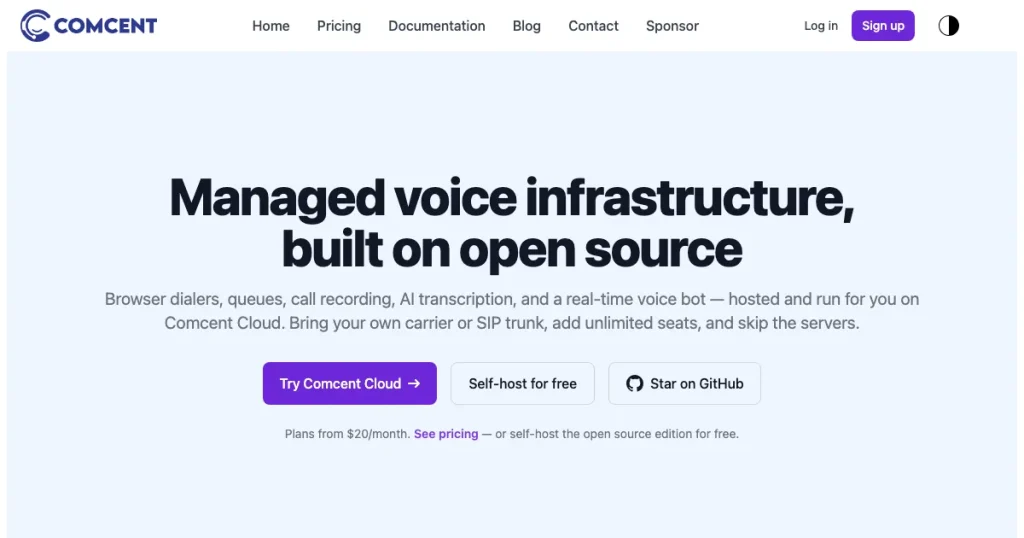
Comcent is open source voice infrastructure: a browser softphone, queues, call recording, AI transcripts and a phone bot on the SIP carrier account you already pay for. The hosted edition prices by concurrent calls, not seats, which is rare. Best for: small support and sales teams with their own carrier. Price: from $20/mo, free plan yes (self-hosted). Rating: 7.0/10.
What is Comcent?
We spotted Comcent on Product Hunt, where it launched on 9 October 2026 as AI-ready voice infrastructure that sits on your own SIP carrier account. The vendor, Comcent Technologies Private Limited, is registered in Karnataka, India, and its terms are governed by Indian law. It sells two editions. Comcent Cloud is the hosted service at app.comcent.io. Comcent CE is the open source Community Edition, licensed under AGPL-3.0, that you install on your own Linux server.
The product itself is older than the launch. The vendor’s blog introduced Comcent as a hosted call-centre platform in September 2024, and the Community Edition went public in July 2026. The code repository was created in April 2026, has 204 commits, 47 stars and 9 forks, lists two contributors, and shipped seven tagged releases between 6 and 9 October 2026. That is a very young open source project with an active but tiny team behind it.
What Are Comcent’s Key Features?
Browser softphone on your own SIP carrier
Every member gets a WebRTC dialer inside the web app, so reps need a browser, a headset and microphone permission. Comcent sells no numbers and no minutes. You connect a carrier such as Twilio, Telnyx or Bandwidth by entering its termination address and the IPs it sends calls from, then add each number in E.164 format. On Twilio there is a one-step import that creates the SIP connection in your carrier account for you. Desk phones can also register on port 5060.
Queues, call flows and transfers
Inbound numbers get a visual flow editor with menu, play, business-hours, ring, queue and voice-bot nodes. Queues are first in, first out, with round-robin offers to reps whose status is Available, plus wrap-up time, reject delay and an automatic logout after a set number of missed calls. The dialer supports hold, blind transfer and attended transfer, and each transfer shows up as a lane on the call graph. On the hosted edition, a transfer can carry a live AI summary to the receiving rep at $0.03 a minute.
AI Insights with promise tracking and search
After each call, Deepgram produces a speaker-attributed transcript, a sentiment reading per party and a short summary; an OpenAI model applies your own labels, extracts promises a rep made (“I’ll email the invoice by Friday”) with due dates, and powers semantic search across calls using embeddings stored in Postgres. An admin can turn on a once-a-day executive summary. On the self-hosted edition you supply your own Deepgram and OpenAI provider keys and pay those companies directly.
Phone bots that hand off to a person
A phone bot is configured with three prompts (what to do, what not to do, how to greet), a pipeline choice (Deepgram speech-to-text with an OpenAI model, or OpenAI’s Realtime speech-to-speech API) and optional MCP servers so it can look up orders in your own systems. Two built-in functions let it hang up or push the caller into a queue, which is how a bot hands over to a human. On Comcent Cloud the standard and Realtime pipelines cost $0.08 a minute and Realtime Premium costs $0.20.
What Is It Like to Use Comcent?
We did not install it; this describes the workflow as the vendor’s documentation and repository show it. For self-hosting, the documented path is a Linux host with a public IPv4, a domain pointed at it, and the web, SIP and media ports opened, then a one-line installer that pulls Docker if needed, generates secrets and writes a compose file pinned to the latest release. The vendor says the installer takes about 30 seconds and the first start pulls around 800 MB of images in five to ten minutes.
The “$12 a month VPS” claim in the repository’s install notes is for a 2 vCPU, 4 GB cloud droplet, and it is not the whole cost. The requirements page lists an S3 or S3-compatible bucket as required for recordings, SMTP as recommended, and your carrier’s per-minute charges on top. The stack is ten containers: a reverse proxy, a certificate copier, an Elixir server, a web app, a Go session border controller, FreeSWITCH, the phone bot, Postgres with an embeddings extension, a cache and a message queue.
Comcent Cloud removes all of that. You sign up, fund a prepaid wallet with PayPal (or Razorpay in rupees if you are in India), pick a plan, and connect the same carrier details. Everything the web app does goes through a documented HTTP API with 30-day session tokens, and finished calls arrive at your webhooks as vCon 0.4.0 documents, an open JSON format for conversations. One catch from the docs: webhook deliveries are attempted once and never retried, so the vendor suggests reconciling against the API.
Where Does Comcent Fall Short?
The commercial terms are strict. Every payment is non-refundable, including wallet top-ups, unused days after a downgrade, and any wallet balance left when an account is shut. Liability is limited to the lower of USD 100 and three months of fees, claims must be raised within six months, and there is no service level agreement at all. Disputes go to arbitration in Udupi, Karnataka.
Data residency is odd for an Indian company: the privacy policy places hosting on DigitalOcean, recordings on AWS S3, and the AI on OpenAI and Deepgram, all in the United States. The policy says data is not sold and relies on Standard Contractual Clauses for EU and UK transfers, but it says nothing about whether OpenAI or Deepgram may train on call audio. The app also records user sessions with an analytics tool and sends hashed sign-up emails to Google Ads and Reddit, with consent.
The open source community is thin. Forty-seven stars, two contributors and a contributor licence agreement on every contribution mean this is a vendor-run project, not a community one. Several hosted-only extras (transfer intelligence, managed retention, included AI minutes) show where the paid line is drawn. The recording retention on the $20 plan is only 30 days, and the “New feature out” banner on the marketing site links nowhere.
How Much Does Comcent Cost?
Comcent Cloud starts at $20 a month for the Starter plan, paid from a prepaid wallet with a $25 minimum top-up. Starter buys 5 concurrent calls, extra slots at $3 a month each, 30 days of recording retention, and AI Insights on a pay-as-you-go basis at $0.020 a minute. Team is $99 a month for 20 concurrent calls, extra slots at $4, one year of retention and 3,000 AI minutes included, then $0.015. Scale is $249 for 50 concurrent calls, extra slots at $5, three years of retention and 10,000 AI minutes, then $0.012.
Seats are unlimited on every plan and Comcent charges nothing for talk time; your carrier does. Prices are in US dollars, exclude GST and other taxes, and the terms say Indian top-ups convert at the European Central Bank reference rate with no markup. The hosted cloud has no free tier and no trial; the free option is the self-hosted Community Edition. The Product Hunt launch post said new accounts get $25 of credit as a launch offer; the vendor’s own site and docs do not mention it.
The arithmetic is where it gets interesting. Starter plus 15 extra slots reaches Team’s 20 concurrent calls for $65, so Team’s extra $34 is really paying for 3,000 AI minutes, which would cost $60 at Starter’s rate, plus the longer retention. Team wins once you transcribe more than about 1,700 minutes a month. Scale’s 10,000 included minutes would cost $200 on Starter, so heavy AI users should skip straight to it. Per-seat rivals charge $29 to $50 a user a month, so a ten-person team pays less here before counting AI.
Enterprise is a self-hosted edition with custom pricing that adds metered billing per tenant, GDPR workflows, audit logs, SLA tracking, outbound campaigns and scheduled executive summaries. The site carries no testimonials and no case studies.
| Plan | Price | Plan Features | Best For |
|---|---|---|---|
| Community Edition (self-hosted) | Free, AGPL-3.0 | Your own Linux server, S3 bucket, SIP carrier and Deepgram/OpenAI provider keys; no transfer intelligence | Developer-led teams that want full control of call data |
| Starter | $20/mo | 5 concurrent calls (+$3/mo each), 30-day recording retention, AI Insights pay as you go at $0.020/min, transfer intelligence $0.03/min, unlimited seats | Small teams trying the hosted edition |
| Team | $99/mo | 20 concurrent calls (+$4/mo each), 1-year retention, 3,000 AI Insights min/month then $0.015/min, transfer intelligence $0.03/min | Support and sales desks that transcribe most calls |
| Scale | $249/mo | 50 concurrent calls (+$5/mo each), 3-year retention, 10,000 AI Insights min/month then $0.012/min, transfer intelligence $0.03/min | Busy call centres with heavy AI usage |
| Enterprise (self-hosted) | Custom | Adds per-tenant metered billing, GDPR workflows, audit logs, SLA tracking, outbound campaigns and executive summaries, with commercial licensing and support | Larger operators and multi-tenant deployments |
Who is Comcent Best For?
Use Comcent if you already have a SIP carrier account, your team has more people than it has simultaneous calls, and you want transcripts, promise tracking and a phone bot without paying per seat. The self-hosted edition is a strong fit for a developer-led team that is comfortable with Docker and wants call data in its own S3 bucket under its own provider keys. The vCon webhooks and HTTP API suit anyone feeding calls into a CRM or warehouse.
Skip Comcent if you want numbers and minutes from one vendor, need an SLA or any refund path, require a US or EU legal entity for procurement, or want a mature marketplace of integrations. A team that lives in its CRM will find no native connector here beyond the API. And if nobody on the team can read a Linux log, the hosted plan is the only sensible choice.
Best Comcent Alternatives
3CX
3CX is the closest match in pricing model: a flat price per system per year based on simultaneous calls, with your own SIP provider and numbers, hosted by 3CX or self-hosted. Its pricing page’s own data table lists the self-hosted Basic edition at $0 for 4 simultaneous calls and $300 a year for 8, with Pro at $395 a year for 8 simultaneous calls, excluding tax. It is far more mature, with desk phone provisioning and video, but its AI features are newer and it is not open source.
Aircall
Aircall sells the full bundle, numbers and minutes included. Its pricing page lists Essentials at $30 per licence per month and Professional at $50, both when paid annually, with a minimum of three licences, plus add-ons such as live AI coaching at $49 per seat. For a 15-person team that is $450 a month before add-ons, against $99 on Comcent’s Team plan plus carrier minutes. Aircall has 250-plus integrations that Comcent cannot touch.
JustCall
JustCall is the per-seat route for sales and support desks that want numbers, calling, SMS and CRM automations in one subscription. Its pricing page lists Team at $29 per user per month paid annually ($39 monthly), Pro at $49 ($69 monthly) and Pro Plus at $89 ($109 monthly), each with a two-licence minimum. It has native CRM connectors Comcent lacks, but ten reps on Pro cost $490 a month before any AI add-on, against $99 for Comcent Team.
Final Verdict: Is Comcent Worth It?
Comcent gets the economics right for a specific buyer. Pricing by concurrent calls with unlimited seats, no per-minute markup, and AI charged by the transcribed minute is a fairer model for small teams than per-seat licences, and the Team plan’s included minutes are priced sensibly. The feature set is complete for an inbound or outbound desk: flows, queues, transfers, recordings, transcripts, promises, search, and a phone bot that can escalate to a human.
What holds it back is trust and maturity. A no-refund wallet, a $100 liability limit, no SLA, US-hosted data under an Indian entity, and an open source project with two contributors and four days of release history are real risks for anything that answers your phones. We rate Comcent 7.0 out of 10: try the self-hosted edition first, fund the cloud wallet $25 at a time, and keep a backup line, which is advice the vendor’s own terms give you.
Comcent Pros & Cons
What We Like
- Pricing by concurrent calls with unlimited seats; Team is $99/mo for 20 simultaneous calls however many people you add
- No per-minute talk fee from Comcent; you bring Twilio, Telnyx, Bandwidth or any SIP carrier and pay them directly
- AI Insights add speaker-attributed transcripts, sentiment, labels, promise tracking and semantic search, with 3,000 minutes included on Team
- Free AGPL-3.0 Community Edition installs with one script on a small Linux VPS, with call data in your own S3 bucket
- Phone bots can call MCP servers and hand callers to a human queue; finished calls reach webhooks as vCon documents
What Could Be Better
- All payments are non-refundable, including unused wallet balance when an account is shut; liability is limited to the lower of $100 and three months of fees, with no SLA
- Hosted data sits on DigitalOcean, AWS, OpenAI and Deepgram in the US under an Indian entity, and the privacy policy does not say whether AI providers may train on call audio
- Open source project is very young: 47 stars, two contributors, first release on 6 October 2026, and a CLA on every contribution
- Starter keeps recordings for only 30 days, webhooks are delivered once with no retry, and there is no native CRM connector beyond the API
Comcent FAQ
What is Comcent?
Comcent is open source voice infrastructure from Comcent Technologies Private Limited in India. It gives a team a browser softphone, call flows, queues, recording, AI transcripts and a real-time phone bot on top of the SIP carrier account the team already has. It comes as a hosted service, Comcent Cloud, and as a free self-hosted Community Edition under AGPL-3.0.
How much does Comcent cost?
Comcent Cloud starts at $20 a month for 5 concurrent calls, with Team at $99 for 20 and Scale at $249 for 50. Seats are unlimited and Comcent charges no talk-time fee; your carrier does. AI Insights cost $0.012 to $0.020 a minute beyond included allowances, phone bots $0.08 to $0.20 a minute. Plans are paid from a prepaid wallet with a $25 minimum top-up, prices exclude tax, and payments are non-refundable.
Is Comcent worth it?
Yes for a small team that already has a SIP carrier and has more people than simultaneous calls, because concurrent-call pricing with unlimited seats undercuts per-seat phone products. It is less convincing if you need an SLA, refunds, a US or EU legal entity, or a mature integration marketplace. We rate it 7.0 out of 10.
What are the best Comcent alternatives?
3CX is the closest in model, pricing per system by simultaneous calls with your own SIP provider, from $0 for 4 calls self-hosted. Aircall bundles numbers and minutes from $30 per licence per month paid annually with a three-licence minimum. JustCall is the per-seat bundle with CRM connectors, from $29 per user per month paid annually with a two-licence minimum.
Does Comcent offer a free plan?
The hosted Comcent Cloud has no free tier and no trial. The free option is the self-hosted Community Edition, which is open source under AGPL-3.0 and runs on your own Linux server with your own S3 bucket, SIP carrier and AI provider keys. The Product Hunt launch post mentioned $25 of launch credit, but the vendor's site does not.
Who is Comcent best for?
Comcent suits small support and sales teams that already pay a carrier such as Twilio or Telnyx and want queues, transcripts, promise tracking and a phone bot without per-seat licences. The self-hosted edition fits developer-led teams comfortable with Docker Compose who want call data under their own keys.






