Betterworks Review (2026): Pricing, Features & Honest Verdict
TLDR
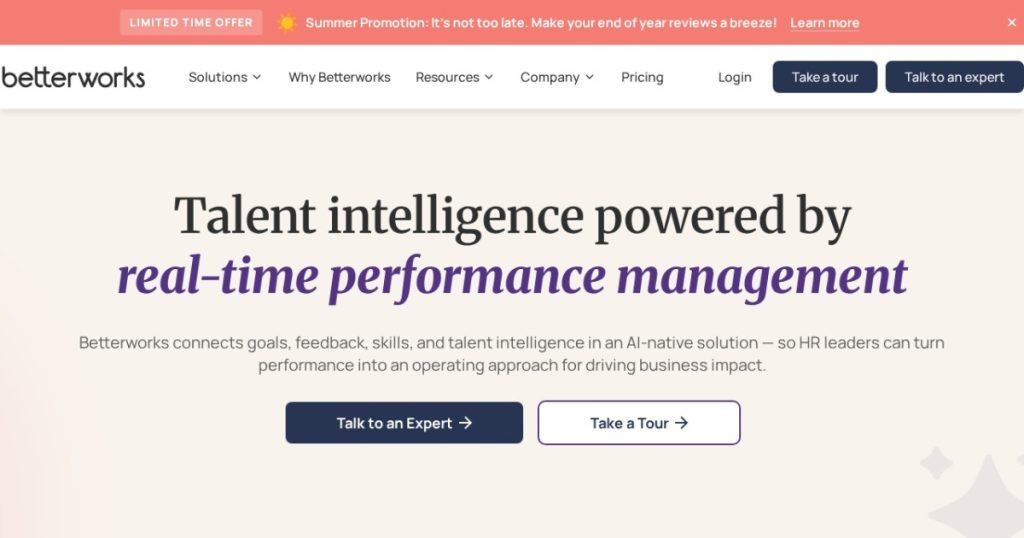
Betterworks is an enterprise performance management platform that ties OKRs, continuous feedback, reviews and skills data into one system. It is genuinely strong at scale and genuinely overbuilt for a 20 person startup. Best for: HR teams running reviews across several hundred employees. Price: from $8/user/mo. Free plan: no. Rating: 7.9/10
What is Betterworks?
Betterworks is performance management software built for large organisations. It covers goal setting and OKRs, continuous feedback, 1-on-1s, review cycles, calibration, succession planning and engagement surveys. The pitch is that all of that lives in one connected system instead of being scattered across a goals spreadsheet, a survey tool and an annual review form nobody enjoys filling in.
The company was founded in 2013 in Redwood City, California, and has raised more than $65 million from investors including Kleiner Perkins and Emergence Capital. Betterworks says the platform serves over two million employees, and names Intuit, Business Insider, LivePerson and Taulia among its customers. The 2026 positioning leans hard into AI and what the company calls talent intelligence: inferring employee skills from the work people actually do rather than from a self-reported skills survey that goes stale in a quarter.
One thing worth being clear about up front: Betterworks is not a HRIS. It does not run payroll, hold your employee records of truth or handle time off. It sits on top of your HRIS and handles the performance layer. That means it is an addition to your stack, not a replacement for anything, and the business case has to stand on its own.
What Are Betterworks’ Key Features?
Goals and OKRs
This is the module Betterworks has been known for since 2013, and it is still the strongest part of the product. You cascade company objectives down through teams and individuals, and every goal shows its parent, its owner, its progress and its check-in history. Progress can be updated manually or pulled from connected systems like Jira and Salesforce, so a sales goal moves when the pipeline moves. Managers get a single view of which goals are on track, at risk or quietly abandoned, which is exactly the view that spreadsheets never give you. Check-in cadences are configurable, so you can run weekly updates for a sales org and monthly for engineering without forcing one rhythm on the whole company.
Continuous feedback, 1-on-1s and reviews
Betterworks pushes performance out of the annual cycle and into the week. Employees can request or give feedback at any time, and that feedback is stored against the person so it is still there when review season arrives. The 1-on-1 module gives managers a shared agenda, notes and action items per direct report. When the formal review cycle runs, the AI summarisation feature drafts a performance summary from the year of goals, feedback and check-ins already in the system. Users in review sites consistently call out the AI writing assist as the feature that saves managers the most time.
Talent Intelligence and Skills Intelligence
This is the newer, more expensive half of the platform. Skills Intelligence builds a skills profile for each employee out of their goals, feedback and review content. That feeds a Unified Talent Profile, which then powers Anytime Calibration, succession planning, talent mobility and development plans. The honest framing: if you are a 300 person company, you probably do not need this. If you are a 5,000 person company trying to answer “who could replace this director in 12 months”, this is the reason you would pick Betterworks over a cheaper tool.
HRIS and chat integrations
Betterworks syncs employee records from Workday, SAP SuccessFactors, ADP, BambooHR, UKG Pro and Oracle, so new hires, reorgs and manager changes flow in without HR ops touching a CSV. On the daily usage side, it pipes goal nudges, feedback prompts and check-in reminders into Slack and Microsoft Teams. Okta and OneLogin handle SSO. There are also connections to Jira, Salesforce, Asana, GitHub, Google Sheets, LinkedIn Learning and Udemy. This integration depth is a real moat against lighter tools, and it is the practical reason adoption does not collapse after month two.
How Much Does Betterworks Cost?
Betterworks starts at $8 per user per month for the Performance plan, which includes Goals and OKRs, feedback, conversations, 1-on-1s, the AI assist and SSO. The Performance plus Talent Intelligence bundle is $9 per user per month and adds calibration, succession, skills intelligence, unified talent profiles and development plans. Enterprise is custom priced and layers on Engage surveys, in-app guides, change management services and signature support. Betterworks has also run a promotional rate of $1 per user per month for the first contract year, but it requires signing a three year agreement, so treat it as a discount on a long commitment rather than a cheap entry point.
Against the market, that list price is competitive. Lattice starts around $11 per user per month, and its Foundations bundle of Performance plus Goals and OKRs runs $13 per seat per month with an annual minimum around $4,000. 15Five charges $4 per user per month for Engage and $11 per user per month for Perform, billed annually. Leapsome is modular and starts around $8 per user per month depending on which modules you buy. So Betterworks is priced at or below its direct competitors on paper.
The caveat is that the sticker price is not the deal. Betterworks sells per employee per month with pricing shaped by module mix, headcount, contract term and implementation. Verified buyer reports in 2026 put real enterprise deployments in the $8 to $15 per user per month range, with companies over 2,000 employees negotiating toward the bottom. There is no self-serve signup and no published free trial, so every purchase goes through a sales conversation and a demo. Budget for an annual or multi-year contract, and budget time for the negotiation. One practical tip we would give any buyer: price the Performance module and the Talent Intelligence bundle separately during the demo. The $1 per user gap between them looks trivial, but across 3,000 employees it is $36,000 a year, and you should be able to name the specific succession or skills question you are buying it to answer.
| Plan | Price | Plan Features | Best For |
|---|---|---|---|
| Performance | $8/user/mo | Goals and OKRs, feedback, conversations, 1-on-1s, AI assist, SSO, ongoing support | Companies standardising goals and review cycles |
| Performance + Talent Intelligence | $9/user/mo | Adds Anytime Calibration, succession and talent mobility, Skills Intelligence, Unified Talent Profile, development plans | HR teams making promotion and succession decisions |
| Enterprise | Custom pricing | Adds Engage surveys, in-app guides, transformational program design, change management, signature support | Global rollouts needing dedicated program design |
Who is Betterworks Best For?
Use Betterworks if you are running performance across several hundred to several thousand employees and the current process is a mess of spreadsheets and Google Forms. Use it if you already run OKRs and want them audited, cascaded and visible rather than filed away in January. Use it if you have a real HRIS like Workday or SuccessFactors that needs to stay in sync. And use it if succession planning and skills mapping are on your roadmap, because the Talent Intelligence tier is the differentiator worth paying for.
Skip Betterworks if you are under roughly 100 people. The setup effort, the sales cycle and the multi-year contract all assume an HR function that can own the rollout, and a 40 person startup does not have one. Skip it if your main need is engagement surveys, where a dedicated tool will be cheaper and better. And skip it if your team lives in reporting dashboards, because reporting is the most consistent complaint in Betterworks user reviews: admins want more control over how the data is sliced than the platform currently gives them.
- Great fit: 500 to 5,000 employee companies with an HR ops team and an existing HRIS.
- Workable fit: 100 to 500 employees running formal OKRs and review cycles.
- Poor fit: under 100 employees, or anyone wanting to buy with a credit card today.
- Also consider: distributed teams that live in Slack or Teams, where the nudge integrations do most of the adoption work.
Best Betterworks Alternatives
Lattice
Lattice is the closest competitor and the better pick for mid-market companies that value polish over depth. It starts around $11 per user per month, with the Performance plus Goals and OKRs bundle at $13 per seat per month and roughly a $4,000 annual minimum. Engagement, Compensation and Grow are paid add-ons, and a fully loaded configuration can land near $25 to $28 per person. Lattice is easier to launch and nicer to use day to day. Betterworks wins on OKR rigour, HRIS breadth and enterprise-scale calibration.
15Five
15Five is the cheapest serious option here. Engage costs $4 per user per month and Perform costs $11 per user per month, billed annually, with no minimum seat count. Its heritage is weekly check-ins and manager coaching rather than cascading enterprise goals, so the OKR layer is thinner than Betterworks. If your problem is that managers are not talking to their people often enough, 15Five solves that for less money. If your problem is that 3,000 employees have goals nobody can see, it does not.
Leapsome
Leapsome is modular like Betterworks and starts around $8 per user per month depending on the modules you select, with individual modules reported as low as $3 per employee per month billed annually. It bundles performance, engagement, learning and compensation, which makes it a strong all-in-one for European and mid-market teams. It does not go as deep on succession planning or skills inference as Betterworks Talent Intelligence, but for most companies under 1,000 people that depth is not the deciding factor.
Final Verdict: Is Betterworks Worth It?
Betterworks earns a 7.9. The OKR engine is mature after more than a decade of iteration, the HRIS integration list is genuinely enterprise grade, and the Talent Intelligence layer at $9 per user per month is priced well below what you would expect for skills mapping plus succession planning. Slack and Teams delivery keeps it in front of managers, which is the difference between a performance tool that gets used and one that gets ignored by March.
What keeps it off the top shelf is the buying experience and the reporting. No free plan, no self-serve trial, and a promotional rate that requires a three year commitment all mean you are committing before you really know. Reporting limitations come up repeatedly in user feedback, and that matters for the HR leaders who most need this data. The interface also draws mixed reactions: reviewers call the day to day flow modern and easy, but describe navigation as unintuitive for occasional users who only open it during review season. Our recommendation: if you have 500 or more employees, an HRIS to connect and a real OKR practice, put Betterworks on your shortlist and push hard on reporting requirements during the demo. If you are smaller than that, 15Five or Leapsome will get you 80 percent of the value for less money and a fraction of the rollout effort.
Betterworks Pros & Cons
What We Like
- Modular pricing lets you buy Goals and OKRs at $8 per user per month without paying for the full talent suite
- Deep HRIS integrations with Workday, SAP SuccessFactors, ADP, BambooHR, UKG Pro and Oracle keep employee data in sync automatically
- Goal nudges and feedback prompts land directly in Slack and Microsoft Teams, which keeps managers actually using it
- Skills Intelligence infers skills from real work and feedback rather than from self-reported surveys
What Could Be Better
- No free plan and no self-serve signup, so every purchase runs through sales and an annual or multi-year contract
- Reporting is the most common complaint in user reviews, with admins wanting more control over how data is sliced
- Overkill for teams under about 100 people, where a lighter tool deploys faster and costs less
Betterworks FAQ
What is Betterworks?
Betterworks is an enterprise performance management platform covering goals and OKRs, continuous feedback, 1-on-1s, review cycles, calibration, succession planning and engagement surveys. It was founded in 2013 in Redwood City, California, and says it serves over two million employees.
How much does Betterworks cost?
The Performance plan costs $8 per user per month. Performance plus Talent Intelligence costs $9 per user per month. Enterprise is custom priced. Betterworks has also run a $1 per user per month promotional rate for the first contract year, which requires a three year agreement.
Is Betterworks worth it?
Yes, if you have 500 or more employees, an HRIS to connect and a real OKR practice. The OKR engine and integration depth justify the price at that scale. Below about 100 people it is not worth the rollout effort or the contract commitment.
What are the best Betterworks alternatives?
Lattice from around $11 per user per month is the polished mid-market pick. 15Five at $4 per user per month for Engage and $11 for Perform is the cheapest serious option. Leapsome from around $8 per user per month is the modular all-in-one.
Does Betterworks offer a free plan?
No. Betterworks has no free plan and does not publish free trial terms. You book a demo and buy through sales, typically on an annual or multi-year contract.
Who is Betterworks best for?
Companies with roughly 500 to 5,000 employees that already run OKRs, have a dedicated HR ops function and use an HRIS such as Workday or SuccessFactors. It is a poor fit for startups under 100 people.