Cronitor Review (2026): Pricing, Features & Honest Verdict
TLDR
Cronitor is a focused monitoring tool built specifically for cron jobs, background tasks, and uptime checks. Best for: developers who run scheduled jobs and need reliable failure alerts. Price: Free (5 monitors) / $12/mo Starter. Rating: 7.3/10
What is Cronitor?
Cronitor started as a cron job monitoring service and has expanded to include uptime monitoring, status pages, and heartbeat checks. The core idea remains the same: you instrument your scheduled tasks to ping Cronitor, and it alerts you when something fails to run or takes too long.
Unlike general-purpose monitoring platforms, Cronitor is opinionated about its audience. It targets developers who manage scheduled jobs, background workers, and automated pipelines. This focus means the product is well-tuned for those use cases, but it can feel limited if you need broader observability.
Key Features
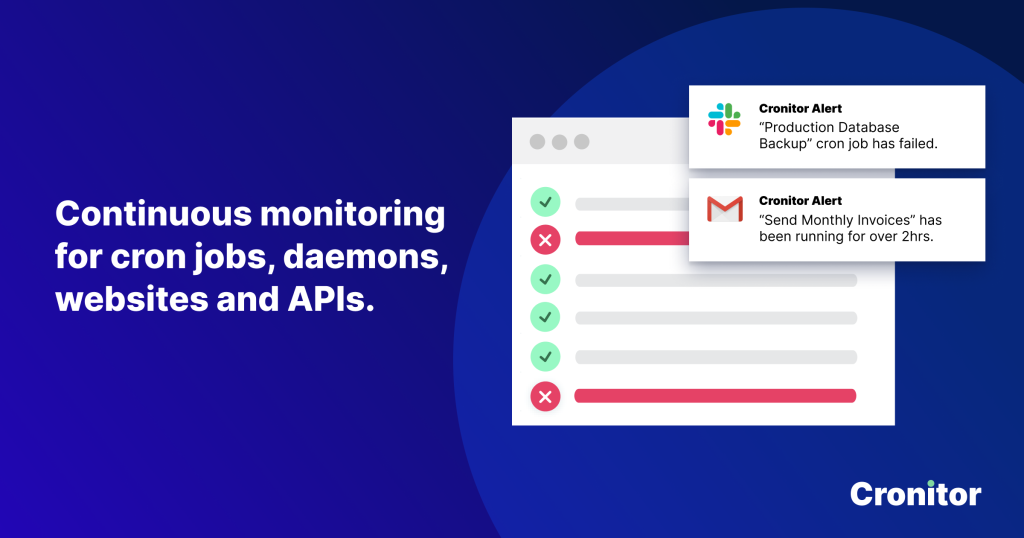
Cron job monitoring is where Cronitor shines. You integrate by adding a single curl command or SDK call to your scheduled tasks. Cronitor tracks each run, measures duration, detects missed runs, and alerts on failures. The dashboard shows a clear timeline of job executions with pass/fail status.
Uptime monitoring covers HTTP, TCP, and ICMP checks from multiple global locations. It is competent but not as feature-rich as dedicated uptime tools. Status pages let you communicate service health to users, with customizable branding.
The Terraform provider is a standout for infrastructure-as-code teams. You can define monitors alongside your deployment configurations, which keeps monitoring in sync with infrastructure changes. The CLI tool also helps manage monitors from the terminal.
Alerting supports email, Slack, PagerDuty, Microsoft Teams, OpsGenie, and webhooks. Integration setup is straightforward and notifications are timely.
Pricing Breakdown
The free tier gives you 5 monitors, which is enough to try the product but not enough for any real workload. Starter at $12/month covers 50 monitors. Pro at $49/month adds 200 monitors, multi-user support, and advanced features. Business Plus runs $85/month for larger teams.
Compared to Healthchecks.io, Cronitor is pricier at every tier. The Starter plan costs more than Healthchecks.io’s Hobbyist ($17/mo for 100 checks) while offering fewer monitors. This pricing gap is Cronitor’s biggest weakness for cost-conscious developers.
Pros and Cons
Cronitor does cron job monitoring really well. The integration is minimal (a single HTTP ping), the dashboard gives clear visibility into job health, and the Terraform provider is genuinely useful for DevOps teams. The CLI tool rounds out a developer-friendly experience.
The downsides are notable. The free tier with only 5 monitors is stingy. Pricing is higher than comparable tools, particularly Healthchecks.io which offers more monitors at lower price points. The uptime monitoring features feel tacked on rather than deeply developed. The UI is clean but the product lacks the depth you would find in a full observability platform.
| Plan | Price | Plan Features | Best For |
|---|---|---|---|
| Free | $0/mo | 5 monitors, basic alerts | Trying the product |
| Starter | $12/mo | 50 monitors, all integrations, status pages | Solo developers with multiple jobs |
| Pro | $49/mo | 200 monitors, multi-user, advanced features | Small teams and growing projects |
Who Should Use Cronitor?
Backend developers and DevOps engineers who manage cron jobs, scheduled tasks, and automated pipelines. Teams using Terraform who want monitoring defined as code. If your primary need is cron monitoring and you value a polished developer experience over raw value, Cronitor is a solid pick. If budget matters more, Healthchecks.io delivers similar functionality at a lower cost.
Alternatives
Healthchecks.io
Healthchecks.io is an open-source cron monitoring tool that offers more monitors at lower prices. It is simpler and more focused, with a generous free tier of 20 checks. The trade-off is fewer integrations and no Terraform provider. Great for developers who prioritize value.
Better Stack
Better Stack combines uptime monitoring, incident management, and log aggregation. It is a broader platform than Cronitor, with more polished UX and deeper features. Better suited for teams needing full observability rather than just cron monitoring.
Sentry Crons
Sentry added cron monitoring to its error tracking platform. If you already use Sentry for error monitoring, adding cron checks is seamless and avoids another tool in your stack. The cron feature is newer and less mature than Cronitor, but the bundled value is compelling.
FAQ
Cronitor Pros & Cons
What We Like
- Excellent cron job monitoring with clear run timelines
- Terraform provider for infrastructure-as-code workflows
- Clean CLI tool for managing monitors from terminal
- Minimal integration effort (single HTTP ping)
What Could Be Better
- Free tier limited to just 5 monitors
- Higher pricing than Healthchecks.io at every tier
- Uptime monitoring feels secondary to cron monitoring
- Lacks deeper observability features like log aggregation
Cronitor FAQ
How do I integrate Cronitor with my cron jobs?
Add a curl ping to the start and end of your cron command, or use Cronitor's SDK for your programming language. Each monitor gets a unique ping URL that tracks execution.
Does Cronitor support uptime monitoring?
Yes. Cronitor includes HTTP, TCP, and ICMP uptime checks alongside its cron monitoring. Checks run from multiple global locations.
Can I manage Cronitor monitors with Terraform?
Yes. Cronitor provides an official Terraform provider that lets you define and manage monitors as infrastructure code alongside your deployments.
What is Cronitor?
Cron job and background task monitoring with uptime checks and status pages. Includes Terraform provider and CLI for infrastructure-as-code workflows.
How much does Cronitor cost?
Cronitor pricing starts at $12/mo. A free plan is available.
Is Cronitor worth it?
Cronitor is a capable cron job monitoring tool with solid developer ergonomics and a useful Terraform provider. The pricing is higher than alternatives like Healthchecks.io, and the stingy free tier limits its appeal for budget-conscious developers. Best for teams who value developer experience and infrastructure-as-code integration. We rate it 7.3/10.






