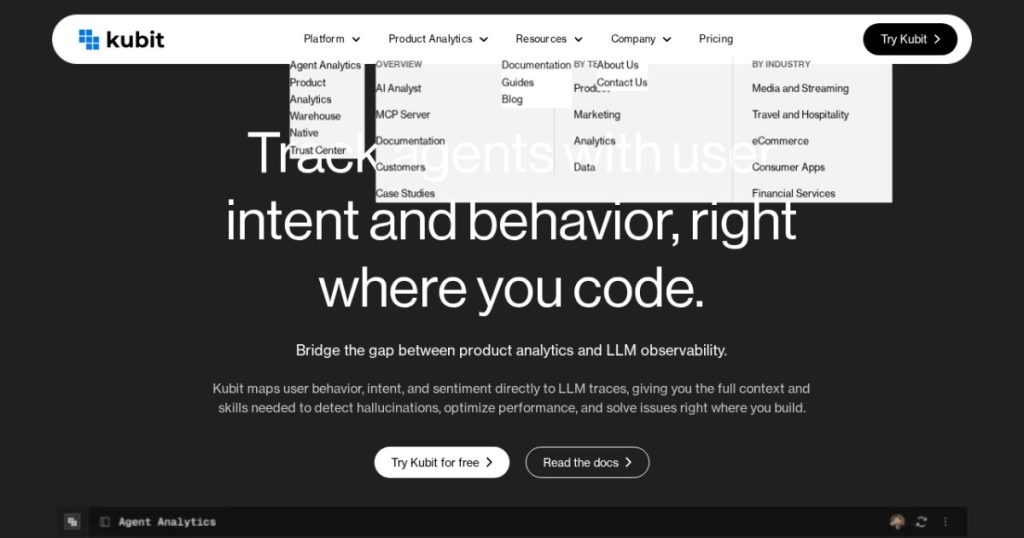
Kubit Review (2026): Pricing, Features & Honest Verdict
TLDR
Kubit is a warehouse-native product analytics platform that runs funnels, retention and cohort analysis directly inside Snowflake, BigQuery or Databricks with no data copying. It is a strong fit for data-mature teams who already trust their warehouse and hate SDK-driven tools that duplicate data. Best for: data teams at growth-stage and enterprise SaaS. Price: From $199/mo (free plan: yes). Rating: 7.8/10
What is Kubit?
Kubit is a warehouse-native digital and product analytics platform. Instead of ingesting your events into a proprietary black box the way Amplitude or Mixpanel do, Kubit sits on top of the data warehouse you already run and sends SQL directly to it. Your customer journeys, funnels, retention curves and cohorts are computed live against Snowflake, Google BigQuery, Databricks or Amazon Redshift, with no ETL pipelines, no data duplication and no sampling. Every report ships with the underlying SQL, so analysts and engineers can inspect and validate exactly what the tool is doing.
The company, Kubit AI, Inc., has been building in the warehouse-native analytics space for years and counts Samsung, Pluto TV, Miro, Skyscanner, Lyst and BET among its customers. In 2025 it leaned hard into AI, launching a set of explainable AI agents and a Snowflake-native integration, and more recently it added LLM observability so teams shipping AI agents can correlate user behavior with model reasoning. That combination — governed, no-copy analytics plus agent debugging — is what makes Kubit stand out from the standard self-serve analytics crowd.
What Are Kubit’s Key Features?
Warehouse-native architecture
This is the whole pitch. Kubit runs queries against your existing warehouse rather than copying data into its own store, which means numbers always match what the warehouse returns, and you can drop ETL/ELT line items and duplicate-storage costs from your budget. It also keeps data inside your governance perimeter, so GDPR, HIPAA and SOC 2 requirements are met without shipping raw event data to a third party.
Explainable AI agents
Kubit ships five specialized agents: a Report Agent that turns plain-English questions into analytical reports, a Detect Agent for anomaly detection, a Diagnose Agent that finds root causes behind metric shifts, a Narrative Agent that writes executive summaries, and a Historian Agent that resurfaces relevant past analyses. Crucially, these agents generate SQL that runs inside your warehouse under existing role-based access controls and a consistent semantic layer, so the AI cannot invent metrics that contradict your definitions.
Semantic layer and reusable model
You define reusable components — Measures, Filters and Cohorts — once in a domain-specific semantic layer, and every report and agent uses those definitions. That keeps metric definitions consistent across the team and stops the classic “why does my funnel number differ from finance’s” problem that plagues SDK-based tools.
LLM observability
For teams building AI products, Kubit correlates clickstream events with LLM traces, tool calls, prompt versions and user intent. It extracts intent, sentiment and resolution from traces, tracks token cost and error rate by intent, and integrates with Langfuse, LangSmith, Braintrust, Arize and OpenTelemetry, plus an MCP server for Claude Code and Cursor to enable auto-fixes.
How Much Does Kubit Cost?
Kubit’s public pricing starts with a free Developer plan ($0/month plus usage) that includes 100,000 traces per month, 45-day data access and one seat. The paid Growth plan is $199/month plus usage and covers 1,000,000 traces per month, 200-day data access, 20 seats and the Product Analytics add-on. Additional traces are billed at $0.0003 each. A free 30-day unlimited trial of Growth features is available with no credit card. The full warehouse-native product analytics deployment sits in the Enterprise tier, which is custom, sales-led pricing with a dedicated architect, SSO, SLA and Slack Connect.
Compared to the incumbents, Amplitude’s entry paid Plus plan is around $49/month and Mixpanel’s Growth plan starts near $25/month, so on paper Kubit’s $199 Growth tier looks pricier — but that comparison is misleading. Kubit’s real value shows up at scale, where warehouse-native means you avoid the event-volume overage bills and duplicate-storage costs that push Amplitude and Heap deals into the tens of thousands of dollars a year for large teams.
| Plan | Price | Plan Features | Best For |
|---|---|---|---|
| Developer | $0/mo + usage | 100,000 traces/mo, 45-day data access, 1 seat, core features, Discord support | Developers evaluating the platform |
| Growth | $199/mo + usage | 1,000,000 traces/mo, 200-day data access, 20 seats, Product Analytics add-on | Growth-stage data teams |
| Enterprise | Custom | 10,000,000+ traces/mo, unlimited data access, unlimited seats, warehouse-native, SSO, SLA, dedicated architect | Enterprises needing full warehouse-native deployment |
Who Is Kubit Best For?
Kubit is built for data-mature organizations that already treat their cloud warehouse as the source of truth and want product analytics that respects that.
Use Kubit if you run Snowflake, BigQuery, Databricks or Redshift, you have a data team that cares about governance and SQL transparency, and you want to stop paying to duplicate event data into a proprietary analytics tool. Skip Kubit if you are a solo founder or small startup without a warehouse — the SDK-first simplicity of Mixpanel or PostHog will get you to insights faster and cheaper at low volume, and Kubit’s $199/mo Growth entry point assumes real data infrastructure already exists.
Best Kubit Alternatives
If Kubit is not the right fit, these three product analytics tools are the ones most teams evaluate alongside it.
Amplitude
The most established product analytics platform, with deep behavioral and experimentation tooling. Its Plus plan starts around $49/month, but it ingests your data into its own store rather than running warehouse-native, and large deployments frequently land in the five-figure annual range. Choose Amplitude for breadth and maturity; choose Kubit to keep data in your warehouse.
Mixpanel
The easiest and cheapest way to start, with a generous free tier and a Growth plan from about $25/month. Mixpanel is SDK-driven and event-based, which is great for fast setup but means data duplication and volume-based overages as you scale. It is the better pick for early-stage teams without a data warehouse.
Heap
Heap’s autocapture records everything automatically, which reduces instrumentation work but generates large data volumes and custom, often expensive, pricing. Like the others it is not warehouse-native by default. Kubit is the stronger choice when governance and matching warehouse numbers matter more than zero-config capture.
Final Verdict: Is Kubit Worth It?
Kubit is one of the clearest expressions of the warehouse-native analytics thesis, and it executes it well. If your data already lives in Snowflake, BigQuery or Databricks, being able to run funnels, retention and cohorts against that data with full SQL transparency — and having AI agents that respect your semantic layer rather than hallucinate metrics — is genuinely valuable. The recent LLM observability additions make it a rare tool that spans both classic product analytics and AI-agent debugging.
The catch is that Kubit is not a plug-and-play tool for small teams. It assumes a real data warehouse and a data function to steward it, the flagship product analytics lives behind add-on and enterprise pricing, and the $199/mo Growth entry point is steep next to Mixpanel. But for the audience it targets — data-mature SaaS and enterprise teams tired of duplicating event data into a black box — Kubit is well worth a trial and often the more defensible long-term bet.
Kubit Pros & Cons
What We Like
- Truly warehouse-native: runs on Snowflake, BigQuery, Databricks and Redshift with no data copying or sampling
- Every report ships with inspectable SQL, so numbers always match the warehouse
- Explainable AI agents (Report, Detect, Diagnose, Narrative, Historian) run under your access controls and semantic layer
- Keeps data inside your governance perimeter, easing GDPR, HIPAA and SOC 2 compliance
- Adds LLM observability for teams shipping AI agents, integrating with Langfuse, LangSmith and OpenTelemetry
What Could Be Better
- Flagship product analytics sits behind add-on and enterprise (sales-led) pricing
- $199/mo Growth entry point is steep for small teams versus Mixpanel or PostHog
- Only makes sense if you already run a cloud data warehouse with a data team to steward it
Kubit FAQ
What is Kubit?
Kubit is a warehouse-native product and digital analytics platform that runs funnels, retention and cohort analysis directly inside your cloud data warehouse (Snowflake, BigQuery, Databricks or Redshift) with no data copying, plus explainable AI agents and LLM observability.
How much does Kubit cost?
Kubit offers a free Developer plan ($0/mo plus usage, 100,000 traces), a Growth plan at $199/month plus usage (1,000,000 traces, 20 seats), and custom Enterprise pricing. Extra traces are billed at $0.0003 each, and a free 30-day unlimited trial is available.
Is Kubit worth it?
For data-mature teams that already run a cloud warehouse and want product analytics with full SQL transparency and no data duplication, Kubit is well worth a trial. For small startups without a warehouse, cheaper SDK-based tools like Mixpanel are a better starting point.
What are the best Kubit alternatives?
The main alternatives are Amplitude (from about $49/month, more mature but ingests your data), Mixpanel (from about $25/month, easy and cheap to start), and Heap (autocapture with custom pricing). Kubit's differentiator is running natively on your data warehouse.
Does Kubit offer a free plan?
Yes. Kubit has a free Developer plan at $0/month plus usage that includes 100,000 traces per month, 45-day data access and one seat, plus a free 30-day unlimited trial of the Growth plan with no credit card required.
Who is Kubit best for?
Kubit is best for data-mature SaaS and enterprise teams that run Snowflake, BigQuery, Databricks or Redshift and want governed, no-copy product analytics with SQL transparency and AI agents that respect their existing metric definitions.