KloudMate Review (2026): Pricing, Features & Honest Verdict
TLDR
KloudMate is a hosted observability platform that takes logs, metrics, traces and profiles over OTel and adds alerting, on-call and an AI assistant for incident investigation. Broad for the money, but the $99 floor, 14-day retention and a tiny AI allowance hold it back. Best for: small SRE teams fleeing per-host pricing. Price: from $99/mo, free plan yes. Rating: 7/10.
What is KloudMate?
We found KloudMate on Product Hunt, where it launched on 8 October 2026 as KloudMate 2.0, a relaunch of a product first listed there in April 2023. It is a cloud observability service from KloudMate Technologies, Inc., a Delaware corporation whose footer lists Austin and Bengaluru. Telemetry arrives over OTel, the open telemetry standard, or through the vendor’s own agent, and the platform adds dashboards, alerting, on-call paging, status pages, SLOs and incident management on top of the raw data.
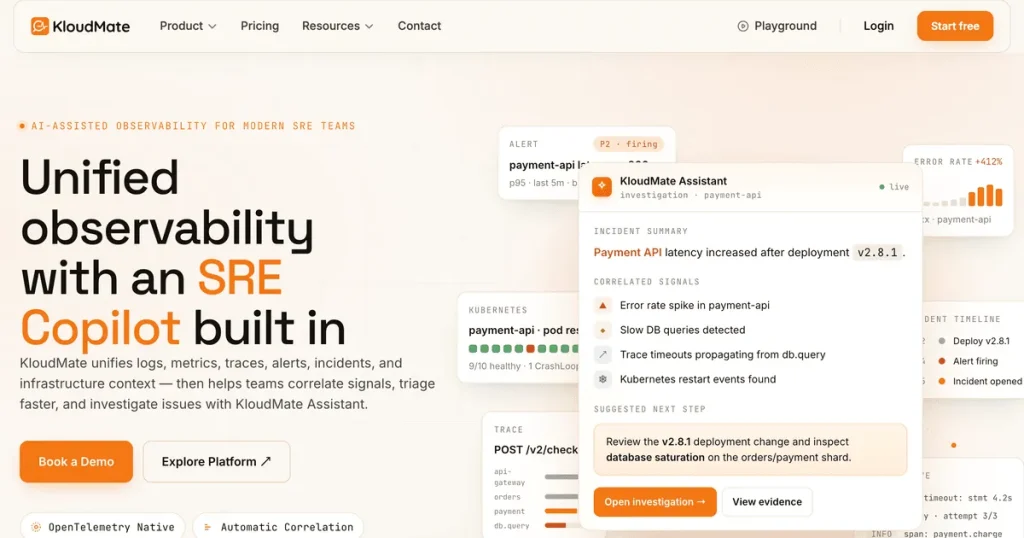
The 2.0 label is about the AI side. The in-app assistant now has four modes: Assistant for chat, Builder for drafting dashboards and alerts, Investigator for background root-cause analysis, and Docs for questions about the product itself. Curiously, neither the marketing site nor the changelog uses the words 2.0 anywhere. The newest changelog entry, dated 29 September 2026, covers Workflows and database monitoring, so we could not pin the 2.0 release to a date from the vendor’s own pages.
What Are KloudMate’s Key Features?
OTel ingestion and the KloudMate Agent
Every plan accepts OTel data, and the documentation offers instrumentation guides for Java, Node.js, Python, Go, .NET, PHP and React. For less setup there is the KloudMate Agent, a single program built on the OTel Collector that discovers what runs on a host, ships system metrics and logs, and uses eBPF to collect RED metrics, a network service map and database activity with no code changes. It is configured from the web interface, not by editing files. eBPF needs a Linux kernel, so Windows hosts get Event Tracing instead; Kubernetes and Docker are covered.
Assistant, Builder, Investigator and Docs modes
All four modes sit in a side drawer and run on credits. A chat message costs 1 credit, a workflow step that asks the assistant costs 1, and a full investigation costs 5. Investigator collects the incident details, runs asynchronously and returns a report with severity, top suspects, likely causes, affected resources and recommended fixes. Builder turns a sentence like create a dashboard for my cluster into a draft you can edit before saving. Docs mode answers product questions from the indexed documentation and is the only mode that does not burn credits.
Alerting, on-call and status pages in one place
KloudMate bundles what many teams buy as two or three subscriptions. Alert rules support grouping, label-based routing, maintenance windows and anomaly detectors that learn a baseline per entity, with built-in CPU and memory safeguards that fire on fresh hosts before any baseline exists. Pro adds Auto-RCA on alerts, escalation policies with phone paging, SLOs with burn-rate alerts, incident timelines and status pages on a custom domain. Notification channels cover email, webhooks, two chat tools, one ticketing tool and AWS SNS.
Infinity, the run-it-in-your-cloud option
Enterprise buyers can take KloudMate Infinity, which deploys the complete platform inside the customer’s own cloud account with KloudMate operating upgrades and scaling. Telemetry never leaves the customer’s network, storage sits in the customer’s account, and retention is limited by their budget rather than a SaaS default. It is the same product rather than a cut-down build, according to the vendor. Pricing is custom and nothing about it is published.
What Is It Like to Use KloudMate?
We did not install KloudMate; this section follows the vendor’s docs and the public demo at demo.kloudmate.com. Signup needs no card. The docs recommend a phased rollout: install the agent for hosts and logs first, add OTel instrumentation per service for richer traces, then connect AWS CloudWatch, Azure Monitor or an existing metrics pipeline to pull in the rest. The agent’s auto-instrumentation covers Java, Node.js, Python, .NET and PHP, with per-service opt-in because each one needs a process restart.
Investigations start from an issue, a log line or a span: a button labelled Investigate with KloudMate Assistant hands the context across. A context picker lets you attach services, dashboards, alert rules, Kubernetes resources, synthetic checks or saved queries before you ask. There is also a hosted MCP endpoint at api.kloudmate.com over streamable HTTP, authenticated with a personal key plus a workspace header, so an editor-side AI assistant can query errors, latency and firing alerts without opening the UI.
The Usage tab shows credits spent per day, per user and per mode, which matters when a month’s allowance is 20. One oddity in the docs: the assistant page describes three modes while the chat-modes page lists four, and the two name the dashboard mode differently (Dashboarding versus Builder). Minor, but it suggests the docs were updated in a hurry for the launch.
Where Does KloudMate Fall Short?
The legal pages lag the product. The terms of service were last updated on 23 December 2023 and state that a valid payment method is required to start a free trial and that users will be charged when it expires. The pricing FAQ says the opposite: a 14-day Pro trial with no card. The pricing page is almost certainly what happens today, but a contract that contradicts the checkout is not a good look. The terms also give no refunds on cancellation, with 30 days notice of price changes.
Pro’s AI allowance is thin. Its 20 credits a month equal four investigations, or 20 chat messages, for the whole workspace. Free gets 5 credits, which is one investigation. You can buy prepaid credits, but neither the pricing page nor the docs publish a price per credit, so the cost of real AI usage is unknown until you are a customer. Enterprise avoids credits by bringing its own provider key.
Retention is short by default and gets expensive fast. Pro keeps logs and metrics for 14 days. Keeping logs for a year applies a 2.0x factor, so $0.40 per GB becomes $0.80, and seven years is 5.0x. The Pro card says traces up to 1 year, yet the calculator lists 14 days as the default for traces with the same factors, so read the card as a ceiling rather than an included benefit.
Security claims are modest once you read them. The security page cites SOC 2 Type I, not Type II, and the report is only available to Enterprise customers after an NDA. The privacy policy is a generic website policy that says nothing about how ingested telemetry is handled or whether it trains anything. Free is also stripped of profiling, on-call, SLOs, incident management, workflows and SSO, and allows a single workspace with 10 alert rules.
Annual billing exists only by contacting sales, and the discount is unstated. The pricing page carries four named testimonials with company names, which we did not verify.
How Much Does KloudMate Cost?
KloudMate starts at $99 per month on the Pro plan, charged monthly, with no card needed for the 14-day trial. That $99 is a usage budget rather than a seat fee: logs and traces are metered at $0.40 per GB and metrics at $0.30 per million samples, drawn down from the $99, with overage at the same rates. In practice $99 buys 247.5 GB of logs, or 247.5 GB of traces, or 330 million metric samples, or any mix. Users are unlimited on every plan, with no per-host charge.
Free costs nothing forever and includes 10 GB of logs, 10 GB of traces and 15 million samples a month at 7-day retention, with the assistant included. Valued at Pro rates that is $4 of logs, $4 of traces and $4.50 of metrics, so $12.50 of usage. Enterprise is custom, adds Infinity, custom retention, bring-your-own-key AI and a dedicated account manager, and is the only tier that can pay by invoice.
The $99 minimum is where rivals bite. One open-source rival’s cloud tier charges a $49 minimum that includes $49 of usage at $0.30 per GB for logs and traces and $0.10 per million metric samples, so it is a quarter cheaper per GB and a third of the price per sample. New Relic gives 100 GB of ingest free every month and charges $0.40 per GB beyond, the same rate as KloudMate, but its Pro full-platform users cost $349 each on an annual commitment.
Better Stack prices ingestion of logs and traces at $0.15 per GB in its US region and $0.10 in Germany, plus $0.08 per GB per month for retention, with a $34 per month responder licence for on-call. KloudMate’s flat $0.40 looks dear next to that until you add up what the bundle replaces.
Against the incumbents KloudMate looks cheap. The biggest of them charges $15 per host per month for infrastructure on an annual deal, $31 per host for APM, and $0.10 per GB of logs ingested before indexing fees. A ten-host shop paying for both is at $460 a month before a single log line. KloudMate’s answer is $99 plus volume, which is the whole argument for the product.
| Plan | Price | Plan Features | Best For |
|---|---|---|---|
| Free | $0/mo | 10 GB logs, 10 GB traces, 15M metric samples per month, 7-day retention, 10 alert rules, 1 workspace, 10 synthetic monitors, 5 AI credits per month, community support | Side projects and early workloads |
| Pro | $99/mo (billed monthly) | $99 of usage included at $0.40/GB logs, $0.40/GB traces, $0.30 per million metric samples; overage at the same rates; 14-day retention for logs and metrics; 200 alert rules, 10 workspaces, 50 monitors, SSO, on-call, SLOs, incident management, 20 AI credits per month | Production teams replacing per-host tools |
| Enterprise | Custom | Custom volumes and retention, KloudMate Infinity in your own cloud, bring-your-own-key AI, unlimited alert rules and workspaces, dedicated account manager, invoice billing | Regulated or high-volume organisations |
Who is KloudMate Best For?
Use KloudMate if you run a few dozen services on Kubernetes or VMs, already emit OTel or are happy to install one agent, and want tracing, logs, alerting, on-call and status pages from one vendor at a predictable number. Teams that resent per-host or per-seat fees get the most from the model, and the eBPF agent is a quick way to get RED metrics on services nobody has instrumented.
Skip KloudMate if your monthly telemetry is under about 100 GB, because a $49-minimum rival or a free 100 GB tier elsewhere will cost less. Skip it if you need SOC 2 Type II today, long retention at a flat price, or an AI assistant you can use freely rather than four investigations a month. Teams that have built a mature dashboard stack on open-source tooling will find the migration bigger than the savings on the invoice.
Best KloudMate Alternatives
SigNoz
SigNoz is open source and self-hostable, with a cloud Teams plan at $49 per month that includes $49 of usage, then $0.30 per GB for logs and traces and $0.10 per million metric samples. Retention starts at 15 days. It has no on-call, status pages or built-in incident management, so it suits teams that already pay for paging.
Grafana Cloud
Grafana Cloud has a free tier with 10,000 active series and 50 GB each of logs and traces at 14-day retention. Pro carries a $19 per month platform fee covering the same volumes, then pay as you go: $6.50 per 1,000 extra series and logs priced in three parts, with the write charge at $0.40 per GB. It takes more wiring together, but the free tier is far more generous than KloudMate’s.
Datadog
Datadog is the full-featured incumbent with 1,000 plus integrations. Infrastructure Pro costs $15 per host per month on an annual deal ($18 on demand), APM adds $31 per host, and logs cost $0.10 per GB ingested plus indexing. Budget for a much larger invoice at any real scale, in exchange for depth KloudMate cannot match yet.
Final Verdict: Is KloudMate Worth It?
KloudMate earns a 7 out of 10. The breadth is real: traces, logs, metrics, profiling, synthetics, database and network monitoring, on-call, SLOs, status pages and workflows, with unlimited users and no host tax. For a small platform team consolidating three or four tools, $99 plus usage is a fair deal, and the OTel-first design means leaving is not painful.
Buy it for the platform, not for 2.0. Four AI investigations a month is a taster, the price of more is unpublished, the terms contradict the trial offer, and retention costs climb quickly. If those are fixed, the rating goes up. Start on Free, send a week of real traffic, and check the cost estimator before the trial ends.
KloudMate Pros & Cons
What We Like
- Usage-based pricing with unlimited users and no per-host fees; $99 buys 247.5 GB of logs or 330 million metric samples.
- OpenTelemetry-native ingestion plus an eBPF agent built on the OTel Collector that collects RED metrics and a service map with no code changes.
- Alerting, on-call paging, SLOs, incident management, status pages and workflows are included on Pro, replacing two or three separate tools.
- Free plan with 10 GB of logs, 10 GB of traces and 15 million samples a month, no card required, and a 14-day Pro trial.
- Hosted MCP endpoint and four AI modes (Assistant, Builder, Investigator, Docs); the Docs mode is free of credits.
What Could Be Better
- Pro includes only 20 AI credits a month, which is four investigations, and the price of prepaid credits is not published.
- Default retention is 14 days on Pro; a year of log retention doubles the per-GB rate and seven years multiplies it by five.
- The terms of service (dated December 2023) say a payment method is required for the trial and no refunds are given, contradicting the no-card trial on the pricing page.
- Security attestation is SOC 2 Type I only, with the report limited to Enterprise customers under NDA; annual billing is contact-sales only.
KloudMate FAQ
What is KloudMate?
KloudMate is a hosted observability platform from KloudMate Technologies, Inc. that ingests logs, metrics, traces and profiles over OpenTelemetry or its own eBPF agent, and adds dashboards, alerting, on-call, SLOs, status pages, incident management and an AI assistant with Assistant, Builder, Investigator and Docs modes.
How much does KloudMate cost?
KloudMate has a free plan and a Pro plan at $99 per month, charged monthly, which includes $99 of usage at $0.40 per GB for logs and traces and $0.30 per million metric samples. Overage is charged at the same rates. Enterprise pricing is custom and annual billing is arranged through sales.
Is KloudMate worth it?
Yes for small SRE teams consolidating tracing, logs, alerting, on-call and status pages under one usage-based bill with unlimited users. It is less compelling if you send under 100 GB a month, need long retention at a flat price, or want heavy AI usage, since Pro includes only four investigations a month.
What are the best KloudMate alternatives?
SigNoz offers a similar usage model from $49 per month with $0.30 per GB. Grafana Cloud has a generous free tier and a $19 per month Pro platform fee. Datadog is the full-featured incumbent at $15 per host for infrastructure and $31 per host for APM. New Relic and Better Stack are also worth pricing.
Does KloudMate offer a free plan?
Yes. The Free plan costs nothing and includes 10 GB of logs, 10 GB of traces and 15 million metric samples per month with 7-day retention, 10 alert rules, one workspace and 5 AI credits. No card is needed, and a 14-day Pro trial is also available without a card according to the pricing page.
Who is KloudMate best for?
Small and mid-sized engineering, SRE and platform teams running services on Kubernetes or VMs who already use OpenTelemetry or are happy to install one agent, and who want to replace per-host or per-seat observability bills with one predictable usage-based plan.






