Metronome Review (2026): Pricing, Features & Honest Verdict
TLDR
Metronome is a usage-based billing platform built for high-scale SaaS and AI companies, handling real-time metering, configurable pricing, and invoicing. Best for: SaaS and AI companies with usage-based models. Price: Custom. Rating: 7.7/10
What is Metronome?
Metronome is billing infrastructure purpose-built for usage-based pricing. Companies like OpenAI and Databricks use it to meter consumption in real time, calculate charges based on configurable pricing models, and generate invoices at scale. It sits between your product (which generates usage events) and your financial systems (which need accurate revenue data).
The platform tackles the hard engineering problems of usage billing: ingesting millions of events per second, computing charges without lag, handling pricing changes mid-cycle, and producing audit-ready invoices. For companies where billing accuracy directly impacts revenue, Metronome replaces fragile homegrown metering pipelines.
Key Features
Real-Time Usage Metering
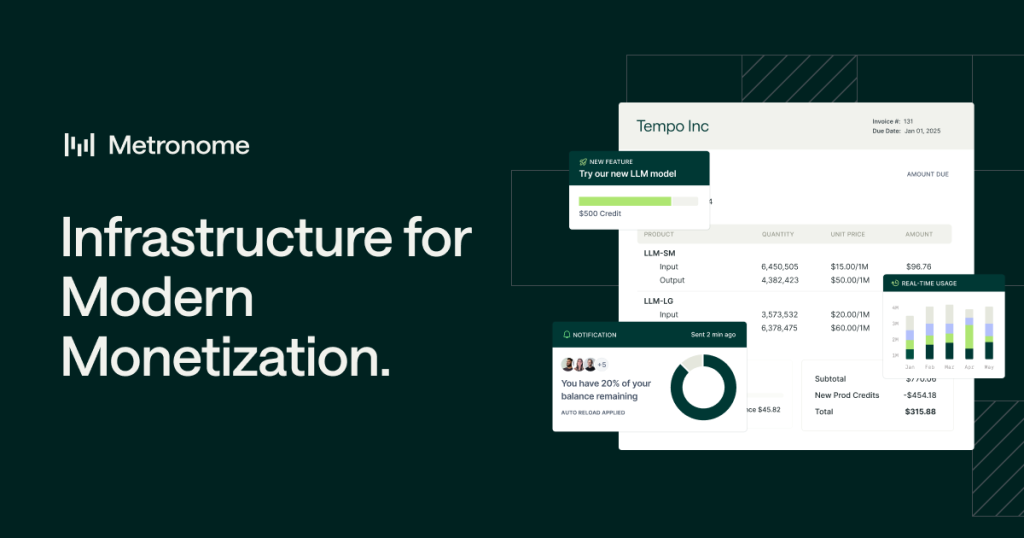
Metronome ingests usage events as they happen and makes them queryable immediately. Your customers can see current consumption in dashboards, and your billing system always has up-to-date totals. The metering pipeline is designed for high throughput, handling the volume that AI inference platforms and developer tools generate.
Configurable Pricing Models
Support for tiered, volume, graduated, seat-based, and hybrid pricing models. Define pricing rules through the API or dashboard, and Metronome applies them to usage data automatically. Changes can take effect immediately or at the next billing cycle, giving finance teams flexibility without engineering work.
Invoicing
Automated invoice generation based on metered usage and pricing rules. Invoices include line-item detail showing exactly what was consumed and how charges were calculated. Integration with accounting systems (NetSuite, QuickBooks) keeps your financial records aligned without manual data entry.
Revenue Analytics
Dashboards showing revenue by customer, product, pricing model, and time period. Track MRR, usage trends, and cohort behavior. The analytics layer uses the same metering data that drives billing, so numbers are always consistent between what you bill and what you report.
Integrations
Native connectors for Stripe (payment processing), NetSuite (accounting), Salesforce (CRM), and data warehouses. The event ingestion API accepts usage data from any source. Webhook support for billing events lets you trigger downstream workflows automatically.
Pricing
Metronome uses custom pricing, which means you need to talk to sales. There is no free tier or self-serve plan. This is consistent with their enterprise positioning: the platform targets companies with complex billing needs and significant usage volume. Expect pricing to scale with event volume and invoice count.
The lack of transparent pricing or a free tier limits accessibility for smaller startups. If you are pre-revenue or handling simple subscription billing, Metronome is likely overkill both in capability and cost.
Pros and Cons
Pros
- Real-time metering handles massive event volumes reliably
- Flexible pricing model configuration without code changes
- Battle-tested by major companies (OpenAI, Databricks)
- Strong integration ecosystem including NetSuite and Stripe
Cons
- No free tier or self-serve pricing, sales call required
- Overkill for companies with simple subscription billing
- Enterprise focus means slower onboarding compared to developer-first tools
- Custom pricing makes it hard to budget without a conversation
| Plan | Price | Plan Features | Best For |
|---|---|---|---|
| Custom | Contact sales | Real-time metering, configurable pricing, invoicing, integrations | High-scale SaaS and AI companies |
Who Should Use Metronome?
SaaS and AI companies billing based on consumption. If you meter API calls, compute time, tokens, storage, or any usage metric, and your billing volume is significant enough that accuracy and scale matter, Metronome is built for you. Companies already processing millions of billable events monthly and outgrowing homegrown billing systems are the ideal fit. If you are on flat-rate subscriptions or have fewer than a few hundred customers, simpler tools will serve you better.
Alternatives
Orb
Developer-first billing platform for usage-based pricing. Orb offers a more self-serve experience with transparent pricing, making it more accessible for smaller teams. Comparable metering capabilities but with a lighter onboarding process.
Lago
Open-source usage-based billing. Lago gives you full control over your billing stack with self-hosting options. Better if you want to avoid vendor lock-in or need deep customization of the billing pipeline.
Chargebee
Subscription management platform with usage-based billing add-ons. Chargebee handles a broader range of billing models including traditional subscriptions. More accessible for companies that need both subscription and usage billing under one roof.
FAQ
Is Metronome only for usage-based billing?
Usage-based billing is the core focus, but Metronome supports hybrid models that combine subscriptions with usage components. Pure subscription billing without usage metering would be better served by simpler tools.
How does Metronome compare to building billing in-house?
Metronome replaces the custom metering pipeline, rating engine, and invoice generation that companies typically build internally. The main advantage is reliability at scale and faster iteration on pricing models.
What scale does Metronome handle?
The platform is designed for millions of events per second. Companies like OpenAI and Databricks use it for production billing at significant scale.
Does Metronome integrate with my existing payment processor?
Native Stripe integration is available. Other payment processors can be supported through the API and webhook system.
Verdict
Metronome is serious billing infrastructure for companies with serious billing needs. The real-time metering, configurable pricing, and enterprise integrations deliver on the promise of accurate usage-based billing at scale. The customer roster (OpenAI, Databricks) validates the platform for high-volume scenarios. The trade-off is accessibility: no free tier, opaque pricing, and an enterprise sales process that filters out smaller teams. If your usage-based billing is complex enough to justify the investment, Metronome is one of the strongest options available.
Metronome Pros & Cons
What We Like
- Real-time metering handles massive event volumes reliably
- Flexible pricing model configuration without code changes
- Battle-tested by major companies (OpenAI, Databricks)
- Strong integration ecosystem including NetSuite and Stripe
What Could Be Better
- No free tier or self-serve pricing, sales call required
- Overkill for companies with simple subscription billing
- Enterprise focus means slower onboarding compared to developer-first tools
- Custom pricing makes it hard to budget without a conversation
Metronome FAQ
Is Metronome only for usage-based billing?
Usage-based billing is the core focus, but hybrid models with subscriptions are supported. Pure subscription billing would be better served by simpler tools.
How does Metronome compare to building billing in-house?
Metronome replaces custom metering pipelines, rating engines, and invoice generation. Main advantage is reliability at scale and faster pricing iteration.
What scale does Metronome handle?
Designed for millions of events per second. Companies like OpenAI and Databricks use it for production billing.
Does Metronome integrate with my existing payment processor?
Native Stripe integration is available. Other processors can be supported through the API and webhook system.
What is Metronome?
Usage-based billing platform with real-time metering, configurable pricing models, and invoicing. Used by OpenAI and Databricks for high-scale consumption billing.
How much does Metronome cost?
Metronome pricing starts at Custom pricing.