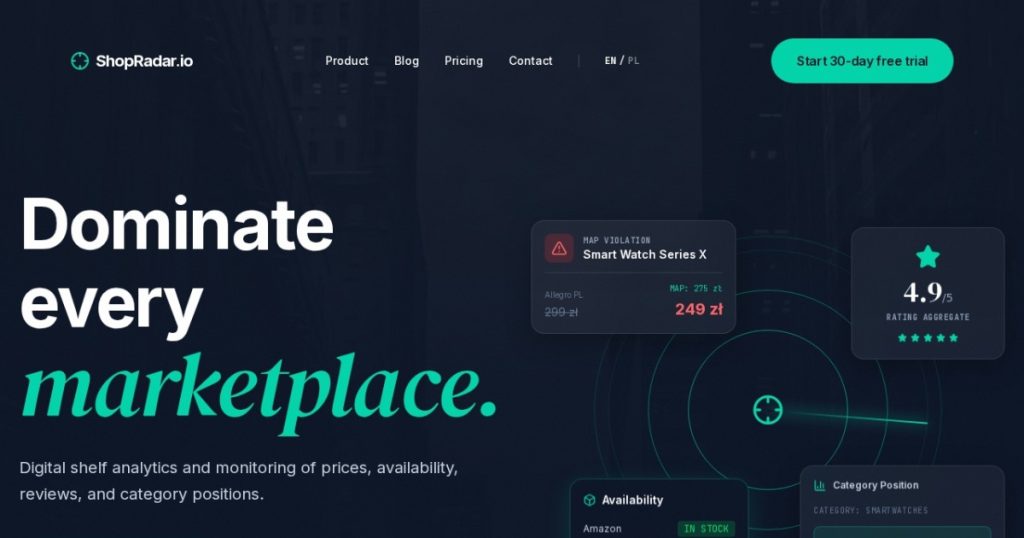
ShopRadar Review (2026): Pricing, Features & Honest Verdict
TLDR
ShopRadar is a digital shelf analytics platform that tracks prices, stock, reviews and category rankings for your products across marketplaces like Amazon, Allegro and Kaufland. It is focused and reliable, if pricey. Best for: brands selling on multiple online marketplaces. Price: from EUR 200/mo, no free plan. Rating: 7.9/10.
What is ShopRadar?
ShopRadar is a digital shelf analytics tool built for brands and manufacturers who sell through online marketplaces. Instead of logging into Amazon, Allegro, Kaufland and half a dozen other stores every morning, you point ShopRadar at your products and it pulls prices, stock levels, customer reviews and category rankings into one dashboard. When a reseller drops below your minimum advertised price, or a listing goes out of stock, you get an alert the same day.
The tool leans hard into European marketplace coverage, which is where it separates itself from the big American players. Amazon is covered, but so are Allegro, Kaufland, OTTO, bol, eBay and Zalando, channels that a lot of global analytics suites treat as afterthoughts. ShopRadar says it can add a new marketplace within 24 hours of a request, which matters if you sell somewhere niche. It is a focused product rather than a sprawling retail-intelligence suite, and that focus is its strength.
We dug into how it positions itself against the enterprise players, and the difference is scope. ShopRadar is not trying to score your product content, model retail media spend or forecast demand. It answers three questions: what is my price across every store, is my stock where it should be, and is anyone breaking my pricing rules. For a lot of mid-sized brands, those are the only questions that matter day to day, and paying enterprise money for the rest is waste. That clarity of purpose is why it works, and also why it will feel thin to a large team that wants everything in one platform.
What Are ShopRadar’s Key Features?
Multi-marketplace price and stock tracking
The core of ShopRadar is a single dashboard that watches your products across every marketplace you sell on. It refreshes data daily and flags price changes, stock-outs and new sellers as they happen, including third-party resellers who list your product without permission, which is often the first sign of grey-market activity you need to shut down. For a brand juggling listings on five or ten stores, this replaces a spreadsheet and a lot of manual checking with one view you can scan in a couple of minutes.
MAP violation alerts
Minimum advertised price policing is the feature most buyers come for. ShopRadar detects when a reseller lists your product below your set floor and sends an instant email alert, so you can act before a price war spreads across the channel. Because the detection runs on the daily refresh, you are not waiting a week to find out a distributor is undercutting your entire network.
Aggregated reviews and rankings
ShopRadar pulls customer reviews from every marketplace into one feed and tracks where your products sit in category rankings over time. That gives you a read on both reputation and visibility without opening each store, and it makes it easy to spot a listing whose rating or ranking is sliding before it costs you sales. Because it watches ranking movement rather than a single snapshot, you can tie a drop in position to a competitor’s promotion or a lapse in stock and react while it still matters.
Currency and channel flexibility
ShopRadar handles multiple currencies, which is essential when you are comparing a listing on German Kaufland against one on Polish Allegro without doing conversion math in your head. Add the 24-hour marketplace onboarding and you get a tool that adapts to wherever you sell rather than boxing you into a fixed roster of channels. For brands expanding into new European markets, that flexibility means the monitoring keeps pace with the sales footprint instead of lagging behind it.
API access and fast onboarding
On the Plus tier and above, ShopRadar exposes an API so its data can flow into your own business intelligence and ERP systems rather than living in a separate tab. Combined with the promise of adding new marketplaces within 24 hours, it means the tool bends to your setup instead of forcing you into a fixed list of supported channels.
How Much Does ShopRadar Cost?
ShopRadar starts at EUR 200/mo for the Start plan, which covers up to 5 marketplaces and 50 products with daily refresh and MAP alerts. The Plus plan is EUR 400/mo and lifts you to 10 marketplaces, 80 products and API access, while Premium is custom pricing for unlimited marketplaces, unlimited products and a dedicated account manager. There is a 30-day trial with no credit card and no product cap, so you can size your catalog before committing.
That pricing sits in the mid-market. It is well above a pure price-tracking tool like Prisync, which starts around $99/mo, but that tool only watches competitor prices and skips the reviews, rankings and MAP workflow. At the top end, enterprise suites like Profitero and DataWeave are quote-based and typically run into the thousands per month, so ShopRadar is the cheaper way into digital shelf analytics if you do not need a full retail-intelligence platform.
The catch is the product cap. Fifty products on Start and 80 on Plus is fine for a focused brand but tight if you carry hundreds of SKUs, and you will land in Premium custom pricing quickly. Budget accordingly if your catalog is large. The math changes depending on how many marketplaces you sell on too: if you only need Amazon and two others, you are paying for coverage you will not use, whereas a brand spread across eight European stores gets far more out of the same EUR 200. Run the 30-day trial with your real catalog loaded so you know which tier you actually land on before the first invoice.
| Plan | Price | Plan Features | Best For |
|---|---|---|---|
| Start | EUR 200/mo | Up to 5 marketplaces, 50 products, daily refresh, MAP alerts | Smaller brands starting marketplace monitoring |
| Plus | EUR 400/mo | Up to 10 marketplaces, 80 products, API access | Growing brands needing BI integration |
| Premium | Custom pricing | Unlimited marketplaces and products, dedicated account manager | Large manufacturers with wide catalogs |
Who is ShopRadar Best For?
Use ShopRadar if you are a brand owner, manufacturer or distributor selling the same products across several online marketplaces and you need one place to watch prices, stock and MAP compliance. It is a strong fit if any of those marketplaces are European, since the Allegro, Kaufland, OTTO and bol coverage is genuinely hard to find elsewhere.
Skip ShopRadar if you sell on a single channel, where the marketplace’s own tools will do, or if you carry a very large catalog on a small budget, because the product caps push you toward custom pricing fast. Teams that need deep retail-media analytics and content scoring on top of monitoring will also outgrow it and should look at an enterprise suite.
Best ShopRadar Alternatives
Profitero
Profitero is the enterprise category leader in digital shelf analytics, adding content scoring, search-share tracking and retail-media insight on top of price and availability monitoring. It is quote-based and considerably more expensive than ShopRadar, so it suits large brands with dedicated ecommerce teams rather than a lean operation that just needs alerts. If you have the budget and want content analytics and search-share tracking alongside pricing, it is the more complete platform, but you will pay several times what ShopRadar charges for the privilege.
Prisync
Prisync is the cheaper, narrower option, starting around $99/mo for competitor price tracking and dynamic repricing. It does not aggregate reviews or track category rankings the way ShopRadar does, but if your only concern is watching competitor and reseller prices, it costs a fraction as much.
DataWeave
DataWeave is a broad retail and brand-intelligence platform covering pricing, assortment, availability and digital shelf performance at scale. Like Profitero, it is enterprise and custom-priced, aimed at global brands with big catalogs and complex needs, which makes it overkill for the mid-market seller ShopRadar targets.
Final Verdict: Is ShopRadar Worth It?
ShopRadar earns its 7.9 by being sharp about what it does. The dashboard is clean, the MAP alerts are genuinely fast, and the European marketplace coverage fills a gap that the big American suites leave open. For a brand selling across Amazon plus a handful of regional stores, it turns a daily chore into a five-minute glance, and the API on the Plus tier means the data does not stay stranded.
What keeps it from a higher score is the price-to-limits ratio. EUR 200/mo with a 50-product cap is a lot for a small catalog, and there is no free plan to soften the entry. There is also the vendor question: ShopRadar is a smaller, younger company than Profitero or DataWeave, so you are betting on a leaner operation, which is fine for the price but worth knowing. If you sell on several marketplaces and want reliable price, stock and MAP monitoring without paying enterprise rates, ShopRadar is an easy recommendation. If your catalog is large or your budget is small, run the 30-day trial first and check where you land on the pricing tiers.
ShopRadar Pros & Cons
What We Like
- Covers European marketplaces others ignore, including Allegro, Kaufland, OTTO and bol
- MAP violation alerts fire the same day the price drops
- API access on the Plus tier feeds data straight into BI and ERP systems
- Adds new marketplaces within 24 hours of a request
What Could Be Better
- No free plan, and the entry tier starts at EUR 200/mo
- Product caps of 50 and 80 are tight for large catalogs
- Smaller, less established vendor than Profitero or DataWeave
ShopRadar FAQ
What is ShopRadar?
ShopRadar is a digital shelf analytics platform. It monitors your products across online marketplaces like Amazon, Allegro and Kaufland, tracking prices, stock, reviews and category rankings from one dashboard.
How much does ShopRadar cost?
Pricing starts at EUR 200/mo for the Start plan (5 marketplaces, 50 products). Plus is EUR 400/mo (10 marketplaces, 80 products, API access), and Premium is custom pricing. A 30-day trial is available with no credit card.
Is ShopRadar worth it?
For brands selling across several marketplaces, yes. The same-day MAP alerts and broad European marketplace coverage save real time. If you sell on one channel or have a tiny catalog, the EUR 200/mo floor is hard to justify.
What are the best ShopRadar alternatives?
Profitero is the enterprise category leader, Prisync is a cheaper price-monitoring tool from around $99/mo, and DataWeave is a broad retail-intelligence platform for large brands.
Does ShopRadar offer a free plan?
No. There is no permanent free plan, but ShopRadar offers a 30-day trial with no product limits and no credit card required.
Who is ShopRadar best for?
It is best for manufacturers, brand owners and distributors selling through multiple online marketplaces who need centralized visibility into pricing, stock and MAP compliance.