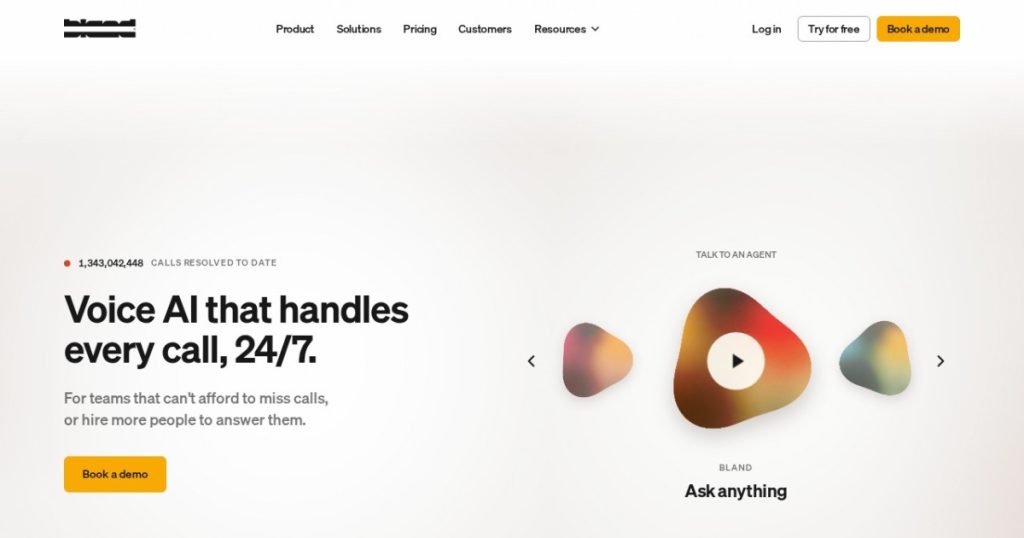
Bland AI Review (2026): Pricing, Features & Honest Verdict
TLDR
Bland AI is a developer-first API platform for AI phone calls, and it is the most capable one we tested for technical teams. Conversational Pathways, all-in per-minute pricing, and roughly 400ms latency are real strengths. Best for: engineering teams that want full API control. Price: free tier, then $299 or $499/mo plus $0.11 to $0.14/min. Rating: 7.9/10.
What is Bland AI?
Bland AI is a voice AI platform built around an API. Where no-code rivals hand you a visual builder, Bland hands you endpoints. You use it to build AI phone agents that handle inbound and outbound calls at scale, and you wire the logic yourself. Its signature feature, Conversational Pathways, lets developers define exactly how a call branches, what data it captures, and when it transfers to a human. It supports 40+ languages and connects to tools like Twilio, Salesforce, HubSpot, and Slack.
The company runs its own infrastructure rather than building on top of OpenAI’s APIs, which is how it claims latency around 400ms against an industry average closer to 1,240ms. It reports 250+ enterprise customers in healthcare, finance, insurance, and travel, and offers on-premises and VPC deployment for teams with strict data rules. We dug into Bland because it keeps getting recommended as the serious, build-it-properly option in a category full of no-code demos. MakerStack reviewed PollyReach for AI phone agents recently; Bland sits in the same space but is aimed squarely at developers rather than operators.
What Are Bland AI’s Key Features?
Conversational Pathways
This is Bland’s core. Pathways let you define call flows as structured logic: nodes for questions, conditions, data capture, API calls mid-call, and transfers. It gives engineers far more deterministic control than a single freeform prompt, which matters when a call has to follow compliance rules or hit specific steps in a fixed order. A freeform prompt can wander; a pathway cannot, because you have wired the branches yourself. That predictability is exactly what regulated industries need, and it is why technical teams pick Bland over more conversational, less controllable setups. It is powerful, and it is also where the learning curve lives, because building a robust pathway is a development task, not a drag-and-drop afternoon. Expect to spend real engineering time before your first production agent is solid.
Developer Tooling: Norm, Tornado Mode, and Guardrails
Bland ships tools to make agent-building less painful. Norm is an AI assistant that drafts agents from a natural-language description. Tornado Mode is automated testing that cycles through detecting failures, fixing them, and re-testing. Guardrails apply real-time, rule-based actions during a call. Together they address a real concern with AI voice agents, which is keeping them on-script and transparent. AI phone bots that can be coaxed into denying they are bots have drawn industry scrutiny, and deterministic guardrails are how Bland tries to keep behavior controlled.
All-In Per-Minute Pricing
Bland’s pricing model is a genuine differentiator. The per-minute rate covers the language model, speech-to-text, text-to-speech, and telephony in one number, with no token charges and no provider pass-throughs. With Synthflow, Retell, and Vapi you assemble those costs from parts and the all-in figure is hard to predict. With Bland you know your talk-time rate up front, which makes budgeting at scale far easier.
Enterprise-Grade Infrastructure
Bland is SOC 2 Type II, HIPAA, PCI DSS v4.0, and GDPR certified, with AES-256 encryption at rest and TLS 1.3 in transit. Enterprise customers get on-prem or VPC deployment and a dedicated engineer, with production agents typically live in two to six weeks. Running its own infrastructure rather than reselling third-party model APIs gives Bland tighter control over latency, uptime, and where data lives, which is the kind of thing a security team asks about before signing. It reports 250+ enterprise customers in healthcare, finance, insurance, and travel, which are exactly the sectors that will not deploy a voice bot without these guarantees. This is the part that justifies its placement against polished competitors: it is built to pass a security review, not just to demo well.
How Much Does Bland AI Cost?
Bland AI starts free, then runs $299/mo or $499/mo for production, plus per-minute usage. Pricing is plan-based: the free Start plan charges $0.14/min for talk time, Build ($299/mo) drops that to $0.12/min, and Scale ($499/mo) to $0.11/min. The free Start plan needs no credit card and includes 2 free credits and a free inbound number worth about $15/month. The higher your plan, the more concurrency and daily call volume you unlock: Start allows 10 concurrent calls and 100 a day, Scale allows 100 concurrent and 5,000 a day.
Watch the extras. Call transfers to a human are billed separately at $0.03 to $0.05/min depending on tier (and free if you use your own Twilio number), voicemails are charged per minute, and outbound calls under 10 seconds carry a $0.015 minimum. Compared to rivals, the all-in $0.11 to $0.14/min is competitive: Synthflow’s effective rate lands $0.11 to $0.24/min once you add components, while Retell advertises $0.07/min and Vapi $0.05/min for orchestration alone, with real setups climbing past $0.13/min after you add an LLM and telephony.
The honest comparison is that Bland’s bundled number is easier to predict, but the monthly platform fee means low-volume users may pay more than a pure usage-based tool. If you are running a few hundred minutes a month, a $299 or $499 fee on top of usage is a meaningful tax; if you are running tens of thousands of minutes, it disappears into the per-minute math and the predictability becomes a real advantage. Enterprise pricing is custom and contracted to volume, so the more you commit, the better the rate you can negotiate.
| Plan | Price | Plan Features | Best For |
|---|---|---|---|
| Start (Free) | $0/mo + $0.14/min | 2 free credits, free inbound number, 10 concurrent calls, 100 calls/day, 1 voice clone | Developers testing the API |
| Build | $299/mo + $0.12/min | 50 concurrent calls, 2,000 calls/day, 5 voice clones, 50 knowledge bases | Teams shipping a production agent |
| Scale | $499/mo + $0.11/min | 100 concurrent calls, 5,000 calls/day, 15 voice clones, 100 knowledge bases | High-volume calling operations |
| Enterprise | Custom | Unlimited concurrency and caps, on-prem/VPC deployment, dedicated engineer | Regulated enterprises at scale |
Who is Bland AI Best For?
Use Bland AI if you have engineers and you want AI phone calls embedded in your own product or workflow with real control. The API-first design, Conversational Pathways, low latency, and predictable bundled pricing make it the strongest technical choice we tested. It is a good fit for SaaS companies, technical startups, and agencies with development resources who want to ship something robust rather than a quick demo.
Skip Bland AI if nobody on your team writes code. The platform’s own users note that almost every advanced feature requires code or API calls, so a non-technical operator will hit a wall fast. If that is you, a no-code builder like Synthflow will get you live in an afternoon. Also weigh the monthly platform fee: if your call volume is light, a fee-free usage-based tool may be cheaper overall.
Best Bland AI Alternatives
Synthflow
Synthflow is the no-code alternative and the obvious pick if Bland’s code requirement is a dealbreaker. It offers a visual Flow Designer, 200+ integrations, and agency white-labeling, with pay-as-you-go pricing that lands around $0.11 to $0.24/min all-in. It is easier to use and more agency-friendly, but it gives developers less low-level control than Bland’s Pathways. Different tool for a different team.
Retell AI
Retell AI is a usage-based platform for builders, advertising $0.07/min for voice infrastructure with no mandatory subscription, landing around $0.11 to $0.15/min in practice once you add an LLM and telephony. With no platform fee, it can be cheaper than Bland for low-to-medium volume, and it sits between Bland and Synthflow on the technical scale: more approachable than raw API work, less bundled than Bland’s single rate.
Vapi
Vapi is the most flexible developer toolkit. It charges about $0.05/min for orchestration and passes provider costs through at cost, so all-in rates typically run $0.13 to $0.31/min. It gives the most granular control of any option here, which suits teams that want to assemble every layer themselves. The trade-off is unpredictable all-in cost and a steeper setup than Bland’s bundled, single-rate model.
Final Verdict: Is Bland AI Worth It?
Bland AI earns its 7.9 by being the developer-first voice platform that actually feels built for production. The all-in per-minute pricing is refreshingly honest, latency around 400ms is genuinely good, and Conversational Pathways plus enterprise-grade compliance make it a tool you can put in front of a security team. For engineering teams that want to own their AI calling stack, it is one of the best choices on the market.
The reason it lands below a no-code leader rather than at the top is fit, not quality. Bland expects code for almost everything, which makes it the wrong tool for non-technical operators, and the $299 to $499/mo platform fee plus separate transfer and voicemail charges mean light users can overpay. If you have developers and want control, Bland is worth it. If you want to click an agent together and go live today, choose Synthflow instead.
Bland AI Pros & Cons
What We Like
- All-in per-minute pricing covers LLM, speech, and telephony with no surprise pass-through fees
- Conversational Pathways gives developers precise control over call flow and logic
- Low latency around 400ms, well below the industry average
- Proprietary infrastructure plus SOC 2 Type II, HIPAA, PCI DSS, and GDPR compliance
What Could Be Better
- Almost every advanced feature requires code or API calls, so non-developers will struggle
- Production plans carry a $299 or $499/mo platform fee on top of per-minute usage
- Transfers, voicemails, and short calls each add separate per-minute charges
Bland AI FAQ
What is Bland AI?
Bland AI is a developer-first API platform for building AI phone agents that handle inbound and outbound calls. Its core feature, Conversational Pathways, lets engineers define call logic in detail. It runs on proprietary infrastructure rather than reselling third-party model APIs.
How much does Bland AI cost?
Bland AI uses plan-based per-minute pricing. The free Start plan is $0.14/min, Build is $299/mo plus $0.12/min, and Scale is $499/mo plus $0.11/min. Transfers cost $0.03 to $0.05/min depending on tier, and voicemails are billed separately. Enterprise is custom.
Is Bland AI worth it?
Yes, if you have engineers and want full control over AI phone calls. The all-in per-minute pricing is honest, latency is low, and Conversational Pathways is powerful. If you want a no-code builder, the value drops sharply because Bland expects code for almost everything.
What are the best Bland AI alternatives?
Synthflow is the no-code platform for non-technical teams, Retell AI is a cheaper usage-based builder, and Vapi is the developer toolkit that passes provider costs through at cost.
Does Bland AI offer a free plan?
Yes. The Start plan requires no credit card and includes 2 free credits plus a free inbound number worth about $15/month. You still pay $0.14/min for talk time once your free credits run out, but there is a genuine free entry point.
Who is Bland AI best for?
Bland AI is best for engineering teams and technical startups that want to embed AI phone calls into their own product or workflows with full API control. It is a poor fit for non-technical operators who want to click together an agent.






