Didit Review (2026): Pricing, Features & Honest Verdict
TLDR
Didit is a Y Combinator-backed identity verification platform that unifies KYC, biometrics, AML screening, and fraud prevention into a single API with a generous free tier. We found it to be the most developer-friendly and affordable KYC solution on the market, especially for startups. Best for: fintech startups and SaaS builders needing identity verification. Price: From $0.03/check (free plan: yes, 500 checks/mo). Rating: 8/10.
What is Didit?
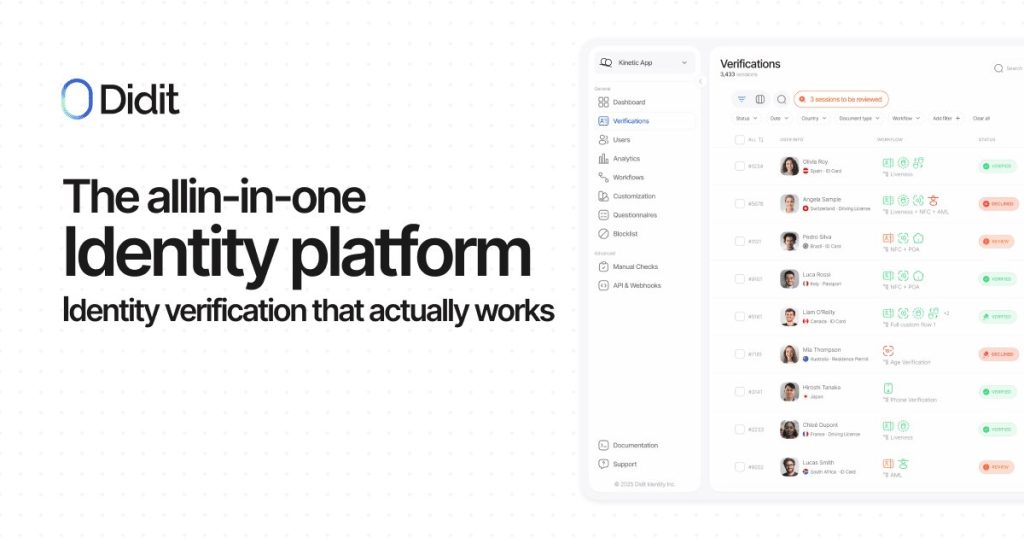
Didit is an all-in-one identity verification platform that handles document verification, biometric face matching, liveness detection, AML screening, and fraud prevention through a single integration. It supports 14,000+ government-issued documents from 220+ countries and processes verifications in under 30 seconds. Version 3, launched in March 2026, adds a visual node-based workflow builder for creating custom verification flows.
The company was founded by twin brothers Alberto Rosas (CEO) and Alejandro Rosas (CTO), both formerly at Oracle in Silicon Valley. Didit is part of Y Combinator’s Winter 2026 batch, has raised $2M, and serves over 1,000 companies. What makes Didit stand out is the free tier: 500 core KYC checks per month with no credit card required. No other major KYC provider offers this. We found Didit on Product Hunt where its v3 launch highlighted the new workflow builder and enterprise-grade features at startup-friendly pricing.
What Are Didit’s Key Features?
Node-Based Workflow Builder
The flagship v3 feature is a visual drag-and-drop editor for designing verification flows. You connect nodes for ID checks, liveness detection, AML screening, age estimation, and custom conditions to build complex decision trees. Pre-built templates help you get started quickly. This replaces the need to hard-code verification logic into your application.
Free Core KYC
Didit gives you 500 free verifications per month for each core feature: ID verification, passive liveness, face match, and IP analysis. No credit card, no contract, no setup fee. This is genuinely unique in the KYC market, where competitors like Sumsub and Veriff require paid plans from day one. For early-stage startups still validating product-market fit, this alone justifies evaluating Didit.
Multi-Signal Fraud Detection
Didit analyzes hundreds of data points per verification across documents, biometrics, devices, and networks. The Face Search 1:N feature compares a new user’s selfie against your existing database to detect duplicate accounts. Built-in deepfake detection and anti-spoofing protect against AI-generated identity fraud. This is the kind of fraud stack that typically requires multiple vendors.
Global Coverage and Multiple SDKs
Support for 14,000+ document types from 220+ countries, localized in 48 languages. Integration options include hosted links, native SDKs for iOS, Android, Flutter, and React Native, a Web SDK, iframe embedding, and standalone REST APIs. Average verification completes in under 30 seconds. The native iOS SDK includes NFC chip reading for supported documents.
How Much Does Didit Cost?
Didit starts at $0 with 500 free core KYC checks per month. After the free tier, you pay per successful verification: $0.15 for ID verification, $0.05 for face match, $0.10 for passive liveness, and $0.03 for IP analysis. Premium add-ons like AML screening cost $0.20 per check and NFC verification costs $0.15 per check.
This is dramatically cheaper than alternatives. Sumsub charges approximately $1-2 per verification with no free tier. Veriff starts around $1.50 per session. Onfido (now Entrust IDV) runs $2-3+ per check at enterprise scale. Didit claims 70% lower costs, and the math checks out. A full KYC check on Didit (ID + liveness + face match + IP) costs $0.33 total versus $1-3 at competitors. You only pay for successful verifications, so failed or abandoned sessions cost nothing.
| Plan | Price | Plan Features | Best For |
|---|---|---|---|
| Self-Serve (Free) | $0/mo | 500 free checks/mo per feature (ID, liveness, face match, IP), pay-per-check after | Startups validating product-market fit |
| Pay-Per-Check | $0.03-$0.20/check | ID verification $0.15, face match $0.05, liveness $0.10, AML $0.20, NFC $0.15 | Growing companies with predictable verification volume |
| Enterprise | Custom | Volume discounts, dedicated account manager, SLA guarantees, integration support | Large-scale regulated businesses |
Who is Didit Best For?
Use Didit if you are a fintech startup building onboarding flows, a crypto exchange needing regulatory compliance, an e-commerce marketplace verifying sellers, or any SaaS product that needs identity verification without a massive upfront investment. The free tier makes it ideal for startups in pre-revenue or early-revenue stages.
Skip Didit if you are a regulated enterprise that requires an established vendor with multi-year track record and extensive compliance certifications beyond ISO 27001. Larger fintechs may prefer Sumsub or Onfido for their deeper regulatory expertise and dedicated compliance teams. Also skip Didit if you need KYB (Know Your Business) verification, which is not listed as a core feature.
Best Didit Alternatives
Sumsub
An end-to-end KYC/KYB/AML platform popular with crypto and gaming companies. More feature-rich with deeper regulatory compliance tools but significantly more expensive and no free tier. Choose Sumsub if you need KYB verification or operate in heavily regulated industries.
Veriff
A speed-focused identity verification platform claiming 6-second verification sessions and the largest document database. Veriff is enterprise-proven but costs around $1.50+ per session with no free tier. Choose Veriff if verification speed and document coverage are your top priorities.
Persona
A developer-friendly identity platform with highly customizable verification workflows. Persona is popular with fintechs and offers flexible building blocks. Pricing is custom but typically runs $1-2 per verification. Choose Persona if you need maximum customization and are willing to pay for it.
Final Verdict: Is Didit Worth It?
Didit is the best entry point for startups that need identity verification. The free tier is real, the pay-per-check pricing is transparent and affordable, and the v3 workflow builder eliminates the need to hard-code verification logic. Being YC-backed with ISO 27001 certification and iBeta Level 1 liveness testing gives it credibility that most young startups lack.
The product is not without gaps. It is newer and smaller than Sumsub, Veriff, and Onfido, which means less battle-tested at massive scale. The team is about 12 people, so enterprise support capacity is limited. And if you need KYB or deep regulatory consulting, you will need to look elsewhere. But for the core use case of verifying individual identities at startup-friendly prices, Didit is hard to beat. The free 500 checks per month mean you can ship identity verification today without spending a dollar.
Didit Pros & Cons
What We Like
- Only KYC provider with a free tier: 500 checks/month, no credit card required
- Pay-per-successful-verification pricing is 70% cheaper than Sumsub and Veriff
- Visual node-based workflow builder eliminates hard-coded verification logic
- YC W26 backed with ISO 27001 certification and iBeta Level 1 liveness
What Could Be Better
- Newer and smaller than established players like Sumsub, Veriff, and Onfido
- 12-person team limits enterprise support capacity
- No KYB (Know Your Business) verification for business entity checks
Didit FAQ
What is Didit?
Didit is an all-in-one identity verification platform that unifies KYC, biometrics, AML screening, liveness detection, and fraud prevention into a single API. It supports 14,000+ document types from 220+ countries and processes verifications in under 30 seconds.
How much does Didit cost?
Didit starts free with 500 core KYC checks per month. After the free tier, pricing is pay-per-successful-verification: ID verification at $0.15, face match at $0.05, passive liveness at $0.10, IP analysis at $0.03, and AML screening at $0.20 per check.
Is Didit worth it?
Yes, especially for startups. The free tier lets you ship identity verification without spending a dollar, and the pay-per-check pricing is 70% cheaper than alternatives. The YC backing and ISO 27001 certification add credibility. Only skip it if you need an established enterprise vendor.
What are the best Didit alternatives?
The best alternatives are Sumsub for end-to-end KYC/KYB/AML compliance, Veriff for speed-focused verification with 6-second sessions, and Persona for highly customizable developer-friendly workflows. All are more expensive with no free tier.
Does Didit offer a free plan?
Yes, Didit offers 500 free core KYC checks per month for ID verification, passive liveness, face match, and IP analysis. No credit card required, no contracts, no setup fees. Reusable KYC is always free and unlimited.
Who is Didit best for?
Didit is best for fintech startups building onboarding flows, crypto exchanges needing regulatory compliance, e-commerce marketplaces verifying sellers, and any SaaS product requiring identity verification at startup-friendly pricing.






