Range Review (2026): Pricing, Features & Honest Verdict
TLDR
Range is an async check-in and standup tool that replaces daily status meetings with written updates in Slack or Teams. Best for: distributed teams tired of standup calls. Price: free for up to 12 users, then $8/user/mo. Rating: 7.3/10. Strong on simplicity and integrations, lighter on advanced reporting.
What is Range?
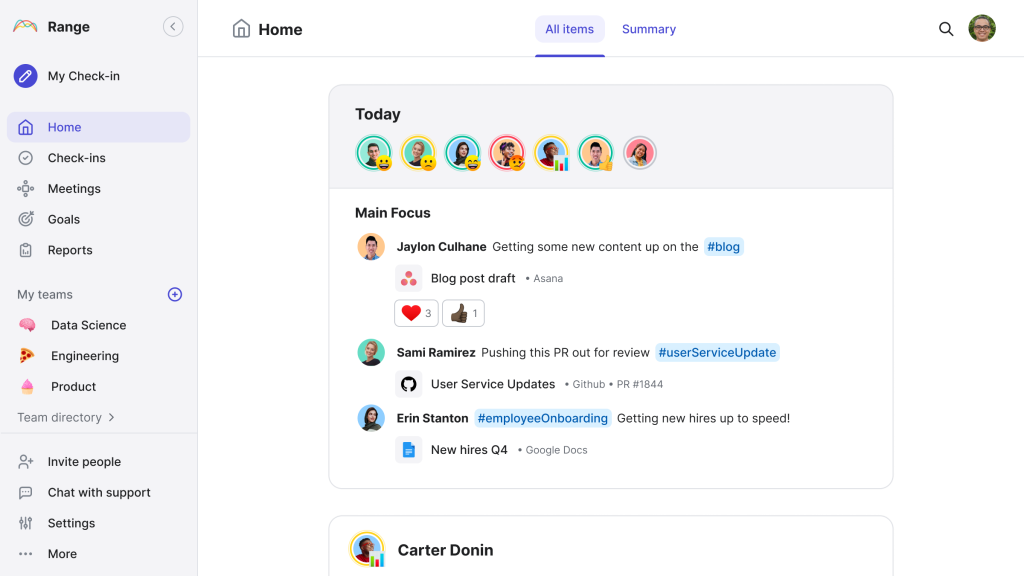
Range lets your team run standups without the standup. Each person posts a short written check-in covering what they’re working on, what’s blocking them, and how they’re feeling. Range pulls activity from 75+ connected apps like GitHub, Jira, Asana and Google Workspace so updates take about five minutes, and everything lands in Slack or Microsoft Teams where your team already lives.
The product is built by Range Labs Inc, a San Francisco company founded around 2017 by Daniel Pupius, Jennifer Dennard and Braden Kowitz, and backed by roughly $16.5M in funding. It matters because async work is now the default for distributed teams, and Range turns the daily sync from a calendar-blocking meeting into a 5-minute written habit anyone can read on their own schedule.
What Are Range’s Key Features?
Async Check-Ins
The core feature. Team members answer a few prompts each day to share progress, plans and blockers. Range automatically surfaces relevant work from your connected tools so people aren’t typing updates from scratch, and the whole team can scan everyone’s status without a meeting.
75+ Integrations
Range connects to GitHub, Jira, Asana, Linear, Google Workspace, Zoom and dozens more, then folds that activity into check-ins. The Slack and Microsoft Teams integrations are the headline, letting people post and read updates directly in chat.
Mood Sharing and Icebreakers
Each check-in can include a mood, giving managers a lightweight read on team morale over time. Range also ships 350+ icebreakers to keep remote teams feeling connected, which pushes it beyond a pure status tool into team-culture territory.
Goals and Meetings
Range includes OKR-style goal tracking tied to check-ins, plus a meetings feature for collaborative agendas and notes. These keep daily updates connected to bigger objectives rather than floating as disconnected status posts.
How Much Does Range Cost?
Range starts free for up to 12 users and 3 teams, which is genuinely usable for a small team. The Pro plan is $8 per user per month for unlimited users, teams, goals and check-in history, and Enterprise is custom-priced for larger orgs that need SSO and advanced admin. By comparison, Geekbot starts around $2.50/user/mo and Standuply and DailyBot sit in a similar $2-4 range, so Range is pricier per seat but bundles more culture and goal features rather than just standups.
| Plan | Price | Plan Features | Best For |
|---|---|---|---|
| Free | Free | Up to 12 users, 3 teams, 3 goals, check-ins, mood sharing, unlimited Slack and Teams integrations | Small teams trying async standups |
| Pro | $8/user/mo | Unlimited users and teams, unlimited goals, unlimited check-in history, private meetings, Team Directory | Growing distributed teams |
| Enterprise | Custom | Everything in Pro plus SSO/Okta/OneLogin, advanced admin, security audits, premium SLA, dedicated account manager | Large orgs (100+ users) with security needs |
Who Is Range Best For?
Use Range if you run a distributed or hybrid team, you’re tired of daily video standups, and you already work in Slack or Microsoft Teams. The free tier makes it low-risk to try, and the integrations plus mood tracking suit teams that care about both alignment and morale.
Skip Range if you’re a solo founder or a tiny co-located team that doesn’t need structured check-ins, or if you’re an engineering org that wants deep cycle-time analytics and reporting. Range’s reporting is intentionally light, so metrics-heavy teams will outgrow it.
What Are the Best Range Alternatives?
Geekbot
The most popular Slack-native async standup tool, starting around $2.50/user/mo. Cheaper and simpler than Range, but more narrowly focused on standups and surveys without Range’s goals and culture features.
Standuply
Standuply adds surveys, polls and analytics on top of standups inside Slack and Teams. A good fit for teams that want more reporting than Range offers, at a comparable low per-user price.
DailyBot
DailyBot brings AI-assisted check-ins, kudos and forms into chat tools. It overlaps heavily with Range’s culture features and tends to be cheaper, making it a strong pick for teams prioritizing engagement.
Final Verdict: Is Range Worth It?
Range nails the thing most teams actually want from a standup tool: a fast, low-friction way to stay aligned without another meeting. The free plan is unusually generous, the integrations are deep, and the mood and icebreaker features add real value that pure standup bots skip.
The catch is reporting. If you need detailed engineering metrics or analytics-heavy dashboards, Range will feel thin and you’ll want a more data-focused tool. But for distributed teams who just want async check-ins that people actually fill out, Range is an easy recommendation, especially while it’s free.
Range Pros & Cons
What We Like
- Free plan covers up to 12 users with full check-in functionality, which is unusually generous
- Flat $8/user pricing is simple and undercuts most competitors
- 75+ integrations auto-pull work from GitHub, Jira, Asana and Google Workspace into check-ins
- Mood sharing and 350+ icebreakers add real team-culture value beyond status updates
What Could Be Better
- Reporting and analytics are thin compared to engineering-focused standup tools
- Premium/Enterprise pricing is custom-only, so larger teams cannot self-serve a price
Range FAQ
What is Range?
Range is a team communication tool for async check-ins and standups. Instead of a daily video call, team members post short written updates in Slack or Microsoft Teams, with work automatically pulled in from 75+ apps like GitHub, Jira and Asana.
How much does Range cost?
Range has a free plan for up to 12 users and 3 teams. The Pro plan is $8 per user per month for unlimited users and teams, and Enterprise pricing is custom for larger organizations that need SSO and advanced admin.
Is Range worth it?
Yes, for distributed teams that want to cut status meetings. The free tier alone is enough for many small teams, and $8/user is competitive. It is less compelling if you need deep engineering analytics or detailed reporting.
What are the best Range alternatives?
Top alternatives include Geekbot (Slack-native async standups from $2.50/user/mo), Standuply (standups plus surveys and polls), and DailyBot (AI-assisted check-ins inside chat tools).
Does Range offer a free plan?
Yes. Range's free plan supports up to 12 users and 3 teams with check-ins, mood sharing, basic meetings, 3 goals and unlimited Slack and Microsoft Teams integrations, with no credit card required.
Who is Range best for?
Range is best for remote and distributed teams that want to replace daily standup meetings with async written updates, especially teams already living in Slack or Microsoft Teams.






