Spreeflo Review (2026): Pricing, Features & Honest Verdict
TLDR
Spreeflo is an all-in-one marketing automation platform built for founders, bundling marketing email, forms, web push, analytics, and transactional sends into one tool. It undercuts Mailchimp, Klaviyo, and Brevo hard on price. Newer and less proven at scale, but a strong value pick. Best for: founders and small SaaS or ecommerce teams. Price: Free forever; paid from $13/mo. Rating: 8.2/10.
What is Spreeflo?
Spreeflo is lifecycle marketing automation aimed at founder-led businesses. Rather than sell one narrow feature, it packages the tools a small team usually cobbles together: marketing email, forms and popups, browser push notifications, web analytics and event tracking, and a transactional email API. On top of that sits AI-assisted personalization and automated customer journeys that fire the right message based on what a contact does. The pitch is that one founder can run their entire messaging stack from a single dashboard.
The product positions itself openly as an alternative to Mailchimp, Brevo, Klaviyo, and MailerLite, and the case studies lean on the metrics founders care about: higher open rates and time saved. We dug into how it is framed and the through-line is cost and simplicity. Spreeflo keeps pricing transparent and avoids the sneaky tiered charges that make incumbent email tools balloon as your list grows. It also has a Shopify app, which tells you ecommerce is a real target, not an afterthought. For a solo founder or a lean team, the appeal is obvious: fewer subscriptions, fewer logins, one bill.
What Are Spreeflo’s Key Features?
AI-personalized email and journeys
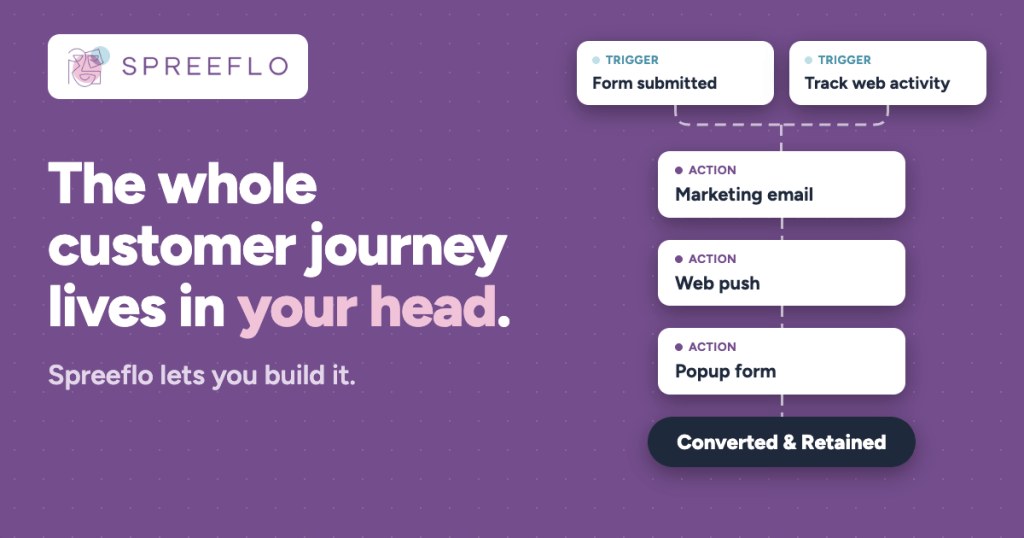
Email is the core. Spreeflo sends campaigns and, more usefully, automated journeys triggered by contact behavior: sign up, abandon, purchase, go quiet. The AI layer personalizes content per recipient rather than blasting one version to everyone. Reported case studies cite open rates several times higher than a plain broadcast, which is the kind of lift you expect when messages are triggered and personalized rather than sent on a schedule. Journeys are where small teams get the most leverage, because they run without anyone touching them. We tested the mental model against how a founder actually works, and it holds up: you build a welcome sequence once, connect it to a signup form, and it keeps warming new contacts while you focus on the product. The AI personalization is not magic, but pairing it with behavior triggers is a meaningful step above the schedule-and-blast approach most beginners start with.
Forms, popups, and web push
Spreeflo bundles list-building and re-engagement tools that usually cost extra elsewhere. Forms come with unlimited responses even on the free plan, popups capture visitors, and browser push notifications let you reach people who never opened an email. Rolling these into the same tool as your email means your capture, segmentation, and sending all share one contact database, so a form submission can immediately drop someone into a journey.
Web analytics and event tracking
Instead of forcing you into a separate analytics product, Spreeflo tracks web events and ties them back to contacts. That means your segmentation can key off real behavior on your site, not just email opens. For a SaaS founder, being able to trigger a message when someone visits the pricing page twice but does not sign up is exactly the kind of signal that usually requires wiring three tools together.
Transactional email API and deliverability tools
Spreeflo also sends transactional email through an API, so receipts, password resets, and system notifications live in the same platform as your marketing. It layers in deliverability audits, account warm-up, and IP and domain monitoring to keep messages landing in inboxes. Having transactional and marketing under one roof is convenient, though this is also where incumbents with longer track records still have an edge on raw deliverability at scale.
How Much Does Spreeflo Cost?
Spreeflo starts at $0 with a free forever plan that includes unlimited non-marketing contacts and forms with unlimited responses. Paid plans begin at $13/mo for Starter, billed annually at $160, and the most popular Professional tier is $20/mo, or $240 a year. There is a custom plan for higher volumes and a 14-day free trial with no card required. You can upgrade or downgrade any time, with changes prorated immediately.
The value case is the headline. Spreeflo works out to roughly $63/mo for around 10,000 contacts, against $130 or more at several competitors for the same list size. For comparison, Klaviyo starts near $20/mo but climbs steeply with contacts and is built for ecommerce budgets, while Mailchimp’s paid tiers escalate fast once you cross into serious volume. Brevo and MailerLite are the closest on price, both offering free tiers and low entry plans, but Spreeflo bundles more channels into the base product. If you are a founder counting every dollar, the math here is hard to argue with.
The honest caveat is that per-plan marketing-contact limits are not spelled out clearly until you configure a plan, and overages apply if you exceed your subscription limit. So the sticker price is genuinely low, but model your expected contact count before committing so the number you actually pay matches the number you saw.
| Plan | Price | Plan Features | Best For |
|---|---|---|---|
| Free | $0 | Unlimited non-marketing contacts, forms with unlimited responses, core tools | Testing and early-stage founders |
| Starter | $13/mo | Marketing email, journeys, billed annually at $160/yr | Solo founders sending campaigns |
| Professional | $20/mo | Most popular tier, full automation and segmentation, $240/yr annually | Growing SaaS and ecommerce teams |
| Custom | Contact sales | Higher volumes and enterprise support | High-volume senders |
Who is Spreeflo Best For?
Use Spreeflo if you are a founder or a small SaaS, ecommerce, or agency team that wants one affordable tool for the whole messaging stack. If you are currently paying for separate email, forms, push, and analytics products, or dreading Mailchimp’s next pricing tier, Spreeflo consolidates all of it and cuts the bill. The free plan and no-card trial make it low-risk to test against what you run today.
Skip Spreeflo if you need a deep, mature integration ecosystem, enterprise-grade deliverability guarantees, or the specific ecommerce automations Klaviyo is famous for. As a newer platform, its third-party app library is thinner, and very high-volume senders will want the track record incumbents offer. If your marketing depends on dozens of native integrations or you are sending millions of messages a month, weigh that carefully before switching.
There is a middle case worth calling out. If you are a small team that has outgrown a basic free email tool but cannot justify Klaviyo money, Spreeflo lands squarely in that gap. You get real automation and multichannel reach at a Starter or Professional price, which is exactly the stage where founders tend to overspend on a name-brand tool they only use a fraction of. Test it against your current stack for a month and let the numbers decide, because the free plan makes that comparison cost you nothing but time.
Best Spreeflo Alternatives
Brevo
Brevo is the closest philosophical match: an all-in-one that spans email, SMS, and automation with a free tier and paid plans from around $9/mo. It adds SMS and CRM-style features Spreeflo does not emphasize, and it has a longer track record. If you want multichannel including SMS and value a more established name, Brevo is the safer swap, though its interface is busier and less founder-focused.
MailerLite
MailerLite keeps things deliberately simple: clean email, automations, and landing pages, with a free plan and paid tiers from about $10/mo. It is cheaper and easier than most, but it is narrower than Spreeflo, with less emphasis on web push, event tracking, and transactional sending. Choose MailerLite if you mostly want great email and a gentle learning curve, and do not need the wider channel bundle.
Klaviyo
Klaviyo is the ecommerce heavyweight, with deep Shopify integration and best-in-class purchase-driven automations, starting around $20/mo but scaling up quickly with list size. It outclasses Spreeflo on ecommerce-specific flows and data, at a meaningfully higher cost as you grow. If your business lives and dies by store revenue and you need the most powerful ecommerce automation available, Klaviyo earns its premium.
Final Verdict: Is Spreeflo Worth It?
Spreeflo is one of the better-value marketing tools we have looked at for early-stage teams. It takes the four or five products a founder usually juggles, email, forms, push, analytics, and transactional, and puts them in one clean platform for a fraction of what the incumbents charge. The free forever plan and no-card trial mean there is almost no reason not to test it, and for most founders the Professional plan at $20/mo will cover a lot of ground.
It earns an 8.2 because the value and the all-in-one convenience are genuinely strong, not because it is flawless. The knocks are real but modest: a thinner integration ecosystem, less-proven deliverability at large scale, and contact limits that need checking before you buy. Those are the trade-offs of choosing a newer challenger over an entrenched incumbent. For founders and small teams who want to spend less and manage fewer tools, Spreeflo is an easy recommendation. Teams with heavy enterprise or high-volume needs should test deliverability first, then decide.
Spreeflo Pros & Cons
What We Like
- Genuinely all-in-one: email, forms, popups, web push, analytics, and transactional API in one tool
- Aggressive pricing, roughly $63/mo for 10,000 contacts versus $130+ at several rivals
- Free forever plan with unlimited non-marketing contacts and a 14-day trial with no card
- Clean, founder-friendly setup with journey triggers and AI-assisted personalization
What Could Be Better
- Newer platform, so the integration ecosystem and third-party app library are thinner than Mailchimp or Klaviyo
- Deliverability and support at very high send volumes are less proven than incumbents
- Per-plan marketing-contact limits are not clearly spelled out until you configure a plan
Spreeflo FAQ
What is Spreeflo?
Spreeflo is an all-in-one marketing automation platform aimed at founders and small teams. It combines marketing email, forms and popups, browser push notifications, web analytics, and a transactional email API, with AI-assisted personalization and automated customer journeys.
How much does Spreeflo cost?
Spreeflo has a free forever plan. Paid plans start at $13/mo for Starter (billed annually at $160) and $20/mo for the most popular Professional tier ($240/year). A custom-priced plan covers higher volumes, and there is a 14-day free trial with no card required.
Is Spreeflo worth it?
For founders and small SaaS or ecommerce teams, yes. It bundles tools you would otherwise pay for separately and undercuts Mailchimp and Klaviyo on price. The main trade-off is that it is newer and less proven at very large scale.
What are the best Spreeflo alternatives?
Brevo for a similar all-in-one with SMS and a free tier, MailerLite for simple low-cost email from about $10/mo, and Klaviyo for deep ecommerce automation from around $20/mo.
Does Spreeflo offer a free plan?
Yes. Spreeflo has a free forever plan that includes unlimited non-marketing contacts and forms with unlimited responses, plus a 14-day free trial of paid features with no credit card required.
Who is Spreeflo best for?
Spreeflo is best for founders and small SaaS, ecommerce, or agency teams who want one affordable tool for email, forms, push, and analytics instead of stitching together several separate products.






