Tripleseat Review (2026): Pricing, Features & Honest Verdict
TLDR
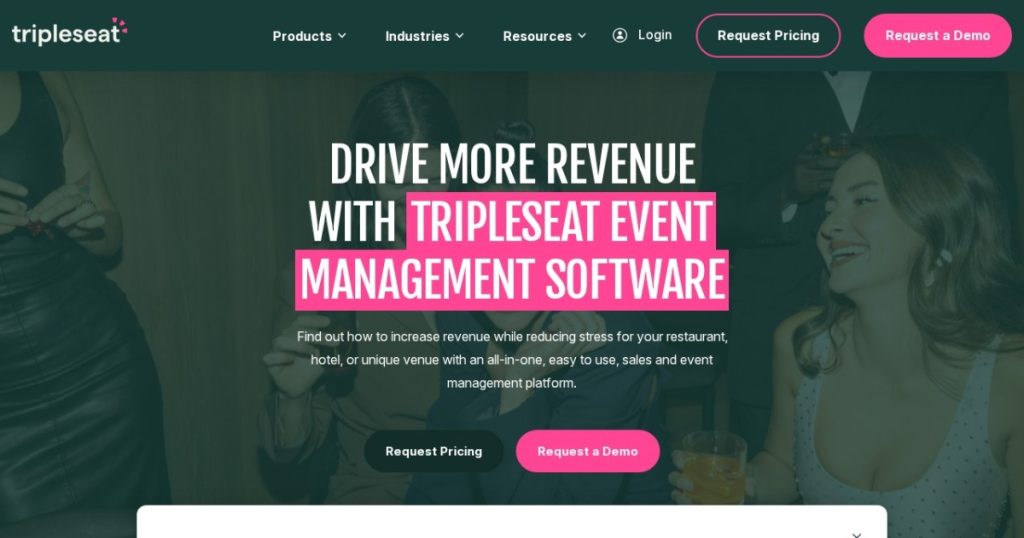
Tripleseat is sales and event management software for restaurants, hotels, and venues. It runs the whole private-event workflow: leads, proposals, banquet event orders, contracts, and payments. It is the category default and the depth shows, but pricing is quote-only with no free plan. Best for: venues booking private events. Price: Custom pricing, no free plan. Rating: 8.1/10.
What is Tripleseat?
Tripleseat is a sales and catering CRM built for the hospitality industry. It manages the full lifecycle of a private event or group booking: capturing the lead, sending a proposal, generating the banquet event order (BEO), getting the contract e-signed, collecting payment, and coordinating the event on the day. In short, it replaces the spreadsheet, email, and paper workflow that most restaurants and venues still limp along with.
The company, Tripleseat Software, has been at this since 2008 out of Concord, Massachusetts, and its homepage claims more than 20,000 venues use it globally. That tenure matters here. Event booking is a messy, detail-heavy job with a hundred small steps, and Tripleseat has had over 15 years to round off the edges. We found it covers restaurants, hotels, wedding venues, breweries, wineries, and large multi-location hospitality groups, with deep enough features that hotels often wire it into their property management systems.
What makes this category matter now is simple math. Private events carry far higher margins than walk-in covers, and the venues that win them are the ones that respond fastest and look most professional in the proposal. Tripleseat exists to make a busy events manager faster and more organized than a competitor still juggling a shared inbox. That is the whole pitch, and after testing the workflow we think it largely delivers.
It is worth being clear about what Tripleseat is not. It is not a point-of-sale system, it is not a reservation tool for normal nightly covers, and it is not a general CRM you would use for a software sales team. It is purpose-built for the private-event and group-booking side of hospitality, and that focus is its biggest strength. Everything in the product assumes you are selling space, food, and an experience for a specific date, which is why it fits venues so much better than a generic tool bent to the job.
What Are Tripleseat’s Key Features?
Lead capture and web forms
Tripleseat gives you embeddable, customizable lead forms that drop new inquiries straight into your booking pipeline. New leads route automatically and show up on a real-time dashboard, so nothing sits in an inbox for three days while a prospect books somewhere else. For a venue that lives and dies by inbound event inquiries, this is the core of the product, and the speed advantage it creates is real.
Document generation: BEOs, proposals, and contracts
This is where Tripleseat earns its reputation. It produces clean, color-coded banquet event orders, proposals, and contracts that clients can e-sign through a guest portal. The same portal lets clients pay invoices online. The documents look professional out of the box, which matters when you are quoting a wedding or a corporate buyout. Kitchen and operations staff read the same BEO the client signed, so fewer details get lost between the sale and the event.
Integrated online payments
Payments run through the PartyPay add-on, so deposits and balances are collected inside the system rather than bounced to a separate processor. That keeps the money trail attached to the event record. One honest limitation we kept seeing: some payment-status updates are manual, meaning when a client pays, a staffer may still need to mark the invoice updated. It works, but it is not fully hands-off, and at volume that manual step adds up.
Floor planning, ticketing, and PMS sync
Tripleseat includes visual floor and seating tools, event ticketing, and a color-coded calendar that keeps the whole team on the same page. For hotels, it integrates with property management systems like Opera to sync inventory in real time and avoid double-booking a room. That integration is a big reason larger properties pick it over lighter tools. A standalone restaurant may never touch it, but for a hotel it is close to a requirement.
Reporting and analytics
Tripleseat tracks your events as data, not just calendar entries. The reporting tools show booked revenue, lead conversion, and pipeline by period, and the optional Tripleseat Insights add-on goes deeper with trends and forecasting. For an operator trying to decide whether to add staff or chase a different event type, that reporting is the difference between guessing and knowing. It is also the kind of feature small venues rarely use but larger groups rely on every week.
How Much Does Tripleseat Cost?
Tripleseat does not publish a single price. The pricing page routes everyone to a “Request Pricing” or demo form, and the model is per-user, tiered, and quote-only. There is no free plan, and no free trial is advertised. You talk to sales before you see a number, which is a real friction point if you just want to compare options on a Tuesday afternoon.
Third-party review sites estimate a starting point in the rough range of $100 to $150 per month, scaling to $300 or more once you add users, payments, and analytics. Treat those as unofficial estimates, not quotes. Add-ons like PartyPay and Tripleseat Insights push the bill higher. By comparison, Perfect Venue has an actual free plan and paid tiers around $79 to $99 per month, and Event Temple starts near $99 per month with public pricing. Tripleseat sits at the premium, opaque end of this market.
The trade-off is straightforward. You pay more and you cannot comparison-shop the number online, but you get the most mature product in the category. For a busy multi-venue operation, the cost is a rounding error against the events it helps close, and the time savings alone usually cover it. For a single small restaurant doing the occasional party, it can feel steep, and the value is harder to prove at low volume.
| Plan | Price | Plan Features | Best For |
|---|---|---|---|
| Custom | Contact sales | Per-user, quote-only; lead forms, BEOs, contracts, payments, reporting | Restaurants and venues booking private events |
| Add-ons | Contact sales | PartyPay payments, Tripleseat Insights analytics, ticketing | Venues needing payments and reporting |
Who is Tripleseat Best For?
Use Tripleseat if you book private events and group dining as a real revenue line and you have outgrown spreadsheets and email threads. Restaurants with active private dining, hotels coordinating banquets, wedding venues, breweries, and multi-location groups all fit cleanly. The PMS integration and depth make it the obvious pick for larger properties, and the more events you run, the better the math gets.
Skip Tripleseat if you only run a handful of events a year, you want transparent self-serve pricing, or you need a quick lightweight tool. The cost and the multi-week onboarding are hard to justify at low volume. A small venue testing the waters will get more value, faster, from a free or low-cost alternative, and can always graduate to Tripleseat once event volume grows.
Best Tripleseat Alternatives
Perfect Venue
Perfect Venue is the budget-friendly challenger and the one to try first if Tripleseat’s pricing scares you off. It has a genuine free plan plus a 14-day trial, with paid plans commonly cited around $79 to $99 per month. It is restaurant and venue focused and far easier to start with. It does not match Tripleseat’s depth or enterprise integrations, but for a small or mid-size venue that gap may not matter.
Event Temple
Event Temple is the strongest mid-market competitor, with public pricing starting around $99 per month and higher Professional and Enterprise tiers. It is popular with hotels and offers a free trial. It is a serious, modern alternative that competes directly with Tripleseat on hotel and venue features, often at a clearer price. If you want most of Tripleseat’s power but with a number you can see upfront, start here.
Planning Pod
Planning Pod is a flexible venue and event management platform that frequently shows up head to head with Tripleseat. It bundles event tools, floor plans, and client management across tiered plans. It is a reasonable middle ground for venues that want broad functionality without committing to Tripleseat’s quote-only model, though its interface feels less polished than the two options above.
Final Verdict: Is Tripleseat Worth It?
Tripleseat is the safe, mature choice for venues that take private events seriously. After 15 years and 20,000-plus venues, it does the unglamorous work of booking, documenting, and billing events better than almost anything else, and the Opera PMS sync seals it for hotels. The 8.1 rating reflects a deep, reliable product that simply works at scale, which is exactly what a busy events team needs.
The honest knocks keep it from scoring higher: no public pricing, no free plan, a multi-week learning curve, and a messaging system that too often dumps client emails into spam. If you book events regularly and can stomach the quote-only sales process, Tripleseat is worth it and you will likely grow into it rather than out of it. If you run a small venue or want to compare prices online before you commit, start with Perfect Venue or Event Temple instead.
Tripleseat Pros & Cons
What We Like
- End-to-end event workflow: leads, proposals, BEOs, e-signed contracts, and payments in one place
- Trusted by 20,000+ venues with deep restaurant and hotel industry focus, including Opera PMS sync
- Customizable lead capture forms feed bookings straight into the pipeline
- Strong reporting and a guest portal where clients sign and pay online
What Could Be Better
- No public pricing and no free plan; everything starts with a sales demo
- Built-in messaging is unreliable and client emails often land in spam
- Steep learning curve, with 2 to 4 weeks to get fully comfortable
Tripleseat FAQ
What is Tripleseat?
Tripleseat is a sales and event management platform for the hospitality industry. It handles the full private-event lifecycle, from lead capture and proposals to banquet event orders, contracts, and payments, for restaurants, hotels, and venues.
How much does Tripleseat cost?
Tripleseat does not publish prices. It is quote-only with per-user, tiered pricing, and there is no free plan. Third-party sites estimate roughly $100 to $300 per month depending on users and add-ons, but only a sales quote confirms your number.
Is Tripleseat worth it?
Yes, if you book private events regularly and need a real CRM to manage them. The depth and industry focus justify the cost. Tiny venues or anyone wanting transparent self-serve pricing should look at cheaper options first.
What are the best Tripleseat alternatives?
Perfect Venue is the cheaper option with a free plan, Event Temple is the strong mid-market competitor from about $99 per month, and Planning Pod is a flexible venue and event management tool.
Does Tripleseat offer a free plan?
No. Tripleseat has no free plan and does not advertise a free trial. The entry path is a sales demo followed by a custom quote.
Who is Tripleseat best for?
Tripleseat is best for restaurants, hotels, wedding venues, breweries, and multi-location hospitality groups that book private events and group dining and have outgrown spreadsheets and email.