Vet Review (2026): Pricing, Features & Honest Verdict
TLDR
Vet is a free, open-source code verification tool from Imbue that catches mistakes made by AI coding agents. It reviews diffs against conversation context to verify intent alignment. Best for: developers using AI coding assistants. Price: Free (open source, BYO API keys). Rating: 7.6/10
What is Vet?
We found Vet on Product Hunt where it launched on March 6, 2026 with 108 upvotes. Built by Imbue, a well-funded AI lab ($232M raised, $1B+ valuation, backed by NVIDIA and Amazon), Vet is a standalone tool that reviews code changes made by AI coding agents. The core idea is simple but powerful: it checks whether an agent’s code actually matches what you asked for.
If you have used Claude Code, Cursor, or Aider, you know the problem. The agent says “done,” but the feature is half-implemented, tests were never actually run, or edge cases got ignored. Vet catches these silent failures by analyzing both the conversation history (your goals) and the resulting code diffs.
Key Features
Intent Verification
This is what separates Vet from standard linters or code review tools. It reads the conversation between you and your AI agent, then compares your stated goals against the actual code changes. If you asked for “add input validation on the email field” and the agent only added a regex without handling empty strings, Vet flags it. Standard tools would see valid code. Vet sees incomplete intent.
Code Correctness Analysis
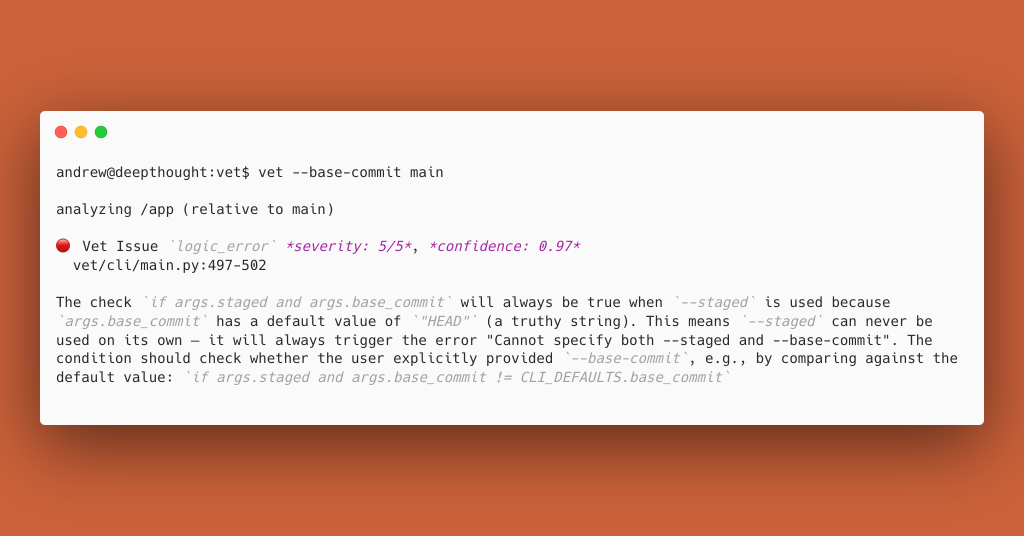
Beyond intent matching, Vet detects logic errors, security vulnerabilities, unhandled edge cases, and design problems in diffs. It uses LLM-based analysis with configurable severity thresholds, so you can tune how aggressive the checks are.
Runs Anywhere
Vet works three ways: as a CLI tool in your terminal (run it after any agent session), as an agent skill (integrate it directly into Claude Code, Cursor, or similar tools), or in CI/CD pipelines with a ready-made GitHub Actions integration. The flexibility means it fits whatever workflow you already use.
Privacy-First Architecture
All execution is local. No data goes to Imbue’s servers. You bring your own API keys (Anthropic, OpenAI, Google Gemini, or any OpenAI-compatible endpoint). Zero telemetry. It even works with local models if you want to keep everything on-premises.
Pricing
Vet is completely free and open source under the AGPL-3.0 license. There are no paid tiers, no subscription, and no SaaS component. The only cost is your LLM API usage, since Vet sends code and conversation context to whatever inference provider you configure. For a typical review session, expect to spend a few cents in API calls.
| Plan | Price | Plan Features | Best For |
|---|---|---|---|
| Open Source | Free | All features, BYO API keys, AGPL-3.0 license | All developers using AI coding agents |
Who is Vet Best For?
Developers who rely on AI coding agents daily and want a safety net before committing. Engineering teams running AI-generated code through CI/CD that want automated quality gates. Security-conscious organizations that need local-only code analysis with no third-party data sharing. Anyone doing “vibe coding” who needs a reality check on what the AI actually shipped.
Pros
- Intent verification is genuinely novel, catching what linters and standard review tools miss
- Completely free and open source with no vendor lock-in
- Privacy-first design with zero telemetry and BYO API keys
- Backed by a serious AI lab with $232M in funding and deep reasoning research
Cons
- Requires your own LLM API keys, adding friction for less technical users
- Effectiveness depends heavily on which LLM you use and how well it reasons about code
- No hosted option or dashboard for teams that want centralized reporting
- Still early with a small community (GitHub repo has modest traction)
Alternatives
CodeRabbit
An AI-powered PR reviewer that runs inside GitHub. It focuses on diff-level review with summaries and inline comments. Has a free tier for open source and paid plans for private repos. More polished UX but lacks Vet’s intent verification capability.
Qodo
Formerly CodiumAI, Qodo is an agentic code integrity platform with deep codebase context and multi-repo awareness. Enterprise-focused with paid tiers. Better for large organizations but heavier and more expensive than Vet’s lightweight approach.
Cursor
While Cursor is primarily a code editor with built-in AI, its review features provide some overlap. Cursor catches issues during generation rather than after. Using Vet alongside Cursor adds a verification layer that Cursor’s built-in checks do not provide.
FAQ
Does Vet work with any AI coding agent?
Yes. It analyzes git diffs and optionally conversation logs. If your agent produces code changes in a git repo, Vet can review them. It has native integrations with Claude Code and Cursor, and works with any agent via the CLI.
How much do the API calls cost?
A typical review session sends the diff and conversation context to your LLM provider. For most reviews, this is a few cents to a few dollars depending on the size of the changes and which model you use. Claude Haiku or GPT-4o-mini keep costs low.
Can I use Vet without an internet connection?
Yes, if you run a local LLM. Vet supports any OpenAI-compatible endpoint, including local inference servers like Ollama or vLLM. Quality will depend on the local model’s code reasoning ability.
Verdict
Vet solves a real problem that every developer using AI coding agents has encountered: the gap between what you asked for and what the agent actually built. The intent verification concept is genuinely novel and the execution is clean. Being free, open source, and privacy-first removes all adoption barriers. The main limitation is that it requires some technical setup (API keys, CLI comfort), and the lack of a hosted dashboard means teams cannot easily aggregate findings. But for individual developers and small teams, Vet is an essential addition to any AI-assisted coding workflow. The backing of a $1B+ AI lab suggests this tool will keep improving.
Vet Pros & Cons
What We Like
- Intent verification is genuinely novel, catching what linters miss
- Completely free and open source with no vendor lock-in
- Privacy-first design with zero telemetry and BYO API keys
- Backed by a serious AI lab with $232M in funding
What Could Be Better
- Requires your own LLM API keys, adding setup friction
- Effectiveness depends on which LLM you use for analysis
- No hosted option or dashboard for centralized team reporting
- Still early with a small community on GitHub
Vet FAQ
Does Vet work with any AI coding agent?
Yes. It analyzes git diffs and conversation logs. Native integrations with Claude Code and Cursor, plus CLI support for any agent.
How much do the API calls cost?
A few cents to a few dollars per review session depending on diff size and which model you use.
Can I use Vet without an internet connection?
Yes, with a local LLM via any OpenAI-compatible endpoint like Ollama or vLLM.
What is Vet?
Free, open-source code verification tool that catches mistakes made by AI coding agents. Reviews diffs against conversation context to verify intent alignment.
Is Vet worth it?
Vet solves a real problem every developer using AI agents has encountered. The intent verification concept is genuinely novel and the execution is clean. Free, open source, and privacy-first removes all adoption barriers. Essential for AI-assisted coding workflows. We rate it 7.6/10.
What are the best Vet alternatives?
The top Vet alternatives are CodeRabbit, Qodo and Cursor. Each is compared in the alternatives section of this review.






