Wealthfolio Review (2026): Pricing, Features & Honest Verdict
TLDR
Wealthfolio is an open-source, local-first portfolio and net worth tracker that keeps your financial data on your own devices. It is the best free answer to expensive trackers like Kubera, provided you tolerate CSV imports or pay for sync. Best for: privacy-conscious DIY investors. Price: free, Connect sync from $7.99/mo. Rating: 7.8/10.
What is Wealthfolio?
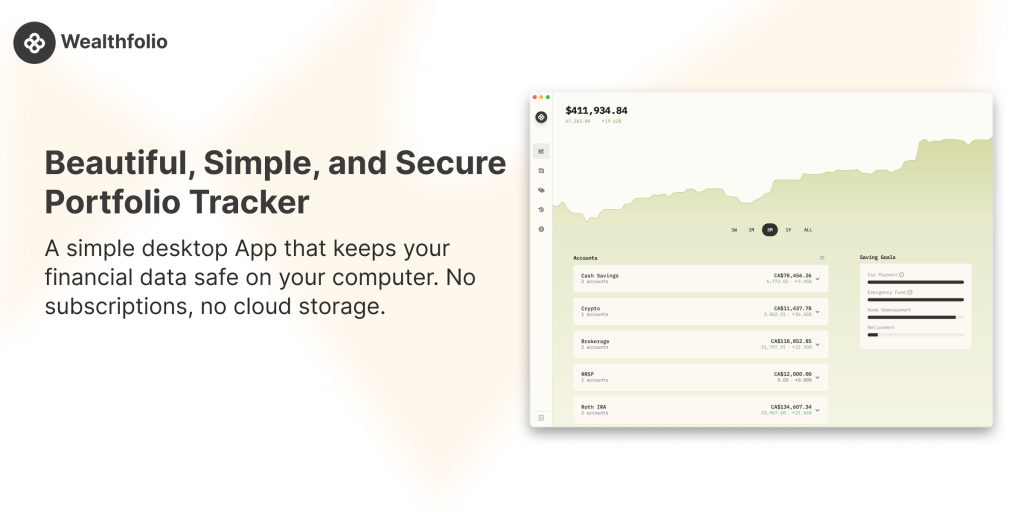
Wealthfolio is a personal finance and investment tracker built around one idea: your money data belongs on your device, not on a fintech company’s server. The app tracks investments across brokers and banks, net worth across assets and liabilities, spending and budgets, plus allocation targets with rebalancing tools. There is a performance dashboard with benchmarking, an income tracker with contribution limit monitoring, and a retirement simulator aimed squarely at the FIRE crowd. You can run it on desktop, mobile, or web, and the core app requires no account at all.
The project was created by developer Aziz Fadil, who open-sourced it and watched it go viral on Hacker News and Product Hunt. It has since grown past 6,200 GitHub stars, which puts it among the most popular open-source finance apps anywhere. That timing matters. Mint is dead, Empower wants to sell you wealth management, and Kubera now charges $249 a year. Trust in cloud finance aggregators is at a low point, and a tracker you can audit line by line answers that mood directly. We found Wealthfolio filling the gap those products left: serious tracking, no ads, no upsell into advisory services, and full source code you can audit.
What Are Wealthfolio’s Key Features?
Local-first portfolio tracking
Everything runs on your own devices. You add brokerage, retirement, and bank accounts (unlimited, with no caps) and Wealthfolio computes holdings, gains, and dividends locally. There is no signup, no cloud account, and no third party holding your transaction history. For anyone burned by finance apps monetizing data, this is the core selling point, and it is real, not marketing: the code is public under an open-source license.
Getting data in is straightforward if unglamorous. You enter transactions manually or import CSV exports from your broker, and the app handles the rest: positions, cost basis, dividends, and performance over time. Because the desktop app stores everything locally, it keeps working offline, and there is no server outage that can lock you out of your own numbers. If you later subscribe to Connect, the same data syncs across your devices with end-to-end encryption rather than living in plaintext on a vendor’s database.
Net worth, spending, and budgets in one place
Wealthfolio is not just a stock tracker. It rolls assets and liabilities into a net worth view, tracks spending against budgets, and monitors income alongside contribution limits for retirement accounts. Most open-source rivals stop at investments; this one covers the whole household balance sheet, which is usually where paid apps like Kubera justify their price.
The practical effect is consolidation. Instead of a brokerage app for stocks, a spreadsheet for net worth, and a budgeting app for spending, one local app holds the whole picture. That makes a question like whether your net worth actually grew this quarter, after the kitchen renovation, answerable in seconds, with every input under your control. For households with accounts scattered across two or three brokers plus a mortgage, that single view is the feature that sticks.
Allocation targets and a FIRE simulator
You can set target allocations and see exactly how far your portfolio has drifted, which turns rebalancing from a spreadsheet chore into a glance. The retirement and FIRE planning simulator lets you model savings rates and withdrawal scenarios. The dashboards also benchmark performance against indexes, so you know whether your stock picking actually beats buying the index.
Connect: optional sync when CSV gets old
The free app imports data manually or via CSV exports from your broker. Wealthfolio Connect is the optional subscription that adds automatic brokerage and bank synchronization, cross-device syncing with end-to-end encryption, and household portfolio sharing. Essentials runs $7.99/mo ($6.58/mo billed yearly), Duo for two people is $12.99/mo, and Plus is $24.99/mo. This is how the project funds itself without ads or data sales.
How Much Does Wealthfolio Cost?
The core Wealthfolio app costs nothing. Not freemium-nothing with crippled features, but genuinely free and open source, with unlimited accounts and portfolios. You only pay if you want Connect, the sync service, which starts at $7.99 per month for Essentials, or $6.58 per month if billed yearly.
Compare that to the competition. Kubera charges $249 per year, and that is after a price hike from $150. Sharesight and Snowball Analytics run subscription models too. Empower Personal Dashboard is free, but it is free because Empower uses it as a funnel for its advisory business and will call you about it. Wealthfolio Connect at roughly $79 per year (billed annually) lands far below Kubera while keeping the no-ads, no-upsell posture.
We think the pricing structure is honest. The free tier is the full product, and the paid tier sells convenience (automatic sync), not features held hostage. The Duo plan at $12.99/mo is a nice touch for couples, something most trackers handle badly or not at all.
One more cost consideration: longevity. Subscription trackers have a habit of raising prices once you are locked in, as Kubera’s jump from $150 to $249 showed. Because Wealthfolio is open source and stores data locally, the worst case if the project ever stalls is that you keep the app and your data exactly as they are. With a closed SaaS tracker, the worst case is an export scramble before a shutdown deadline. That asymmetry is worth real money over a decade of tracking.
| Plan | Price | Plan Features | Best For |
|---|---|---|---|
| Core app | Free | Full tracker: unlimited accounts, net worth, budgets, FIRE simulator, manual/CSV import | Anyone who wants private, local tracking |
| Connect Essentials | $7.99/mo | Automatic brokerage and bank sync, cross-device syncing, $6.58/mo billed yearly | Investors tired of CSV imports |
| Connect Duo | $12.99/mo | Everything in Essentials for two people, household portfolio sharing | Couples managing money together |
| Connect Plus | $24.99/mo | Higher connection limits and full household features, $20.75/mo billed yearly | Complex multi-account households |
Who is Wealthfolio Best For?
Use Wealthfolio if:
- You are a DIY investor who wants one private place for portfolios, net worth, and retirement modeling.
- You are a FIRE planner who wants to run savings-rate and withdrawal scenarios against your real numbers.
- You refuse to pipe bank credentials through third-party aggregators and want data that never leaves your device.
- You are an ex-Mint user who never found a replacement you trusted.
- You have accounts spread across several brokers and are comfortable exporting a CSV once a month, in which case you may never pay a cent.
Skip Wealthfolio if:
- You want a fully hands-off experience out of the box, because automatic syncing requires the paid Connect tier.
- You need tax reporting, capital gains paperwork, or advisor collaboration, where dedicated tools like Sharesight go deeper.
- You hold complex structures like trusts and LLCs, which is Kubera territory.
- You want someone to manage money for you. This is a tracker, not an advisor, and it makes no recommendations beyond what its dashboards show you.
Best Wealthfolio Alternatives
Ghostfolio
Ghostfolio is the other big open-source portfolio tracker, and the natural head-to-head. It is free to self-host under an AGPL license and offers a hosted Premium tier if you do not want to run your own server. Ghostfolio is more investments-focused, while Wealthfolio covers spending, budgets, and household net worth more completely. Pick Ghostfolio if you live in Docker; pick Wealthfolio if you want a polished desktop and mobile app without server admin.
Kubera
Kubera is the premium pick for tracking everything you own: brokerage accounts, crypto, real estate, even collectibles, with strong automatic connections worldwide. It costs $249 per year, with a $1 14-day trial, and the Kubera Black tier for complex estates runs $2,499 per year. It is genuinely good software, but you are paying 3x Wealthfolio Connect’s yearly price mostly for broader account connectivity.
Empower Personal Dashboard
Empower’s free dashboard syncs accounts automatically and tracks net worth and retirement readiness at zero cost. The catch is the business model: it exists to surface prospects for Empower’s wealth management arm, so expect outreach once your linked balances cross their radar. If you do not mind that trade and want free automatic sync, it works. If the thought makes you wince, Wealthfolio is the antidote.
Final Verdict: Is Wealthfolio Worth It?
Wealthfolio earns its 7.8/10. The free core app is a complete, well-designed tracker covering investments, net worth, budgets, and FIRE planning, and the open-source, local-first architecture is a real differentiator, not a gimmick. The Connect subscription is priced fairly at $7.99/mo and funds the project without compromising the privacy story. Few finance apps have this little fine print.
The honest caveats: free users do manual or CSV data entry, the ecosystem is younger than Kubera’s or Sharesight’s, and there is no tax or advisory layer. None of that changes the recommendation. If you want private, serious portfolio tracking without a $249/yr bill, install Wealthfolio first and only look elsewhere if it leaves a gap.
Wealthfolio Pros & Cons
What We Like
- Core app is completely free and open source (6,200+ GitHub stars), with no account required
- Local-first by design: your financial data stays on your device, not on someone's server
- Covers the full picture: investments, net worth, spending, allocation targets, and a FIRE simulator
- Optional Connect sync at $7.99/mo is far cheaper than Kubera's $249/yr
What Could Be Better
- Without a Connect subscription, you are updating holdings via manual entry or CSV exports
- Younger ecosystem than incumbents, so expect occasional rough edges and a thinner help library
- No advisory features or tax reporting; it tracks, it does not advise
Wealthfolio FAQ
What is Wealthfolio?
Wealthfolio is an open-source, local-first investment and net worth tracker. It runs on desktop, mobile, and web, keeps your financial data on your own devices, and covers portfolios, spending, allocation targets, and retirement planning without requiring an account.
How much does Wealthfolio cost?
The core app is free and open source. The optional Connect service, which adds automatic brokerage sync and cross-device syncing, starts at $7.99/mo (or $6.58/mo billed yearly), with Duo at $12.99/mo and Plus at $24.99/mo.
Is Wealthfolio worth it?
Yes, especially if privacy matters to you. The free core app does what $200+/yr trackers charge for, and even the paid Connect tier undercuts rivals. The trade-off is manual data entry unless you subscribe to Connect.
What are the best Wealthfolio alternatives?
Ghostfolio is the closest open-source rival and free to self-host. Kubera is the premium all-asset tracker at $249/yr. Empower Personal Dashboard is a free, ad-supported option with automatic account syncing.
Does Wealthfolio offer a free plan?
Yes. The entire core application is free and open source, with unlimited accounts and portfolios. You only pay if you want the optional Connect subscription for automatic bank and brokerage syncing.
Who is Wealthfolio best for?
DIY investors who want full control of their financial data. It suits privacy-focused users, FIRE planners, and anyone who quit Mint-style apps because they did not trust where their data was going.