Akaunting Review (2026): Pricing, Features & Honest Verdict
TLDR
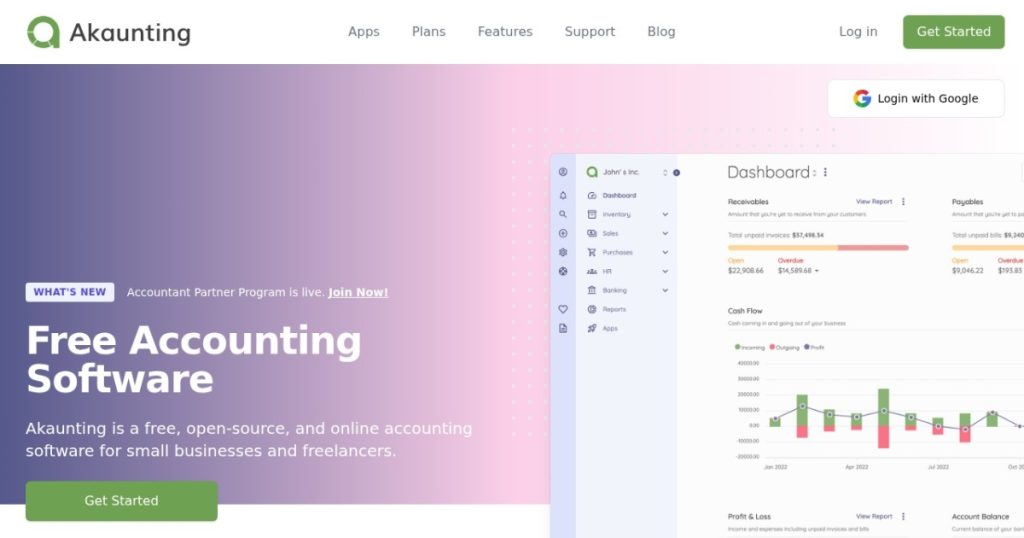
Akaunting is a free, open source accounting platform you can self-host or run in the cloud. It covers invoicing, expenses, reports, and multi-currency support with a modular app marketplace. Best for: budget-conscious freelancers and small businesses wanting full control. Price: free (self-hosted) or $18/mo+ (cloud). Rating: 8.1/10
What is Akaunting?
Akaunting is an open source, online accounting software built on Laravel and designed for small businesses, freelancers, and entrepreneurs. Founded in 2017, it positions itself as the free alternative to platforms like QuickBooks and Xero, with the added benefit of full source code access and self-hosting capability.
The core platform is genuinely free and covers the essentials: invoicing, bill tracking, expense management, bank connections, and financial reporting. Where Akaunting gets interesting is its modular architecture. An app marketplace lets you add features like inventory management, payroll, and CRM without bloating the base install.
For developers and technically savvy business owners, the self-hosting option means complete data ownership and zero recurring costs beyond your server. For everyone else, the cloud-hosted plans provide a managed experience at competitive prices.
Key Features
Invoicing and Billing
Create and send professional invoices with custom branding, track payment status, and set up recurring invoices for retainer clients. The billing side lets you manage vendor bills and track what you owe, giving you a complete picture of cash flow in and out.
Multi-Currency and Multi-Company
Akaunting handles multiple currencies natively with automatic exchange rate updates. You can also manage multiple companies from a single installation, which is valuable for freelancers juggling side projects or agencies managing client books.
Bank Connections
Connect bank accounts to import transactions automatically. The reconciliation workflow is straightforward, letting you match imported transactions to invoices and bills with minimal manual effort.
App Marketplace
The modular approach means you start lean and add what you need. Apps cover inventory, payroll, point of sale, and dozens of other functions. Some are free, others are paid one-time or subscription. This keeps the core lightweight while allowing serious customization.
Client Portal
Give clients their own login to view invoices, make payments, and check transaction history. This reduces back-and-forth emails about payment status and creates a more professional client experience.
Financial Reports
Standard reports include profit and loss, balance sheet, income by category, and expense summaries. The reporting is solid for basic needs, though businesses requiring advanced analytics might want to supplement with dedicated tools.
Pricing
Akaunting’s pricing model is refreshingly simple for the self-hosted version: it is free, forever, with no user limits.
- Self-Hosted: Free and open source, unlimited users, all core features
- Cloud Standard: $18/mo for managed hosting with basic support
- Cloud Professional: $36/mo with priority support and additional apps
Marketplace apps range from free to $50+ for premium modules. The total cost depends heavily on which apps you need, but the base platform covers most freelancer and small business requirements without spending anything.
Pros and Cons
Pros
- Genuinely free and open source with no artificial feature limits
- Self-hostable for complete data ownership and privacy
- Multi-currency and multi-company support out of the box
- Modular marketplace lets you add only what you need
- Laravel-based codebase is clean and extensible for developers
Cons
- Self-hosting requires technical knowledge to set up and maintain
- Some essential features locked behind paid marketplace apps
- UI feels dated compared to polished competitors like Xero
- Community support can be slow for complex issues
- Bank feed reliability varies by region and provider
| Plan | Price | Plan Features | Best For |
|---|---|---|---|
| Self-Hosted | Free | All core features, unlimited users, open source | Developers and technical users |
| Cloud Standard | $18/mo | Managed hosting, basic support, core features | Small businesses wanting managed setup |
| Cloud Professional | $36/mo | Priority support, premium apps included | Growing businesses needing premium features |
Who Should Use Akaunting?
Akaunting is perfect for technically capable freelancers, developers, and small businesses who want accounting software without recurring costs. If you can deploy a Laravel app on a $5/mo VPS, you get a fully functional accounting platform for next to nothing.
It also suits privacy-conscious businesses that need to keep financial data on their own infrastructure, and agencies managing books for multiple clients from a single dashboard.
If you want polished UX, hand-holding onboarding, or enterprise-grade phone support, this is not your tool. Look at Xero or QuickBooks instead.
Alternatives
Wave
Wave is also free for accounting and invoicing, but it is cloud-only with no self-hosting option. It has a more polished interface than Akaunting but less flexibility and no source code access. Wave recently introduced fees for some features that were previously free.
GnuCash
GnuCash is a desktop-based, open source accounting application with deep double-entry bookkeeping support. It is more powerful for traditional accounting but lacks the web-based convenience, invoicing polish, and client portal that Akaunting offers.
Zoho Books
Zoho Books offers a free tier for businesses under specific revenue thresholds and integrates deeply with the broader Zoho ecosystem. It has more polish than Akaunting but locks you into a proprietary platform with less control over your data.
FAQ
Is Akaunting really free?
The core platform is completely free and open source under GPLv3. You can self-host it with no user limits or feature restrictions. The cloud-hosted version and some marketplace apps are paid.
How hard is it to self-host Akaunting?
If you are comfortable deploying a Laravel application, it is straightforward. You need PHP 8.1+, a database (MySQL/PostgreSQL), and a web server. The official Docker image simplifies deployment further. Non-technical users should stick with the cloud version.
Can Akaunting handle multiple businesses?
Yes. A single Akaunting installation can manage multiple companies, each with its own chart of accounts, currencies, and users. This is a core feature, not a paid add-on.
Verdict
Akaunting is the rare open source project that genuinely competes with commercial alternatives on functionality. The free self-hosted version covers invoicing, expenses, multi-currency, and reporting without artificial limits. The modular marketplace adds flexibility without bloat. At 8.1/10, it earns a strong recommendation for anyone who values data ownership, cost control, and the freedom to customize their accounting stack. Just be prepared to trade some UI polish for that freedom.
Akaunting Pros & Cons
What We Like
- Genuinely free and open source with no artificial feature limits
- Self-hostable for complete data ownership and privacy
- Multi-currency and multi-company support out of the box
- Modular marketplace lets you add only what you need
- Laravel-based codebase is clean and extensible
What Could Be Better
- Self-hosting requires technical knowledge to maintain
- Some essential features locked behind paid marketplace apps
- UI feels dated compared to polished competitors
- Community support can be slow for complex issues
- Bank feed reliability varies by region
Akaunting FAQ
Is Akaunting really free?
The core platform is completely free and open source under GPLv3. Self-host with no limits. Cloud hosting and some marketplace apps are paid.
How hard is it to self-host Akaunting?
Straightforward if you can deploy a Laravel app. Needs PHP 8.1+, MySQL/PostgreSQL, and a web server. Docker image available for easier setup.
Can Akaunting handle multiple businesses?
Yes. A single installation manages multiple companies with separate charts of accounts, currencies, and users. This is a core feature.
What is Akaunting?
Free, open source accounting software with invoicing, expenses, multi-currency, and a modular app marketplace. Self-hostable.
How much does Akaunting cost?
Akaunting pricing starts at Free. A free plan is available.
Is Akaunting worth it?
Akaunting genuinely competes with commercial accounting software while being free and open source. A strong choice for anyone who values data ownership and cost control. We rate it 8.1/10.