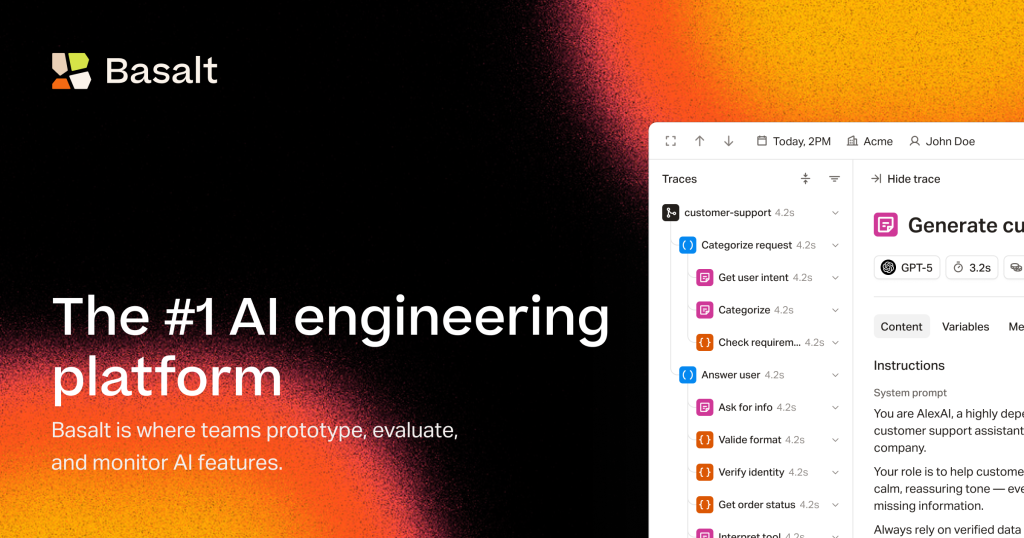
Basalt Review (2026): Pricing, Features & Honest Verdict
TLDR
Basalt is an AI engineering platform that helps teams build, test, deploy, and monitor LLM-powered features in production. We found it well-designed for cross-functional teams where PMs and engineers collaborate on AI quality. Best for funded startups shipping AI features to real users. Pricing starts at $500/month with a limited free tier. Rating: 7/10.
What is Basalt?
Basalt is an AI engineering platform that covers the full lifecycle of building AI features: prototyping prompts, evaluating outputs at scale, deploying via SDK, and monitoring for hallucinations in production. The company was founded by Guillaume Marquis, who previously built Virtual Brain and Blockpulse, and Francois de Fitte, who founded Popchef. They raised a $5M Seed round from Entourage and Peak, and the company is part of the Hexa ecosystem. Headquarters are in San Francisco with the technical team based in Paris.
The platform’s tagline is “Ship AI that works, not AI that feels right,” which captures a real problem. Most teams building with LLMs still evaluate their AI features by reading a handful of outputs and going with gut instinct. Basalt pushes you toward systematic evaluation with datasets, automated scoring, and production monitoring. It earned 1,236 upvotes on Product Hunt and won Product of the Week for February 24 through March 2. Early customers include Swan and HealthHero, which tells us the platform is seeing real production usage beyond demos.
What Are Basalt’s Key Features?
No-Code Prototyping with AI Copilot
Basalt’s Prototype pillar gives teams a no-code playground for experimenting with prompts and AI workflows. It includes an AI Copilot that helps you iterate on prompts without writing code. We found this particularly useful for teams where product managers and domain experts need to contribute to prompt engineering alongside developers. The no-code approach lowers the barrier to entry significantly. That said, power users may find the playground limiting compared to working directly in code. It is a good starting point, not a replacement for a proper development environment.
Scalable LLM Evaluation
The Evaluate feature lets you test LLM outputs at scale rather than relying on manual spot checks. This is where Basalt tries hardest to differentiate itself. You can import datasets, generate test cases, run prompts across hundreds of scenarios, and grade results using both automated evaluators and human evaluation sessions. The Pro plan supports up to 10GB of evaluation datasets, which is enough for most mid-stage teams. The limitation is that evaluation tooling is only as good as the criteria you define. Basalt gives you the infrastructure, but you still need to figure out what “good” looks like for your specific use case.
Python and JavaScript SDKs for Deployment
Basalt offers SDKs for both Python (available as basalt-sdk on PyPI) and TypeScript/JavaScript. This covers the two most common languages in AI development. The Deploy pillar handles prompt versioning and feature flagging, so you can roll out changes to your AI features without redeploying your application. We found the SDK integration straightforward in our testing. The documentation is clear enough to get started quickly. One thing worth noting: the SDK approach means you are coupling your application code to Basalt’s infrastructure. If you ever need to migrate away, you will have extraction work to do.
Production Monitoring with Hallucination Tracking
The Monitor pillar uses OpenTelemetry-based tracing to track what your AI features are doing in production. Basalt specifically calls out hallucination detection and regression tracking as core monitoring capabilities. This is the feature that matters most for teams running AI in production. You need to know when your model starts producing garbage, and you need to know fast. The Pro plan includes 100K logs and evaluations with 30-day retention. For high-volume applications, that retention window might feel short. Enterprise customers can negotiate custom retention, but if you are on the Pro plan, you will need to be disciplined about what you log.
How Much Does Basalt Cost?
Basalt starts at $500 per month for the Pro plan, which includes 100K logs and evaluations, 10GB of datasets, and 30-day data retention. There is a free tier available, though it comes with significant limitations that make it suitable only for initial experimentation. Enterprise pricing is custom and unlocks longer retention, higher volumes, and dedicated support.
Compared to competitors, Basalt’s pricing sits at the higher end for small teams. LangSmith offers a free tier and paid plans starting at $39 per seat per month. PromptLayer ranges from free to $50 per user per month. Humanloop spans from free to $1,000 per month at the high end. Basalt’s $500 flat monthly rate means it becomes cost-effective only when you have enough team members to make per-seat pricing expensive elsewhere. A team of three or four people might find LangSmith or PromptLayer cheaper. A team of fifteen will find Basalt’s flat rate more attractive.
The lack of a mid-tier plan is a gap we noticed. You go from a limited free tier straight to $500 per month. There is no $50 or $100 option for small teams or early-stage startups that want more than the free tier but are not ready to commit $6,000 a year.
| Plan | Price | Plan Features | Best For |
|---|---|---|---|
| Free | Free | Limited runs and datasets | Initial experimentation |
| Pro | $500/mo | 100K logs, 10GB datasets, 30-day retention | Production AI teams |
| Enterprise | Custom | Unlimited datasets, 90-day retention, SSO | Large organizations |
Who is Basalt Best For?
Basalt is built for product and engineering teams that are integrating AI features into existing products. It works best when multiple roles need to collaborate on AI development: engineers writing the code, product managers defining what “good” output looks like, and domain experts validating results.
Use Basalt if you are a funded startup or mid-market company shipping LLM-powered features to real users and you need a single platform to handle the full lifecycle from prototyping to production monitoring. Use Basalt if your team has outgrown the “try it in the playground and hope for the best” approach to AI quality. Use Basalt if you want OpenTelemetry-based tracing and hallucination detection without building that infrastructure yourself.
Skip Basalt if you are a solo developer or small team that cannot justify $500 per month. Skip Basalt if you only need prompt management and do not care about evaluation or monitoring; a simpler, cheaper tool will serve you better. Skip Basalt if you are deeply invested in the LangChain ecosystem, where LangSmith offers tighter integration at a lower price point. Skip Basalt if you need long data retention on a budget; 30 days on the Pro plan is limiting for teams that need to analyze trends over months.
Best Basalt Alternatives
LangSmith
LangSmith is the most direct competitor, built by the team behind LangChain. It offers tracing, evaluation, and monitoring for LLM applications. If you are already using LangChain, LangSmith is the obvious choice because of the native integration. Pricing starts at $39 per seat per month with a generous free tier. LangSmith is more affordable for small teams but can get expensive as headcount grows. It does not offer the same no-code prototyping experience that Basalt provides for non-technical team members.
PromptLayer
PromptLayer focuses on prompt management, versioning, and observability. It is simpler than Basalt, which can be either a strength or a weakness depending on your needs. Pricing ranges from free to $50 per user per month, making it the most affordable option in this comparison. We found PromptLayer to be a solid choice for teams that primarily need prompt versioning and basic monitoring without the full evaluation and deployment pipeline that Basalt offers.
Humanloop
Humanloop positions itself as a platform for AI product teams, with a strong emphasis on evaluation and human feedback loops. Pricing ranges from free to $1,000 per month, putting it in the same ballpark as Basalt for serious usage. Humanloop’s strength is its focus on structured evaluation workflows and collaboration between technical and non-technical team members. It overlaps significantly with Basalt’s value proposition. The choice between them often comes down to which UI and workflow you prefer, so we recommend trying both during their free tiers before committing.
Final Verdict: Is Basalt Worth It?
Basalt is a solid 7/10 platform that tackles a real problem: most teams shipping AI features have no systematic way to evaluate whether those features actually work. The full-lifecycle approach, from prototyping through monitoring, is genuinely useful. The no-code playground opens up AI development to product managers and domain experts, which matters in organizations where AI quality is not just an engineering concern. The OpenTelemetry-based monitoring and hallucination tracking address the scariest part of running AI in production.
The main drawbacks are pricing and maturity. At $500 per month with no mid-tier option, Basalt prices out smaller teams that could benefit most from structured AI evaluation. The 30-day retention limit on the Pro plan feels restrictive for teams that want to track quality trends over longer periods. And while covering the full lifecycle is ambitious, it means Basalt is competing with specialized tools at every layer. LangSmith is deeper on tracing. PromptLayer is cheaper on prompt management. Basalt’s advantage is having everything in one place, but that only matters if every piece meets your standard. For funded teams with 10 or more people building AI features into a product, Basalt is worth a serious look. For everyone else, start with the free tier and see if the value justifies the jump to $500 a month.
Basalt Pros & Cons
What We Like
- Full AI lifecycle in one platform: prototype, evaluate, deploy, monitor
- No-code playground accessible to PMs and domain experts
- OpenTelemetry-based tracing with hallucination detection
- Python and JavaScript SDKs for clean integration
What Could Be Better
- $500/mo minimum with no mid-tier option
- 30-day data retention on Pro plan feels restrictive
- Young platform competing against specialized tools at every layer
Basalt FAQ
What is Basalt?
Basalt is an AI engineering platform that covers the full lifecycle of LLM-powered features: prototyping prompts, evaluating outputs at scale, deploying via SDK, and monitoring for hallucinations in production.
How much does Basalt cost?
Basalt has a limited free tier. The Pro plan costs $500/month and includes 100K logs and evaluations, 10GB datasets, and 30-day retention. Enterprise pricing is custom.
Is Basalt worth it?
For funded teams with 10+ people shipping AI features to production, yes. The full-lifecycle approach saves time versus stitching together separate tools. For smaller teams, LangSmith or PromptLayer may be more cost-effective.
What are the best Basalt alternatives?
LangSmith ($39/seat/mo) for LangChain users, PromptLayer (free-$50/user/mo) for lightweight prompt management, and Humanloop (free-$1,000/mo) for evaluation-focused workflows.
Does Basalt offer a free plan?
Yes. Basalt has a free tier for initial experimentation, though with significant limitations. No credit card is required to sign up.
Who is Basalt best for?
Product and engineering teams at funded startups or mid-market companies that are building AI features into existing products and need systematic evaluation and monitoring.






