Clay Earth Review (2026): Pricing, Features & Honest Verdict
TLDR
Clay Earth is a personal relationship CRM that auto-builds rich profiles for everyone you know from your email, calendar, and social accounts. It keeps your network warm with reconnect reminders and live updates. Best for: founders, investors, and networkers. Price: Free plan: yes, Pro from $10/mo. Rating: 8.1/10.
What is Clay Earth?
Clay Earth is a personal CRM built around relationships instead of deals. You connect your email, calendar, LinkedIn, and other social accounts, and Clay quietly assembles a profile for every person you interact with. It captures who they are, where they work, when you last spoke, and what is new in their life. The whole point is to stop good contacts from going cold. A traditional CRM is built to push deals through a funnel. Clay is built to help you remember people and stay in touch with them over years, not quarters.
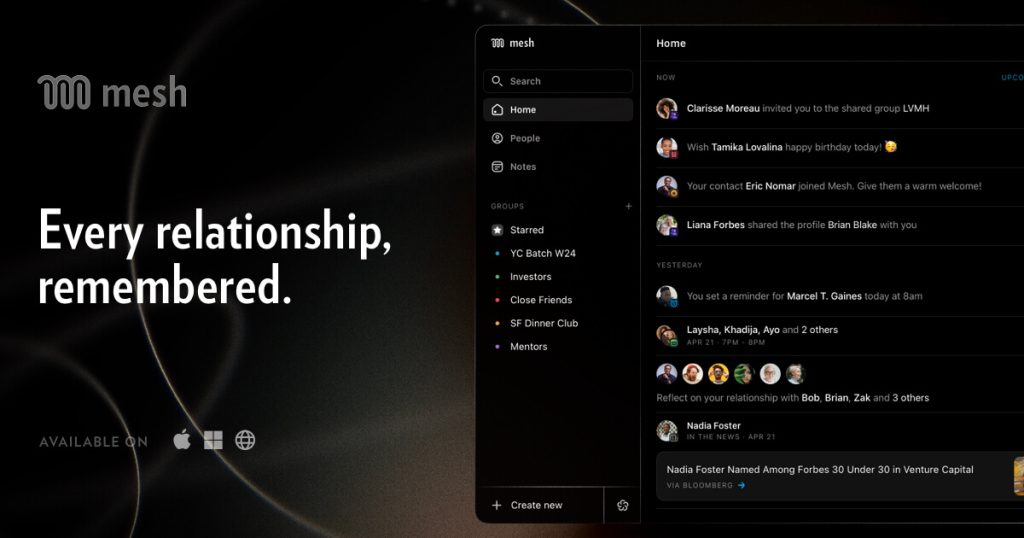
The product was built by Clay and recently rebranded to Mesh, living at me.sh, though the clay.earth domain still works and the underlying app is the same. It has been around since the late 2010s and won a Webby in 2022. The team reports managing over 100 million relationships across its user base, which tells you the product has real traction rather than being a weekend experiment. We tested it as a tool for people who network heavily: founders raising money, investors tracking portfolios, recruiters keeping warm pipelines, and salespeople who think in relationships rather than pipeline stages. The common thread is that these people meet too many others to track by memory, and a spreadsheet is too much manual work to maintain.
What Are Clay Earth’s Key Features?
Automatic contact enrichment
This is the core. Clay scans your inbox, calendar, and connected social accounts and builds a profile for each person without you typing anything. It pulls job titles, company moves, mutual connections, and recent posts. When someone changes jobs or appears in the news, the profile updates on its own. On the Pro plan this refreshes in real time rather than on a schedule. The practical effect is that your contact list is never stale. You do not have to manually update that a founder you backed two years ago has now joined a new company, because Clay already noticed and surfaced it.
Smart Feed and reconnect reminders
The Smart Feed surfaces birthdays, job changes, news mentions, and people you have not spoken to in a while. You can set recurring reminders to check in with key contacts every 30, 60, or 90 days. This is the feature that actually changes behavior: instead of remembering to reach out, the app tells you who is due. The feed has filters for events, posts, social changes, reconnection prompts, and upcoming activities, so you can decide each morning whether you want to scan everything or just the people who matter most. For relationship-driven work, this is the difference between intending to follow up and actually doing it.
Network search and Nexus AI
Search lets you find people by company, location, role, or how you met. The Nexus AI navigator goes further, answering questions like who in your network could introduce you to a given company. For founders chasing warm intros, this turns a static address book into a usable map of your reach. Instead of scrolling LinkedIn hoping to spot a mutual connection, you ask Clay and it returns the path. That single use case justifies the tool for a lot of people who raise money or sell into specific accounts.
Cross-platform apps
Clay ships native apps for macOS, Windows, web, and iOS. Everything syncs, so a note you add on your phone shows up on desktop. The macOS app in particular is fast and feels like a first-class product rather than a wrapped web page. There is also a menu-bar quick-add and integrations with tools like Notion and WhatsApp, so contacts and notes flow in from where you already work. The polish here is a big reason Clay feels more like a finished consumer product than the clunky web apps that dominate the personal CRM category.
How Much Does Clay Earth Cost?
Clay Earth starts free. The Personal plan supports up to 1000 contacts with email, calendar, and social import, search, reconnect reminders, and birthday alerts. For most individuals that limit is generous enough to never pay.
Pro costs $10/mo (billed annually, a 50% discount off the standard rate) and removes the contact cap entirely while adding custom imports, priority support, and real-time network refresh. Team is $40 per seat per month for up to four members with shared relationships and advanced enrichment. Enterprise is custom-priced and adds unlimited seats, SOC 2 Type II, SAML SSO, and a dedicated success manager.
At $10/mo, Clay Earth undercuts most rivals. Dex is $12/mo billed annually, Folk starts at $30/mo, and a full sales CRM like HubSpot runs far higher once you leave its free tier. For a personal CRM, this is strong value. The one cost worth flagging is the discount framing: the $10 rate is a 50% promotional price billed annually, so check the renewal terms before assuming it stays there forever. Even at the higher standard rate, it remains competitive with Dex.
The Team plan deserves a separate note. At $40 per seat per month for up to four members, it is aimed at small partnerships, like a two-person VC fund or a boutique recruiting shop, where everyone benefits from a shared relationship graph. It is not priced or built for large sales teams, so do not evaluate it against HubSpot’s per-seat sales tooling. It is a shared address book with enrichment, not a sales operating system.
| Plan | Price | Plan Features | Best For |
|---|---|---|---|
| Personal | Free | Up to 1000 contacts, email/calendar/social import, reminders | Individuals managing a personal network |
| Pro | $10/mo | Unlimited contacts, custom imports, real-time refresh, priority support | Founders and power networkers |
| Team | $40/seat/mo | Everything in Pro plus shared relationships, up to 4 seats, enrichment | Small teams mapping connections |
| Enterprise | Custom | Unlimited seats, SOC 2 Type II, SAML SSO, dedicated success manager | Larger orgs with compliance needs |
Who is Clay Earth Best For?
Use Clay Earth if you network for a living and your contacts outpace your memory. Founders raising rounds, investors tracking founders, recruiters, agency owners, and community builders all benefit from a tool that keeps profiles fresh automatically and nudges you to reconnect. If you regularly think “I should reach out to so-and-so” and then forget for six months, this is the category of tool that fixes that, and Clay does it with the least manual effort.
Skip Clay Earth if you need a transactional sales CRM. There are no deal pipelines, no stages, no revenue forecasting, and no quote-to-close workflow. If your job is moving deals through a funnel, a tool like HubSpot or Pipedrive will serve you better. Clay is about people, not pipeline.
- Great fit: founders, investors, networkers, recruiters, community builders
- Poor fit: sales teams that manage deals, anyone needing pipeline reporting
Best Clay Earth Alternatives
Dex
Dex is the closest direct competitor and arguably Clay’s main rival in the personal CRM space. It costs $12/mo billed annually (or $20/mo monthly) and offers a free tier with unlimited contacts but fewer features. Dex leans harder on browser extensions and timeline notes, while Clay’s automatic enrichment feels more hands-off. If you want unlimited contacts for free, Dex is worth a look.
Folk
Folk is a lightweight relationship CRM aimed more at small teams and agencies. Pricing starts at $30/mo per user with a 14-day trial and no permanent free plan. It has stronger collaboration and pipeline-lite features than Clay, so it sits between a personal CRM and a sales tool. Choose Folk if a few teammates need to share contacts and light deal tracking.
Monica
Monica is a free, open-source personal CRM you can self-host or use on a hosted plan from around $9/mo. It has no automatic enrichment, so you log interactions manually, but it is private and fully under your control. There is no social scraping and no profiles being built behind your back, which is exactly what privacy-conscious users want. The trade-off is real effort: every note, reminder, and detail is something you type yourself. Pick Monica if data ownership matters more to you than automation, and pick Clay if you would rather the software do the work.
Final Verdict: Is Clay Earth Worth It?
Clay Earth is the most polished personal CRM we tested. The automatic enrichment is the real draw: it does the tedious work of keeping profiles current so you can focus on actually reaching out. The free plan is generous, and $10/mo for unlimited contacts is fair. The native apps are fast and the reconnect reminders genuinely change how often you follow up.
It earns an 8.1 because it nails its niche while staying narrow. If you live in relationships, buy it. If you need deal pipelines and sales reporting, it is the wrong tool entirely, and the recent Clay to Mesh rebrand adds a little friction while the branding settles. The privacy angle is also worth a moment of thought: the enrichment that makes Clay magical works by scraping your email and social accounts, so if that makes you uneasy, a manual tool like Monica is the safer choice. For networkers who are comfortable with that trade, though, Clay Earth is an easy recommendation, and the free Personal plan means you can test it on your own contacts before paying a cent.
Clay Earth Pros & Cons
What We Like
- Automatic enrichment pulls job changes, news, and social updates with no manual data entry
- Free Personal plan supports up to 1000 contacts, which covers most individuals
- Pro is only $10/mo for unlimited contacts, cheaper than most personal CRMs
- Native apps for macOS, Windows, web, and iOS keep everything in sync
What Could Be Better
- Not a sales CRM: no deal pipelines, stages, or revenue reporting
- Heavy reliance on social and email scraping raises privacy questions for some users
- The Clay to Mesh rebrand has caused some confusion across apps and links
Clay Earth FAQ
What is Clay Earth?
Clay Earth is a personal relationship CRM that automatically organizes everyone you know. It pulls contact data from your email, calendar, and social accounts, then keeps profiles updated with job changes, news, and reminders to reconnect. The product recently rebranded to Mesh, though the clay.earth site still works.
How much does Clay Earth cost?
Clay Earth has a free Personal plan for up to 1000 contacts. Pro costs $10/mo for unlimited contacts and real-time refresh, Team is $40 per seat per month for up to four members, and Enterprise is custom-priced with SOC 2 and SSO.
Is Clay Earth worth it?
Yes, if you network for a living. The automatic enrichment and reconnect reminders do real work that a spreadsheet cannot, and $10/mo for unlimited contacts is a fair price. Skip it if you need a deal-based sales pipeline.
What are the best Clay Earth alternatives?
Dex is the closest rival at $12/mo with a free unlimited-contact tier. Folk is a more team-oriented CRM from $30/mo. Monica is a free open-source personal CRM you self-host.
Does Clay Earth offer a free plan?
Yes. The Personal plan is free forever and supports up to 1000 contacts with email, calendar, and social import, reconnect reminders, and birthday alerts. A 14-day Pro trial requires a card.
Who is Clay Earth best for?
Founders, investors, salespeople, and connectors who manage relationships rather than transactions. Anyone who wants to stay top of mind with a large, slow-moving network will get the most value.






