DualEntry Review (2026): Pricing, Features & Honest Verdict
TLDR
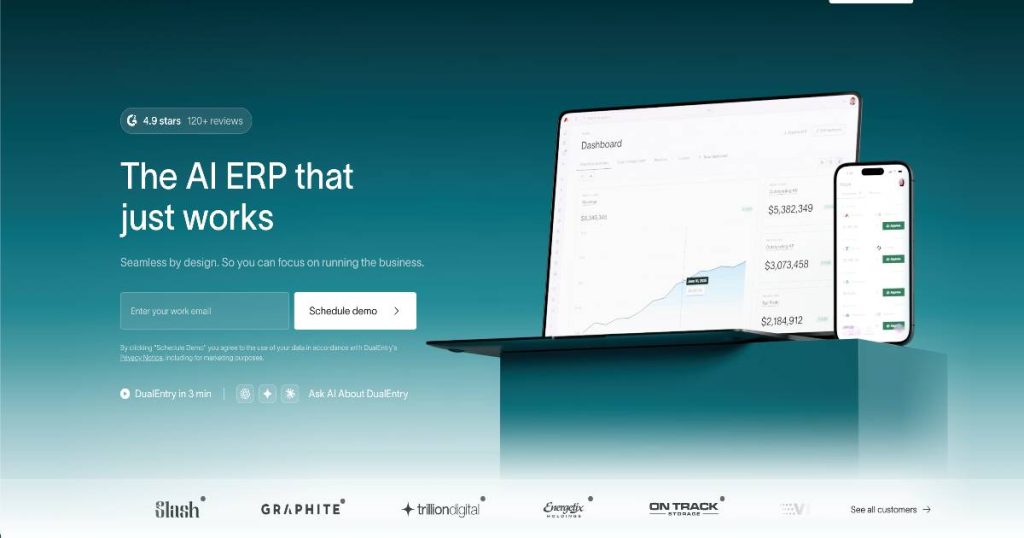
DualEntry is an AI-native ERP built for mid-market finance teams. It handles the general ledger, AP, AR, revenue recognition, and multi-entity consolidation, with 13,000-plus integrations and automation aimed at a faster close. It is genuinely impressive, but pricing is custom and there is no free trial. Best for: mid-market finance teams. Price: Custom, no free trial. Rating: 8.4/10.
What is DualEntry?
DualEntry is an ERP that puts accounting first and builds AI into the core rather than bolting it on. It covers the general ledger, accounts payable and receivable, cash and treasury management, revenue recognition, close management, account reconciliation, budgeting, and multi-entity consolidation. The pitch is a single system that runs the finance function and automates the repetitive parts of it, from coding transactions to reconciling accounts.
It is built by Entry Inc. out of New York, launched in 2023, and raised a $90M Series A, which is a serious war chest for a young ERP. The target is the mid-market, roughly 50 to 1,000 employees, the awkward band where QuickBooks runs out of room and NetSuite feels heavy and expensive. We dug into what it offers, and the standout claims are a 24-hour go-live path and 13,000-plus native integrations, both unusual for this category. It is SOC 2 certified, which matters for finance buyers.
What Are DualEntry’s Key Features?
AI-native general ledger and close
The general ledger is the heart of DualEntry, and the AI is woven through it. Reconciliation, transaction coding, and close tasks that eat days of an accountant’s month are automated or assisted. The company points to customers running $300M-plus in revenue with tiny finance teams and closing fast. If the automation holds up in practice, the time saved at month-end is the single biggest reason to look at it. The distinction from legacy ERPs matters here. Systems like NetSuite were designed before modern AI and have added it in patches on top of an older core. DualEntry started with automation as the assumption, so the AI is not a feature you switch on but the way the ledger works. In accounting, where the close is a monthly grind of matching and coding, that design choice is where the real hours get returned to the team.
Multi-entity consolidation
DualEntry handles multiple entities, currencies, and books, and consolidates them. The base tier covers up to 3 entities, Plus goes to 20, and Ultra is unlimited. For a company with subsidiaries, multiple currencies, or a growth-by-acquisition path, consolidation is usually where legacy tools get painful, and building it in across all tiers is a real strength. Consolidation is the classic reason companies outgrow QuickBooks. The moment you add a second entity or a foreign subsidiary, spreadsheet consolidation becomes a monthly source of errors and eliminations that never quite tie out. Having it native, with the currency translation handled automatically, removes one of the biggest manual jobs in a growing finance team and one of the most common places for a mistake to slip into the numbers.
13,000-plus integrations
This is the number that stands out. Most mid-market ERPs count integrations in the hundreds. DualEntry claims more than 13,000 native connections, which means the odds of your bank, billing system, payroll, and CRM already connecting are high. Fewer custom integrations means less implementation cost and fewer brittle data pipes to maintain.
Revenue recognition and planning
Automated revenue recognition is included, with the advanced modules and financial planning and dynamic allocations reserved for the Ultra tier. For SaaS and subscription businesses, where rev rec is a recurring headache, having it native rather than spreadsheet-driven is a meaningful upgrade. The higher tier also adds SAML authentication for teams that need enterprise sign-on. Revenue recognition is one of those areas where getting it wrong is expensive, since it feeds directly into audited financials and investor reporting. Doing it in spreadsheets means every contract change is a manual edit and every auditor question is a scramble. Native rev rec that follows the rules automatically removes a whole class of risk, and pairing it with built-in planning means the same system that records the past also helps model the future rather than exporting to yet another tool.
How Much Does DualEntry Cost?
DualEntry uses custom pricing across all three tiers, and this is the part buyers will like least. There are no dollar figures on the site. The tiers are DualEntry (up to 3 entities), DualEntry Plus (up to 20 entities), and DualEntry Ultra (unlimited entities), and every one requires a demo to get a quote. Implementation is included and led by accountants, so there is no separate setup fee, but there is also no free trial.
Third-party research puts mid-market DualEntry deployments in the low thousands of dollars per month, scaling with entity count and transaction volume, though the company has not confirmed public numbers. Against named rivals, that positions it below NetSuite, where implementation partners report projects of $75,000 to $175,000-plus, and in the range of Sage Intacct, which runs about $999/mo base plus $99 to $199 per user. Rillet, another AI-native option, starts near $9,000/yr for a single entity.
So the pattern is clear: DualEntry aims to undercut NetSuite on total cost while beating legacy tools on automation. That is a strong position. The catch is that you cannot verify it without a sales call, and finance buyers who want to compare quotes on a spreadsheet before they talk to anyone will find that frustrating.
| Plan | Price | Plan Features | Best For |
|---|---|---|---|
| DualEntry | Custom pricing | Up to 3 entities, unlimited users and transactions, core GL/AP/AR/close | Single-entity mid-market teams |
| DualEntry Plus | Custom pricing | Up to 20 entities, multi-currency consolidation, entity add-ons | Growing multi-entity companies |
| DualEntry Ultra | Custom pricing | Unlimited entities, advanced revenue recognition, planning, SAML SSO | Complex, multi-entity finance orgs |
Who is DualEntry Best For?
Use DualEntry if you are a mid-market company that has outgrown QuickBooks or Xero and needs real multi-entity accounting, a fast close, and heavy automation, but does not want NetSuite’s cost and implementation slog. SaaS and subscription businesses that care about native revenue recognition are an especially good fit, as are finance teams trying to do more with fewer people.
Skip DualEntry if inventory, warehousing, or manufacturing is central to your business, because it is accounting-first and those modules are better served by NetSuite, Acumatica, or a dedicated system. Skip it too if you need to see pricing and trial software before committing, since neither is available here. And very small companies will find it overbuilt for their needs. The clearest signal that you are ready for DualEntry is entity count. The moment you are consolidating two or more entities, juggling multiple currencies, or closing books that a spreadsheet can no longer hold together, the tool starts to earn its price. Below that threshold, when a single-entity QuickBooks file still closes cleanly each month, the automation is solving a problem you do not yet have.
Best DualEntry Alternatives
Oracle NetSuite
NetSuite is the incumbent full-suite ERP and the benchmark DualEntry is measured against. It goes far wider, with strong inventory, manufacturing, and commerce modules, and a huge ecosystem. It also costs far more, with mid-market implementations commonly running $75,000 to $175,000-plus and licensing quoted on request. Choose NetSuite when you need genuine operational breadth; choose DualEntry when accounting is the priority and cost matters.
Sage Intacct
Sage Intacct is the proven mid-market accounting platform, priced around $999/mo base plus $99 to $199 per user per month, with implementation from roughly $30,000 up. It is more established than DualEntry with a long track record, but it is less aggressively AI-native. If you want a safe, battle-tested choice and are comfortable with per-user pricing, Intacct is the conservative pick.
Rillet
Rillet is the closest AI-native competitor, an automated general ledger aimed at mid-market SaaS and subscription companies, starting around $9,000/yr for a single entity. Like DualEntry it leans on automation to speed the close, but it is a general ledger rather than a full ERP, with no inventory or manufacturing. It is worth pricing against DualEntry if your needs are purely accounting.
Final Verdict: Is DualEntry Worth It?
DualEntry is one of the more convincing new entrants in mid-market accounting. The AI-native close, the multi-entity consolidation on every tier, the 13,000-plus integrations, and the accountant-led implementation add up to a product that clearly understands its buyer. The $90M raise and SOC 2 certification give it more credibility than most three-year-old ERPs, and the value case against NetSuite is strong.
It lands at 8.4 rather than a perfect score for two honest reasons: there is no public pricing and no free trial, so evaluating it means committing to a sales process, and it is not the tool for inventory-heavy or manufacturing businesses. For a mid-market finance team that fits the profile, though, DualEntry deserves a spot on the shortlist, and in many cases the top of it. Book the demo, push hard on the quote, and compare it directly against Sage Intacct and Rillet.
DualEntry Pros & Cons
What We Like
- AI-native design automates reconciliation, coding, and close work that is manual elsewhere
- 13,000+ native integrations, far beyond most mid-market ERPs
- Fast implementation, with accountant-led onboarding included in every plan
- Unlimited users and transactions on every tier, with multi-entity consolidation built in
What Could Be Better
- No public pricing at all, so every tier needs a sales call
- No free trial, so you cannot test before committing
- Accounting-first, so inventory and manufacturing are weaker than NetSuite or Acumatica
DualEntry FAQ
What is DualEntry?
DualEntry is an AI-native ERP built for mid-market finance teams. It covers the general ledger, accounts payable and receivable, revenue recognition, cash management, close management, and multi-entity consolidation, with 13,000-plus integrations and AI that automates routine accounting work.
How much does DualEntry cost?
DualEntry uses custom pricing across three tiers: DualEntry, DualEntry Plus, and DualEntry Ultra. It does not publish dollar figures, and third-party estimates put mid-market deployments in the low thousands per month. Implementation is included, and there is no free trial.
Is DualEntry worth it?
For mid-market finance teams that want a faster close and multi-entity consolidation without NetSuite's price and complexity, yes. The main friction is that you cannot see pricing or trial it, so you have to commit to a demo to evaluate it.
What are the best DualEntry alternatives?
Oracle NetSuite for the full enterprise ERP, Sage Intacct (about $999/mo plus per-user fees) for a proven mid-market option, and Rillet (from around $9,000/yr) as another AI-native general ledger.
Does DualEntry offer a free plan?
No. DualEntry has no free plan and no free trial. Instead, every plan includes accountant-led implementation, and pricing is quoted after a demo.
Who is DualEntry best for?
Mid-market companies, roughly 50 to 1,000 employees, that need multi-entity accounting, a fast month-end close, and heavy automation, and that value AI-native design over legacy ERP breadth.






