EAGL Review (2026): Pricing, Features & Honest Verdict
TLDR
EAGL is an AI accounting layer for multi-entity finance teams. It reviews every transaction as it posts, catches booking errors in real time, and automates the month-end close. We found the real-time controls genuinely useful for big, messy ledgers. Best for: multi-entity finance teams. Price: custom, demo-only, no free plan. Rating: 8.3/10.
What is EAGL?
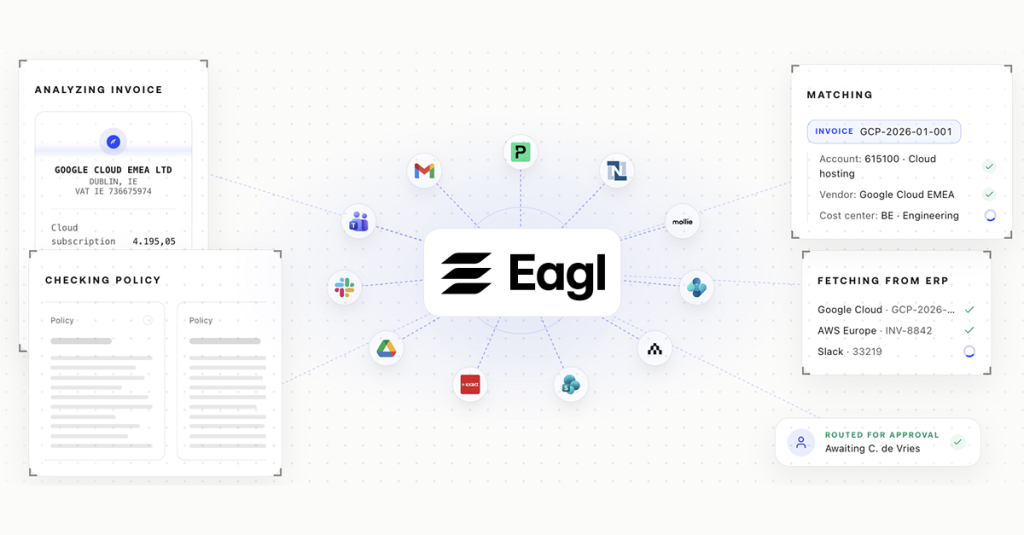
EAGL is an AI-powered accounting platform that sits on top of your ERP and reviews financial data as it is created. Instead of waiting until month-end to find that something was booked to the wrong account, EAGL checks every transaction the moment it posts and flags errors immediately. The idea is simple but powerful: by the time you sit down to close, the books are already right, because the mistakes were caught and corrected throughout the month rather than in a frantic week at the end.
The company behind it, Eagl BV, is based in Gent, Belgium, and aims the product squarely at in-house finance teams running multiple legal entities. That focus matters. Multi-entity close is where reconciliation, intercompany entries and accrual tracking spiral into spreadsheets and late nights. EAGL positions itself as the intelligence layer that keeps books closed faster, with every transaction reviewed and every error caught as it happens. The site cites live counters of anomalies caught and transactions reviewed, which signals an active, working product rather than a concept.
What Are EAGL’s Key Features?
Real-time financial controlling
This is the core. EAGL detects booking errors as they post, not at close. When something lands in the wrong account, against the wrong entity, or breaks an expected pattern, it gets flagged right away. For a finance team, this changes the rhythm of the month: instead of a big error hunt at close, you are correcting small issues continuously. That is the feature that justifies the product, and it is what separates EAGL from a reporting tool that only tells you what already went wrong. The difference is subtle but important. A dashboard tells you the books are wrong after the fact; EAGL tries to stop them from going wrong in the first place. For teams that have lived through a close where a single misposted intercompany entry cascaded into days of rework, continuous controls are the kind of feature that sells itself in the first demo.
Close management
EAGL automates and tracks the tasks that make up a month-end close. You get a structured view of what needs to happen, what is done, and what is blocking, so the close becomes a managed process rather than a shared spreadsheet and a prayer. For multi-entity teams juggling several closes at once, this orchestration layer keeps everyone aligned on status and ownership. It also creates an audit trail, which matters when you need to show how and when each close task was completed. The value here is less about flashy AI and more about turning an informal, tribal-knowledge process into something repeatable that a new team member can pick up.
Bank reconciliation and accruals
The platform uses AI to match bank transactions automatically, taking the grind out of reconciliation. It also manages accruals, tracking them, proposing entries, and reversing them when they should be reversed. Accrual hygiene is one of the quiet sources of close errors, so automating it removes a common failure point. Together, reconciliation and accrual automation target two of the most time-consuming parts of any close.
AI accounting agents and ERP integrations
EAGL runs accounting agents that monitor transactions continuously in the background. It connects to a wide range of systems, including NetSuite, Exact Online, SAP and Microsoft Dynamics, with more than 30 ERP integrations in total. Because it layers on top of your existing ERP rather than replacing it, adoption does not mean ripping out the system of record. On security, EAGL is ISO 27001 certified and GDPR compliant, which is table stakes for handling financial data but reassuring to see stated plainly. The agent model is what gives EAGL its always-on character: rather than a tool you open at close, it is a layer that watches the ledger every day. Because it reads from your ERP rather than replacing it, the system of record stays where your auditors and your team already expect it, which lowers the risk of adopting yet another piece of finance software.
How Much Does EAGL Cost?
EAGL does not publish pricing. There is no pricing page and no self-serve plan. Instead, the site routes you to request a demo or request info, which means cost is quoted based on your situation: how many entities you run, your transaction volume, which ERPs you use, and the size of your finance team. This is normal for finance software sold to mid-market and enterprise teams, but it does mean you cannot size the investment without a sales conversation.
For comparison, the broader financial close software market is firmly in premium territory. Tools like Trintech Adra and Numeric are sold through quotes and land in the thousands of dollars per month for mid-sized organizations, scaling with entities and users. EAGL sits in that same bracket, so expect a premium, custom contract rather than a credit card subscription. The upside of quote-based pricing is that the cost is fit to your scale rather than a one-size plan; the downside is the friction of a sales process and the inability to budget before you talk to someone.
The practical takeaway: EAGL is built for teams where the cost of a slow or error-prone close, in hours and in risk, already justifies a real software budget. If you are a small single-entity business hoping for a cheap monthly plan, this is not that product, and the demo-only model is a clear signal of who it is for.
| Plan | Price | Plan Features | Best For |
|---|---|---|---|
| Custom | Contact sales | Financial controlling, close management, bank reconciliation, accrual management, AI accounting agents, 30+ ERP integrations | Multi-entity finance teams |
Who is EAGL Best For?
Use EAGL if you run an in-house finance team at a multi-entity company and your close is slow, error-prone, or both. If you spend the first week of every month chasing misbookings and reconciling across several entities and ERPs, the real-time controls and close automation are aimed exactly at your pain. Teams already on NetSuite, SAP, Dynamics or Exact Online will find the integration story straightforward, and the multi-entity focus means you are not bending a single-company tool to fit a group structure.
Skip EAGL if you are a small single-entity business with a simple ledger, because the platform is built for complexity you may not have. Skip it too if you need transparent, self-serve pricing and the ability to start today without a sales call, since EAGL is demo-only. And if your finance stack is happy and your close is already fast and clean, the case for adding another layer is weaker.
Best EAGL Alternatives
Numeric
Numeric is a well-regarded financial close management platform known for easy implementation and a clean close workflow. Like EAGL, it is sold through quotes rather than public pricing. Numeric leans into close management and reporting, while EAGL emphasizes catching errors in real time as transactions post. Choose Numeric if structured close orchestration is your priority.
Trintech Adra
Adra by Trintech offers a comprehensive suite for mid-sized organizations, automating reconciliation, close tasks and matching. It is a more established name in the space with a longer track record. It is also enterprise-priced and quote-based. Adra suits teams that want a proven incumbent; EAGL suits teams that want the newer, AI-first approach.
Stacks
Stacks uses AI to automate reconciliations, journal entries and variance analysis, and proactively surfaces discrepancies in complex, multi-entity environments. It overlaps heavily with EAGL on the AI-and-multi-entity angle. Stacks is a strong head-to-head comparison if you are specifically shopping for AI-driven reconciliation and variance work.
Final Verdict: Is EAGL Worth It?
EAGL earns its 8.3 on the strength of its core idea and the breadth of its automation. Catching booking errors the moment they post is the right place to attack the close problem, and pairing that with close management, AI reconciliation, accrual handling and 30-plus ERP integrations makes it a serious tool for multi-entity finance teams. The ISO 27001 and GDPR credentials are the kind of detail finance buyers need to see.
The marks against it are the demo-only pricing and the fact that it is a younger vendor in a category full of incumbents. You cannot quickly compare cost, and you are betting on a newer European company rather than a decades-old name. But for the team it is built for, one running several entities and tired of error-chasing at close, EAGL is well worth a demo. If your close is the bottleneck in your finance function, it belongs on your shortlist alongside Numeric and Stacks. Go in with your entity count, transaction volume and current close timeline ready, and use the demo to pressure-test whether the real-time error detection actually fits how your ledgers behave.
EAGL Pros & Cons
What We Like
- Checks every transaction the moment it posts and flags booking errors before they hit the financials
- Automates and tracks close tasks, bank reconciliation and accruals in one place
- Connects to NetSuite, Exact Online, SAP, Microsoft Dynamics and 30+ other ERPs
- ISO 27001 certified and GDPR compliant, which matters for finance data
What Could Be Better
- No public pricing, so you must book a demo and cannot compare cost quickly
- Aimed at multi-entity finance teams, so overkill for a small single-entity business
- Young European vendor with a shorter track record than incumbent close tools
EAGL FAQ
What is EAGL?
EAGL is an AI accounting platform for multi-entity finance teams. It reviews every transaction as it posts, catches booking errors in real time, and automates close tasks, bank reconciliation and accruals to speed up the month-end close.
How much does EAGL cost?
EAGL does not publish pricing. It is sold through a demo and quote process, so cost is custom and depends on your entities, transaction volume and ERP setup. You request a demo or info to get a number.
Is EAGL worth it?
For multi-entity finance teams drowning in close tasks and error chasing, yes, the real-time controls and automation can pay for themselves in saved hours. Single-entity small businesses will find it more than they need.
What are the best EAGL alternatives?
Numeric for fast close management, Trintech Adra for mid-market close automation, and Stacks for AI-driven reconciliations and journal entries in complex environments.
Does EAGL offer a free plan?
No. EAGL does not offer a free plan or self-serve trial. Access starts with a requested demo, and pricing is custom rather than published.
Who is EAGL best for?
EAGL is best for in-house finance and accounting teams at multi-entity companies that need to close faster, catch errors as they happen, and automate reconciliation and accruals across several ERPs.






