Fetcher Review (2026): Pricing, Features & Honest Verdict
TLDR
Fetcher is an AI candidate sourcing platform that screens profiles across databases and job boards, adds a human review layer, and automates outreach so recruiters can build outbound pipelines faster. We found the human plus AI mix keeps quality higher than pure automation. Best for: mid market teams running continuous sourcing. Price: From $115/mo, Growth $379/mo, no free plan. Rating: 8.2/10.
What is Fetcher?
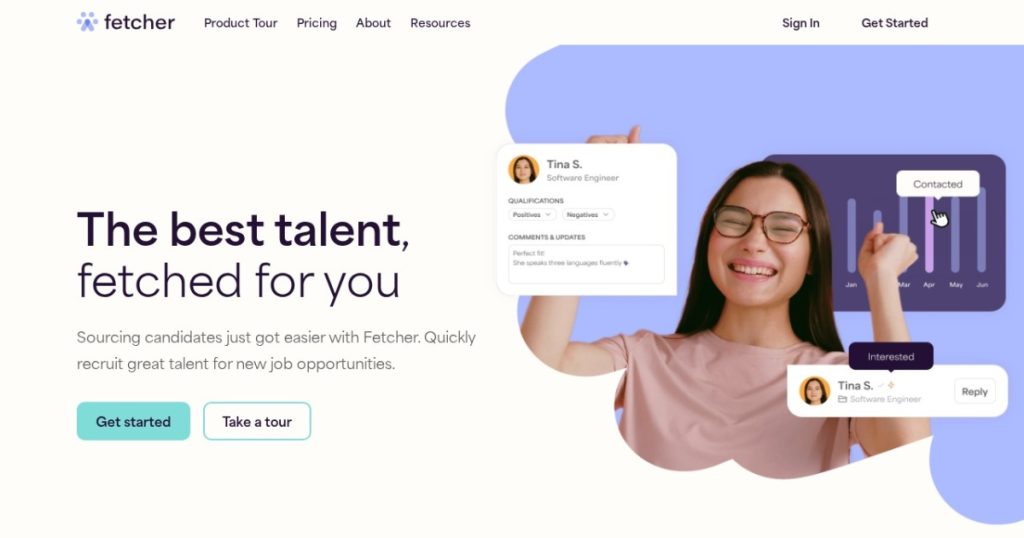
Fetcher is an AI powered recruiting tool that automates talent sourcing and candidate outreach. It works across three jobs: talent sourcing, where AI screens candidates across a 500 million plus profile database combined with expert human review; candidate engagement, where it automates and sequences outreach emails; and analytics, where it tracks recruiting metrics and pipeline performance. The differentiator is the human in the loop. Instead of trusting the algorithm blindly, Fetcher runs a human review pass to weed out profiles that miss the mark before they ever reach your inbox.
The company is based in New York, at 287 Park Avenue South, and is SOC 2 Type 2 certified, which matters when you are piping candidate data through a third party. Its customer list includes Shutterstock, Docker, Deutsche Telekom, Magnite, and Counterpart, a mix that skews toward mid market and growth stage companies rather than tiny startups. We dug into how teams actually use it, and the pattern is clear: it shines for organizations hiring continuously across engineering, product, sales, marketing, operations, and customer success, where a steady stream of outbound sourcing pays for itself.
What Are Fetcher’s Key Features?
AI Sourcing with Human Review
Fetcher’s core is outbound sourcing. The AI screens candidates across job boards and a database of over 500 million profiles, matching them against your role criteria, and then a human review team checks the results before they land in your batch. This two step approach is the reason Fetcher’s shortlists tend to be cleaner than fully automated competitors. It also means you are not just getting a raw algorithmic dump. The tradeoff is that the matching engine leans keyword based, so it can miss strong candidates who describe their experience in different language than your job spec uses.
Automated Outreach and Sequencing
Once you have a batch of candidates, Fetcher automates the outreach. You build email sequences that send on a schedule, follow up automatically, and stop when a candidate replies. For a recruiter juggling dozens of open roles, this removes the grind of manually messaging every prospect and chasing non responders. The sequencing is the feature most users single out as the biggest time saver, and it turns cold outbound into a mostly hands off pipeline. You can personalize templates with candidate details so the messages do not read like a mass blast, and replies route back into your inbox and connected ATS so nothing falls through the cracks. For a lean team, this is the difference between contacting 30 prospects a week and contacting 300.
Diversity Search and Candidate Batches
Fetcher lets you set diversity search criteria so your sourcing can support DEI hiring goals from the top of the funnel. Candidates arrive in reviewable batches, so you approve or reject profiles in bulk rather than one at a time. This batch workflow keeps the review process fast and gives you a feedback loop that, over time, sharpens the matches Fetcher surfaces. For teams with formal diversity targets, having the filter built into sourcing beats bolting it on later.
Integrations and Analytics
Fetcher connects to your ATS, CRM, email, and Slack, so sourced candidates and outreach activity flow into the tools you already run. The analytics layer tracks pipeline metrics like response rates and conversion so you can see which sequences and searches actually produce hires. It is not a deep business intelligence suite, but it gives recruiting leaders enough visibility to justify spend and tune their outbound approach. Because sourced candidates sync straight into your ATS, you avoid the double entry that eats time on teams running multiple disconnected tools. The SOC 2 Type 2 certification is worth noting here too, since it means the data handling has been independently audited, which matters to security conscious buyers.
How Much Does Fetcher Cost?
Fetcher starts at $115 per month for the Self-serve plan, which includes 300 leads per month, one user seat, database access, and basic CRM and analytics. Growth runs $379 per month and adds ATS integration, email outreach tools, and up to 2,500 leads per year with 500 Fetcher sourced candidates. Amplify is $649 per month with 5,000 leads per year, two seats, 1,000 sourced candidates, and a dedicated sourcer covering four to six roles. Enterprise is custom for teams that need 10,000 plus leads and three or more seats. Paying annually cuts all of these rates by about 30%.
Against competitors, that pricing is reasonable but not cheap. Gem and SeekOut, the established leaders, are quote based and typically land in the enterprise range, so Fetcher’s published tiers are actually more transparent than either. On the cheaper end, Apollo.io starts around $49 per month, though it is a sales prospecting tool that happens to do sourcing rather than a purpose built recruiting platform. The $379 Growth tier is the sweet spot for mid market teams, but it gets steep if your hiring is not continuous.
The real catch is the caps. Growth limits you to 500 Fetcher sourced candidates and 2,500 leads per year, and teams doing serious volume hiring will burn through those fast. There is also no self serve trial, so you cannot test the product without committing to at least $115 per month. Budget for the tier above where you think you land, because the annual caps are easier to hit than they look.
| Plan | Price | Plan Features | Best For |
|---|---|---|---|
| Self-serve | $115/mo | 300 leads/mo, 1 seat, 500M+ database access, basic CRM and analytics | Solo recruiters testing outbound |
| Growth | $379/mo | Up to 2,500 leads/yr, 500 Fetcher sourced candidates/yr, ATS integration, email outreach | Mid market teams with steady hiring |
| Amplify | $649/mo | Up to 5,000 leads/yr, 2 seats, 1,000 sourced candidates/yr, dedicated sourcer | Scaling recruiting organizations |
| Enterprise | Custom | 10,000+ leads/yr, 3+ seats, 2,000+ sourced candidates/yr, success team | High volume hiring operations |
Who is Fetcher Best For?
Use Fetcher if you are a mid to large company in a growth phase, hiring continuously across engineering, product, sales, marketing, operations, or customer success, and you want to automate outbound sourcing and outreach without letting candidate quality slip. The human review layer, diversity filters, and outreach sequencing are built for teams that live in the top of the funnel every week. If sourcing is a constant part of your job, Fetcher pays for itself.
Skip Fetcher if your hiring is sporadic or low volume. The monthly cost and annual lead caps only make sense when you are sourcing steadily, and a team filling one or two roles a quarter will not get value from a $115 minimum. The lack of a free trial also makes it a harder first purchase for cautious small teams, who may prefer a cheaper prospecting tool or their ATS’s built in sourcing until volume grows.
Best Fetcher Alternatives
Gem
Gem is the category leader for outbound recruiting, combining sourcing, a candidate CRM, and rich analytics in one platform. Pricing is custom and quote based, and it typically runs in the enterprise range, so it is a bigger commitment than Fetcher’s published tiers. Choose Gem if you want the deepest CRM and reporting and have the budget for it. Fetcher wins on transparency and on the human review layer that keeps its shortlists clean without a large team behind it.
SeekOut
SeekOut offers deep talent search with strong diversity filters and detailed candidate profiles, popular with enterprise talent teams sourcing hard to find technical and specialized roles. Like Gem, its pricing is custom and lands toward the enterprise end. SeekOut goes deeper on search power and profile enrichment, while Fetcher leans on automated outreach plus human review to do more of the work for you. Pick SeekOut when finding rare candidates matters more than automating the outreach.
Apollo.io
Apollo.io is the cheaper, cross functional option, starting around $49 per month with a huge contact database and built in email sequencing. It is built for sales prospecting rather than recruiting, but many small teams use it to source and message candidates on a budget. It lacks Fetcher’s recruiting specific workflows, human review, and ATS depth, so quality control is on you. Choose Apollo if cost is the priority and you are comfortable doing your own vetting.
Final Verdict: Is Fetcher Worth It?
Fetcher earns an 8.2, and it is one of the stronger scores in this category for good reason. The blend of AI sourcing and human review solves the biggest problem with automated recruiting tools, which is quality control, and the outreach sequencing genuinely saves recruiters hours every week. Add solid integrations, SOC 2 Type 2 compliance, and diversity filters built into sourcing, and you have a platform that mid market teams can trust with real hiring pipelines. A 4.6 out of 5 across dozens of G2 reviews backs that up.
What keeps it from a higher score is friction around access and scale. There is no self serve trial, so you commit blind at $115 per month, and the annual lead and sourced candidate caps get hit quickly by high volume teams. The keyword leaning match engine can also miss candidates who phrase their experience differently. Our recommendation: if you source continuously and value quality over raw volume, Fetcher is well worth it. If your hiring is occasional, wait until volume justifies the spend.
Fetcher Pros & Cons
What We Like
- AI screening plus a human review layer keeps the candidate shortlist quality high
- Automated, sequenced email outreach saves recruiters hours of manual messaging
- Solid integrations with ATS, CRM, email, and Slack, plus SOC 2 Type 2 compliance
- Diversity search criteria built into sourcing for teams with DEI hiring goals
What Could Be Better
- No self serve free trial; testing the platform means paying at least $115 per month
- Annual lead and sourced candidate caps get hit fast by serious volume hiring
- Matching leans keyword based, so it can miss candidates who phrase experience differently
Fetcher FAQ
What is Fetcher?
Fetcher is an AI powered candidate sourcing platform. It screens profiles across databases and job boards, adds expert human review to keep quality up, and automates outreach so recruiting teams can build and message outbound talent pipelines faster.
How much does Fetcher cost?
Fetcher starts at $115 per month for the Self-serve plan (300 leads per month). Growth is $379 per month, Amplify is $649 per month, and Enterprise is custom. Paying annually cuts those rates by about 30%.
Is Fetcher worth it?
For mid market teams running continuous outbound sourcing, yes. The human plus AI review keeps quality higher than pure automation, and outreach sequencing saves real time. It earns an 8.2. If your hiring is sporadic, the monthly cost is hard to justify.
What are the best Fetcher alternatives?
Gem (custom priced sourcing and CRM leader), SeekOut (custom priced deep talent search with diversity filters), and Apollo.io (from ~$49/mo, cheaper contact data and outreach with a sourcing bent).
Does Fetcher offer a free plan?
No. Fetcher does not offer a free plan or a self serve trial. You can book a demo, but actually using the platform requires a paid subscription starting at $115 per month.
Who is Fetcher best for?
Mid to large companies in growth phases that hire continuously across engineering, product, sales, marketing, and operations, and want to automate outbound sourcing and outreach without sacrificing candidate quality.






