Gro Review (2026): Pricing, Features & Honest Verdict
What is Gro?
TLDR
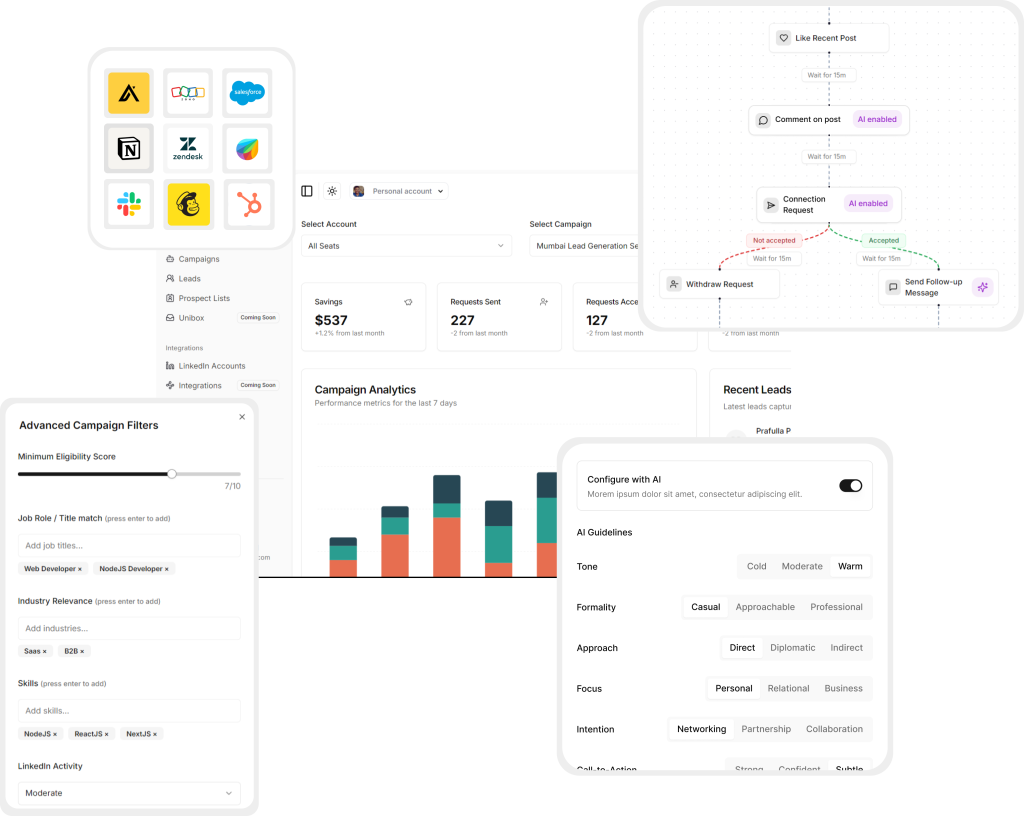
Gro is an AI-powered sales prospecting platform that combines a 1 billion+ contact database, AI propensity scoring, multi-channel outreach automation, and a built-in Social CRM into one tool. Instead of stitching together Apollo for data, Clay for enrichment, and Lemlist for outreach, Gro handles the entire pipeline from lead discovery to email and LinkedIn engagement. Plans start at $49/month with a free tier available. It launched on Product Hunt in February 2026 with 410 votes.
Built by GroundAI, Gro was created by Leo Jiang, a former Chief Digital Officer at Huawei who was named a Global Top 200 CIO. The product originally targeted Asia-based B2B companies expanding globally but now serves a wider market. The positioning is clear: most sales tools either give you data (ZoomInfo), enrichment workflows (Clay), or outreach automation (Lemlist). Gro does all three in one platform at a fraction of the price. The question is whether a new entrant can match the data quality of established players.
What Are Gro’s Key Features?
AI-Powered Lead Discovery
Gro Search pulls from a claimed 1 billion+ contact database combining proprietary datasets, data partners, and real-time enrichment. You search in natural language instead of building Boolean queries or navigating complex filter panels. Describe your ideal customer profile conversationally and Gro surfaces matching leads with verified emails and phone numbers. The database size claim is competitive with Apollo’s 210 million contacts, though independently verifying the “1 billion+” number is not possible. The natural language search is genuinely faster than Apollo’s filter-based interface.
Propensity Scoring with Gro IQ
This is Gro’s strongest differentiator. Gro IQ uses AI to score which accounts are genuinely ready to buy versus those that are window-shopping. It analyzes intent signals, engagement patterns, and timing to recommend when to reach out. The top Product Hunt comment called this feature “a game-changer.” Most competing tools at this price point give you contact data but leave the “who to contact first” decision entirely to you. Gro makes that decision for you based on live signals.
Multi-Channel Outreach Automation
Gro Outreach handles both LinkedIn and email campaigns with AI-generated personalization. The AI co-pilot learns your offerings, your ICP nuances, and your personal messaging style over time. It adapts outreach based on how you position value, rather than just swapping in name tokens. The company claims 30%+ LinkedIn connection rates (vs. 3% industry average) and 10%+ reply rates (vs. 1% average). These numbers are unverified by third parties, but if even half true, the improvement over spray-and-pray automation is significant.
Social CRM
A built-in CRM manages lead tracking and conversion across multiple sales reps and customer segments. It tracks engagement patterns, buying intent, and conversation history without requiring a separate CRM subscription. HubSpot integration is available on the Team plan ($99/month) and above. The limitation: there is no Salesforce, Pipedrive, or other CRM integration. If your team is locked into Salesforce, Gro’s CRM becomes a parallel system rather than a replacement.
Gro starts at $49/month for the Solo plan with 2,000 credits, one LinkedIn account, and one email account. The Team plan at $99/month adds 5,000 credits, five email accounts, HubSpot integration, and support for five team members. Enterprise costs $249/month with 10,000 credits, ten email accounts, and unlimited team members. There is a free tier with 100 credits. Annual billing saves 25%. A promo code PHGRO20 gives 20% off the first three months.
Compared to competitors: Apollo starts at $49/user/month with a similar feature set but a more established database. Clay starts at $720+/month for its enrichment workflows, which is dramatically more expensive. ZoomInfo typically costs $15,000+/year with opaque pricing. Gro’s Team plan at $99/month for five team members is aggressively priced. The catch is the credit system. All search and outreach actions consume credits, and credit economics are not transparently documented. Heavy prospectors on the Solo plan may burn through 2,000 credits quickly.
| Plan | Price | Plan Features | Best For |
|---|---|---|---|
| Freemium | $0/mo | 100 credits, 1 member, basic search and enrichment | Quick testing |
| Solo | $49/mo | 2,000 credits, 1 LinkedIn account, 1 email account, 500 contacts | Solo founders |
| Team | $99/mo | 5,000 credits, 5 email accounts, 5 members, HubSpot integration, 25K contacts | Small sales teams |
| Enterprise | $249/mo | 10,000 credits, 10 email accounts, unlimited members, 30K contacts/seat | Scaling sales orgs |
Who is Gro Best For?
Use Gro if you are a startup founder, small sales team, or agency doing B2B outbound and you are tired of paying for three separate tools. The unified platform genuinely simplifies the prospecting-to-outreach workflow, and the AI propensity scoring adds intelligence that most tools at this price point lack. The 14-day free trial with no payment required makes it easy to test against your specific ICP before committing. Teams currently spending $200+/month across multiple sales tools should benchmark Gro’s $99 Team plan seriously.
Skip Gro if you need Salesforce integration, because it is not available. Skip it if you need independently verified data accuracy. The 1 billion+ database claim has no third-party validation, and there are zero G2 or Capterra reviews as of March 2026. Skip it if you do heavy LinkedIn outreach across multiple reps, because every plan (including Enterprise at $249/month) only includes one LinkedIn account. And be cautious about LinkedIn compliance. While Gro says it follows best practices, LinkedIn automation tools inherently carry account restriction risks that the platform does not explicitly address.
Best Gro Alternatives
Apollo.io is the established B2B sales intelligence platform with 210M+ contacts and built-in email sequences. Plans from $49/user/month. Better if you need a proven, well-reviewed platform with a larger community and more integrations, but it lacks Gro’s AI propensity scoring.
Clay is a data enrichment and outreach platform pulling from 100+ data providers. Plans from $720/month. Better if you need maximum data flexibility and custom enrichment workflows, but dramatically more expensive and requires RevOps expertise to use effectively.
Seamless.AI is a real-time B2B contact search engine focused on simplicity. Custom pricing. Better if you primarily need verified contact data without the outreach automation layer, but it does not include propensity scoring or a built-in CRM.
Final Verdict: Is Gro Worth It?
Gro is an ambitious attempt to consolidate the B2B sales stack into one platform. The AI propensity scoring is a genuine differentiator at this price point, and the unified prospecting-to-outreach workflow eliminates the tool-switching tax that plagues most sales teams. At $99/month for five team members, the pricing undercuts nearly every competitor offering comparable features.
The risks are the risks of any early-stage sales tool. Unverified database claims. No third-party reviews. Limited CRM integrations. One LinkedIn account per plan. These are not dealbreakers for a startup team willing to try something new, but they matter for established sales organizations that need reliability and compliance guarantees. Take the 14-day free trial. Test Gro against your actual target accounts. If the data quality holds up and the propensity scoring delivers on its promise, $99/month for a unified AI sales engine is a strong value proposition. If the data is thin for your market, you will know within the trial period.
Gro Pros & Cons
What We Like
- AI propensity scoring identifies which accounts are ready to buy, a feature most competitors lack at this price
- Unified prospecting, outreach, and CRM eliminates multi-tool stacking and context switching
- Team plan at $99/month for 5 members is aggressively priced vs Apollo, Clay, and ZoomInfo
- 14-day free trial with no payment required, plus 100 free leads on signup
What Could Be Better
- No Salesforce, Pipedrive, or other CRM integration besides HubSpot
- Every plan including Enterprise only includes 1 LinkedIn account per subscription
- Zero G2, Capterra, or TrustRadius reviews as of March 2026, making performance claims unverifiable
Gro FAQ
What is Gro IQ?
Gro IQ is Gro's AI propensity scoring feature. It analyzes intent signals, engagement patterns, and timing to identify which accounts are ready to buy and when to reach out. It helps sales reps prioritize high-probability leads instead of contacting everyone equally.
How big is Gro's contact database?
Gro claims access to 1 billion+ contacts combining proprietary datasets, data partners, and real-time enrichment. This claim has not been independently verified. For comparison, Apollo claims 210 million contacts.
Does Gro integrate with Salesforce?
No. Currently Gro only integrates with HubSpot, available on the Team plan and above. There is no Salesforce, Pipedrive, or other CRM integration available as of March 2026.
Is there a free trial?
Yes. Gro offers a 14-day free trial on all paid plans with no payment information required. You also get 100 free leads upon signup. A promo code PHGRO20 provides 20% off the first three months.
How does Gro compare to Apollo?
Apollo has a larger verified database, more integrations, and extensive third-party reviews. Gro differentiates with AI propensity scoring, a unified platform approach, and lower team pricing. Apollo is the safer choice for established teams. Gro is the value bet for teams willing to try a newer platform.
Who built Gro?
Gro was built by GroundAI, founded in 2024 by Leo Jiang, a former Chief Digital Officer at Huawei who was named a Global Top 200 CIO. The product originally targeted Asia-based B2B companies expanding globally.






