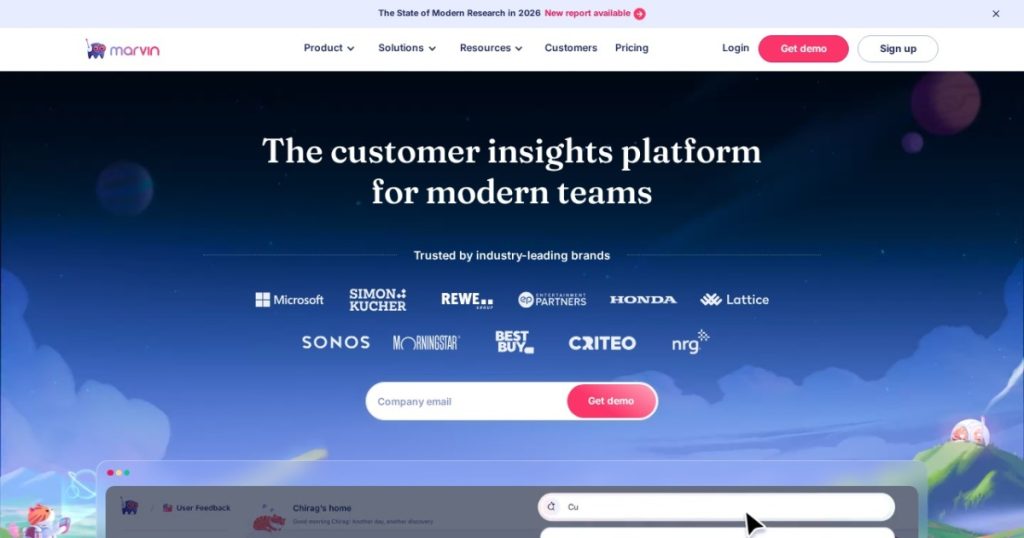
Marvin Review (2026): Pricing, Features & Honest Verdict
TLDR
Marvin is an AI-native research repository that transcribes interviews, automates qualitative analysis, and answers questions across your whole research archive with cited sources. It is excellent and enterprise-leaning, with opaque pricing and a 5-seat minimum on paid plans. Best for: UX research and product teams at growing companies. Price: free plan, paid plans custom. Rating: 8.1/10.
What is Marvin?
Marvin, found at heymarvin.com, is a customer insights platform built around a simple problem: research dies in folders. Interview recordings, survey results, support tickets, and usability notes scatter across drives and tools, and six months later nobody can answer what customers actually said. Marvin pulls all of it into one searchable repository, transcribes and tags it, and layers AI analysis on top so teams can query years of research in seconds. Do not confuse it with Amazing Marvin, the to-do list app; this Marvin is a serious research tool used by Microsoft, Best Buy, Honda, and Sonos.
The company was co-founded by CEO Prayag Narula, a published HCI researcher who previously co-founded the sales intelligence company LeadGenius, and it positions itself as the first AI-powered research repository. That early AI bet shows: while competitors bolted AI summaries onto existing repositories, Marvin built citation-backed AI search and AI-moderated interviews into the core product. It holds a 4.8/5 rating on G2 and carries SOC 2, ISO 27001, ISO 42001, HIPAA, and GDPR compliance, which explains the enterprise logos. We dug into what it does well and where the model gets expensive.
What Are Marvin’s Key Features?
Knowledge Hub: one home for all research
The repository is the foundation. Marvin ingests interview recordings, notes, surveys, and documents through 30+ native integrations, including Zoom, Google Drive, Slack, Salesforce, Notion, Miro, Figma, and Confluence on higher tiers, plus survey tools like SurveyMonkey and Qualtrics. Everything gets transcribed, time-stamped, and taggable. The point is institutional memory: when a PM asks what enterprise users said about onboarding last year, the answer is a search away instead of an archaeology project. Anonymous viewer access means stakeholders outside the research team can browse findings without burning a paid seat, a small detail that matters a lot given the 5-seat pricing model.
Ask AI with point-level citations
This is the feature that separates Marvin from generic AI note-takers. Ask AI answers natural-language questions across your entire repository and cites the exact moments in transcripts that support each claim, so you can click through and verify. That traceability matters because qualitative insights without sources are just opinions. The honest caveat from user reviews: ask a question your data cannot answer and the AI will sometimes answer anyway. G2 reviewers note it can invent findings, so treat outputs as a draft to verify, not a verdict. The citations make that verification fast, which is exactly why they matter.
AI-moderated interviews in 40+ languages
Marvin can run interviews for you: an AI moderator asks your questions, probes on answers, and handles sessions in more than 40 languages, with automatic transcription and analysis afterward. For teams that need 50 customer conversations and have bandwidth for 5, this is the difference between doing the research and skipping it. The free plan includes 5 AI-moderated interviews; paid plans make them unlimited, which is unusually generous for the category. AI moderation will not match a skilled human interviewer on follow-up depth, but for screener-style and feedback interviews it gets you 80% of the value at a fraction of the calendar cost.
Analysis Studio and insight distribution
Analysis Studio handles mixed-methods qualitative work: tagging, affinity mapping, and synthesis across studies. When you have findings, Marvin pushes them out through Slack digests, Salesforce, curated playlists of video clips, and AI-generated presentations. That last mile is underrated. Research that never leaves the research team changes nothing, and Marvin is clearly designed by people who know stakeholders watch a 90-second highlight reel before they read a report.
How Much Does Marvin Cost?
Marvin starts free, and after that it gets vague. The free plan is genuinely free forever: 5 files per month, recordings up to 40 minutes, 5 AI-moderated interviews, the core repository, and Google Drive integration, with no credit card required. Exceed the limits and your account pauses until next month. It is a real working taster, not a crippled demo.
Paid plans are where transparency ends. Standard and Enterprise are both custom-priced, billed annually, and require a minimum of 5 users. Standard adds unlimited storage, 2-hour recordings, unlimited AI-moderated interviews, and the broader integration set, with a 7-day trial. Enterprise adds unlimited recording length, repository-wide Ask AI, SSO via Google, Microsoft, Okta, or SAML, granular access controls, white-labeling, and a dedicated success manager, with a 15-day trial. Nonprofits get 50% off. G2 reviewers consistently flag cost as a complaint, which tells you these contracts are not cheap.
Compare that to the competition and the positioning is clear. Dovetail publishes pricing from $29-$39 per user per month with a free plan. Condens starts around $15 per user per month. Looppanel starts around $30 per month. Marvin’s 5-seat minimum on an annual custom contract means a realistic floor in the thousands per year, so it is competing on capability and compliance, not price. If you need HIPAA or ISO 42001 (the AI management standard, which is rare in this category), that calculus can still favor Marvin.
| Plan | Price | Plan Features | Best For |
|---|---|---|---|
| Free | $0 | 5 files/mo, 40-min recordings, 5 AI-moderated interviews, Google Drive integration only | Solo researchers testing the workflow |
| Standard | Custom (annual) | Unlimited storage and AI interviews, 2-hour recordings, more integrations, 5-user minimum, 7-day trial | Research teams building a shared repository |
| Enterprise | Custom (annual) | Unlimited recording, repository-wide Ask AI, SSO (Okta/SAML), granular access control, dedicated CSM, 15-day trial | Large orgs with compliance and scale needs |
Who is Marvin Best For?
Use Marvin if:
- You run a research or product team of 5+ doing continuous customer interviews and need one searchable source of truth.
- You want AI analysis you can audit: cited answers beat black-box summaries for anything that informs roadmap decisions.
- You operate in healthcare or other regulated spaces where HIPAA and ISO certifications are table stakes.
- You need to scale interview volume with AI moderation across languages and time zones.
Skip Marvin if:
- You are a solo researcher or a startup of three. The free plan will run out fast, and the 5-seat paid minimum is a wall. Condens or Dovetail will serve you for a fraction of the cost.
- You want predictable, published pricing you can expense without a sales call.
- You expect the AI to do the thinking. Users report it needs human review, especially on nuanced or thin data.
The pattern we found across reviews is consistent: teams that already run a steady research practice love Marvin, because it removes the synthesis bottleneck. Teams hoping a tool will create a research culture for them end up paying for shelf-ware. Buy it to accelerate research you are already doing, not to start.
Best Marvin Alternatives
Dovetail
Dovetail is the research repository category leader, with polished analysis tools, strong AI summarization, and transparent pricing: a free plan, then roughly $29-$39 per user per month for Professional. It is the safer default for most teams and far easier to buy. Marvin counters with AI-moderated interviews, deeper citations in AI answers, and stronger compliance certifications. Note that Dovetail’s per-seat costs climb quickly as contributor counts grow.
Condens
Condens is the value pick for UX research repositories, starting around $15 per user per month with team plans in the $190-$450 per month range. It covers transcription, tagging, affinity mapping, and shareable artifacts without the enterprise overhead. You give up Marvin’s AI-moderated interviews and Ask AI depth, but for small and mid-size research teams the price-to-capability ratio is hard to argue with.
Looppanel
Looppanel is the AI-first interview analysis tool, starting around $30 per month. It focuses on call recording, transcription in 17+ languages, and fast AI-generated notes and themes rather than a full enterprise repository. Pick Looppanel if your bottleneck is analyzing interviews quickly; pick Marvin if you need the long-term institutional memory layer across all research methods.
Final Verdict: Is Marvin Worth It?
Marvin earns its 8.1/10. The product vision is right: research should be one queryable, citable body of knowledge instead of a folder graveyard, and Marvin executes that better than almost anyone. Ask AI with point-level citations is the most trustworthy implementation of AI research search we have seen in this category, AI-moderated interviews meaningfully expand how much research a small team can run, and the compliance stack (SOC 2, ISO 27001, ISO 42001, HIPAA) makes it one of the few tools here that enterprise security teams approve without a fight.
The friction is commercial, not technical. Custom pricing, annual billing, and a 5-seat minimum mean Marvin effectively starts at an enterprise-shaped contract, and G2 reviewers confirm it is priced accordingly. Our recommendation: teams of 5 or more doing regular research should take the trial seriously, because the time saved on synthesis alone can justify the contract. Smaller teams should use the free plan to learn the workflow, then graduate to Condens or Dovetail until headcount and budget catch up.
Marvin Pros & Cons
What We Like
- Ask AI answers questions across your whole repository with point-level citations, so insights stay traceable
- AI-moderated interviews in 40+ languages with automatic transcription cut analysis from weeks to hours
- 30+ native integrations (Zoom, Slack, Salesforce, Figma, Notion) make it a true single source of truth
- Serious compliance posture: SOC 2, ISO 27001, ISO 42001, HIPAA, and GDPR
What Could Be Better
- No public pricing and a 5-user minimum on paid plans, with users on G2 calling it expensive
- The AI can overreach: users report it sometimes invents answers when the data is not there, requiring manual review
- Free plan caps at 5 files a month and pauses your account if you exceed limits
Marvin FAQ
What is Marvin?
Marvin (at heymarvin.com) is an AI-native research repository and customer insights platform. It records and transcribes interviews, helps tag and analyze qualitative data, and lets teams query their entire research archive with an AI that cites its sources. It was co-founded by CEO Prayag Narula, who previously co-founded LeadGenius.
How much does Marvin cost?
Marvin has a free plan (5 files per month, 40-minute recordings, 5 AI-moderated interviews). Paid Standard and Enterprise plans are custom-priced, billed annually, and require a minimum of 5 users. Registered nonprofits get 50% off. Expect a meaningful annual contract rather than a cheap per-seat subscription.
Is Marvin worth it?
For research teams of 5+ doing regular customer interviews, yes: the AI analysis, cited search, and 30+ integrations genuinely compress weeks of synthesis work. For solo researchers or small startups, the free plan is a nice taster but the jump to a custom 5-seat contract is steep, and Dovetail or Condens will be cheaper.
What are the best Marvin alternatives?
Dovetail is the category leader, from $29-$39 per user per month with a free plan. Condens is the budget-friendly repository, starting around $15 per user per month. Looppanel is the AI-first interview analysis option, starting around $30 per month.
Does Marvin offer a free plan?
Yes. The free plan is free forever with no credit card and includes 5 files per month, recordings up to 40 minutes, 5 AI-moderated interviews, and the core repository with Google Drive integration. Exceed the limits and the account pauses until the next month.
Who is Marvin best for?
UX researchers, product managers, and insights teams at mid-size to enterprise companies who run continuous customer research and need one searchable home for it. Customers include Microsoft, Best Buy, Honda, and Sonos. Small teams on tight budgets should look at Condens or Dovetail first.






