Integrity Review (2026): Pricing, Features & Honest Verdict
TLDR
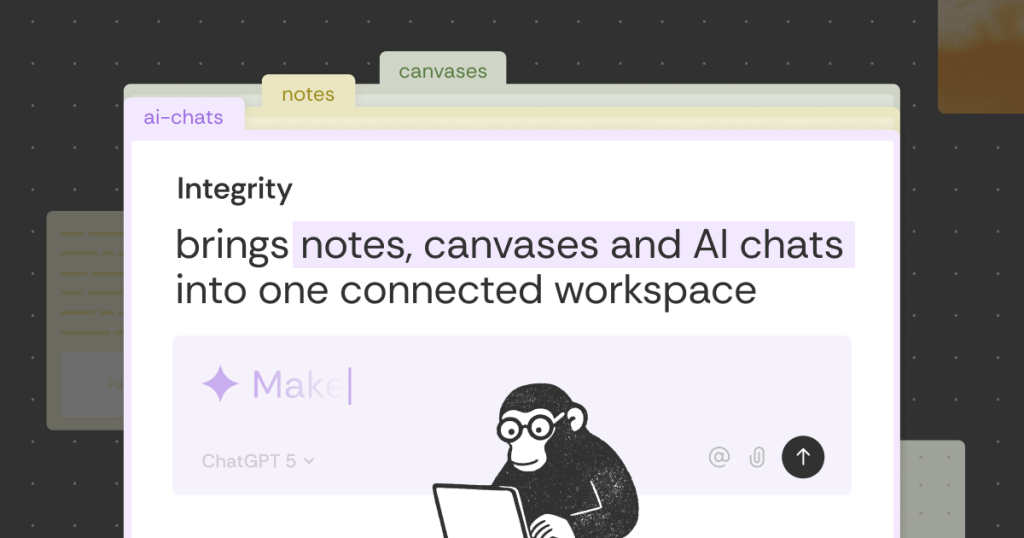
Integrity is a unified workspace that merges notes, visual canvases, and multi-model AI chat into one project tree. It aims to replace switching between Notion, Miro, and ChatGPT. Best for: freelancers and students who want simple organization with built-in AI. Price: Free (limited), Premium at $12/month. Rating: 6.7/10
What is Integrity?
We found Integrity through Product Hunt’s weekly leaderboard where it earned 626 upvotes in September 2025. Built by a creator named Alesia, Integrity is a unified project workspace that combines three surfaces into one environment: structured text notes, freeform visual canvases, and AI chat conversations. The key idea is that these surfaces are interconnected layers within a single project tree, not separate apps bolted together.
You can draft notes, expand them visually on a canvas, then push content into AI to generate polished summaries, tables, or copy. The AI conversations inherit full workspace context, which means the AI is grounded in your actual project content rather than operating in isolation.
Key Features
Universal Blocks
Text, images, tables, notes, and AI chats all coexist on every surface. Drag and drop blocks between notes, canvases, and AI chats without friction. This eliminates the copy-paste workflow that happens when you use Notion for docs, Miro for visual thinking, and ChatGPT for AI assistance separately.
One Tree, Infinite Branches
A single project tree in the sidebar organizes notes, canvases, and AI chats together. Sidebar transparency lets you preview content without opening pages. The structure stays clean even as projects grow, which is a common pain point with tools like Notion where nested pages become unnavigable.
Multi-Model Contextual AI
Supports ChatGPT, Claude, and Gemini. You can switch models mid-conversation without losing context. More importantly, AI responses are grounded in your workspace content through “contextual grounding,” which reduces hallucinations by citing your actual notes and sources rather than generating from general knowledge.
Visual Canvases
Freeform spatial layouts for brainstorming, mind mapping, and visual project planning. Unlike standalone whiteboard tools, canvas blocks connect directly to your notes and AI conversations. Move a sticky note from a canvas into a document, and the content transfers with it.
Pricing
- Free: Limited to 5 workspaces, 100 AI requests per month, no AI-powered search.
- Premium: $12/month. Unlimited workspaces, more AI requests, AI-powered search across all content.
The pricing is straightforward and affordable. At $12/month, Integrity costs less than Notion AI ($10/month add-on) and significantly less than combining separate tools. But the free tier is quite limited with only 5 workspaces and 100 AI requests.
| Plan | Price | Plan Features | Best For |
|---|---|---|---|
| Free | $0 | 5 workspaces, 100 AI requests/month | Trying the concept |
| Premium | $12/month | Unlimited workspaces, more AI requests, AI search | Freelancers and students |
Who is Integrity Best For?
Freelancers and students who want simple organization with built-in AI without managing multiple tools. Researchers connecting ideas across documents and visual boards. Small project teams that need notes, canvases, and AI in one place. Anyone tired of switching between Notion, Miro, and ChatGPT for different aspects of the same project.
Pros
- Genuinely unified workspace where notes, canvases, and AI chat share context
- Multi-model AI support (ChatGPT, Claude, Gemini) with contextual grounding
- Affordable at $12/month compared to stacking separate tools
- Fast, snappy frontend that reviewers praised on launch day
Cons
- Still in open beta with several features marked “coming soon”
- Limited integrations (no Notion or Miro import yet)
- Free tier is restrictive with only 5 workspaces and 100 AI requests
- Cannot replace Notion or ChatGPT individually for power users
Alternatives
Notion
The dominant workspace for documents, databases, and project management. Notion AI adds GPT-powered assistance. Far more mature with hundreds of integrations, templates, and a massive community. But AI is an add-on, not a core surface, and there are no visual canvases. If you need serious project management, Notion wins. If you want AI-native visual thinking, Integrity offers something Notion does not.
Miro
The leading visual collaboration platform for teams. Excellent for whiteboarding, workshops, and visual planning. No built-in AI chat or document editing. If your work is primarily visual and collaborative, Miro is better. Integrity is better when you need documents and AI alongside the canvas.
Taskade
An AI-powered workspace for teams that combines tasks, notes, and AI chat. More focused on task management and team collaboration than Integrity’s research/thinking orientation. Taskade is better for project execution. Integrity is better for project thinking and exploration.
FAQ
Can Integrity replace Notion?
Not yet. Integrity lacks databases, advanced templates, extensive integrations, and the mature ecosystem that makes Notion powerful. It works as a complement for projects where visual thinking and AI grounding matter, but it is not a full Notion replacement.
Which AI models does it support?
ChatGPT, Claude, and Gemini. You can switch between them mid-conversation. The contextual grounding feature works across all three models.
Is my data secure?
Data is stored on their servers. There is no self-hosting option. The platform is still in beta, so detailed security documentation and compliance certifications are not yet available.
Verdict
Integrity has a compelling vision: one workspace where notes, visual canvases, and AI chat are truly interconnected rather than separate tools duct-taped together. The multi-model AI with contextual grounding is the standout feature. But the product is still in open beta with key features marked “coming soon,” limited integrations, and no import path from existing tools. The $12/month price is right, and the fast frontend makes it pleasant to use. If you are a freelancer, student, or researcher who wants to combine visual thinking with AI-assisted writing in one place, Integrity is worth trying. Just know that it cannot yet replace your existing tools, only complement them. Check back in six months when more features ship.
Integrity Pros & Cons
What We Like
- Genuinely unified workspace where notes, canvases, and AI share context
- Multi-model AI support (ChatGPT, Claude, Gemini) with contextual grounding
- Affordable at $12/month compared to stacking separate tools
- Fast, snappy frontend praised by reviewers
What Could Be Better
- Still in open beta with key features marked coming soon
- Limited integrations and no import from Notion or Miro
- Free tier is restrictive with only 5 workspaces
- Cannot replace Notion or ChatGPT individually for power users
Integrity FAQ
Can Integrity replace Notion?
Not yet. Lacks databases, advanced templates, and integrations. Works as a complement for projects needing visual thinking and AI grounding.
Which AI models does it support?
ChatGPT, Claude, and Gemini. You can switch between them mid-conversation with contextual grounding across all three.
Is my data secure?
Data is stored on their servers with no self-hosting option. Detailed security documentation is not yet available during beta.
What is Integrity?
Unified workspace merging notes, visual canvases, and multi-model AI chat into one project tree. Aims to replace switching between Notion, Miro, and ChatGPT.
How much does Integrity cost?
Integrity pricing starts at $12/month. A free plan is available.
Is Integrity worth it?
Integrity has a compelling vision of unified notes, canvases, and AI chat. The contextual grounding is the standout feature. But still in beta with limited integrations and missing features. Worth trying for freelancers and researchers, but cannot yet replace existing tools. We rate it 6.7/10.






