Kompyte Review (2026): Pricing, Features & Honest Verdict
TLDR
Kompyte is Semrush’s competitive intelligence platform. It tracks rivals across hundreds of public sources, filters the noise with AI, and pushes always current battlecards into your CRM. Cheaper and faster to deploy than Crayon or Klue, with some rough edges. Best for: B2B sales and product marketing teams with 10 or more reps. Price: Custom pricing, entry deals reported near $3,600 per year. Rating: 7.8/10
What is Kompyte?
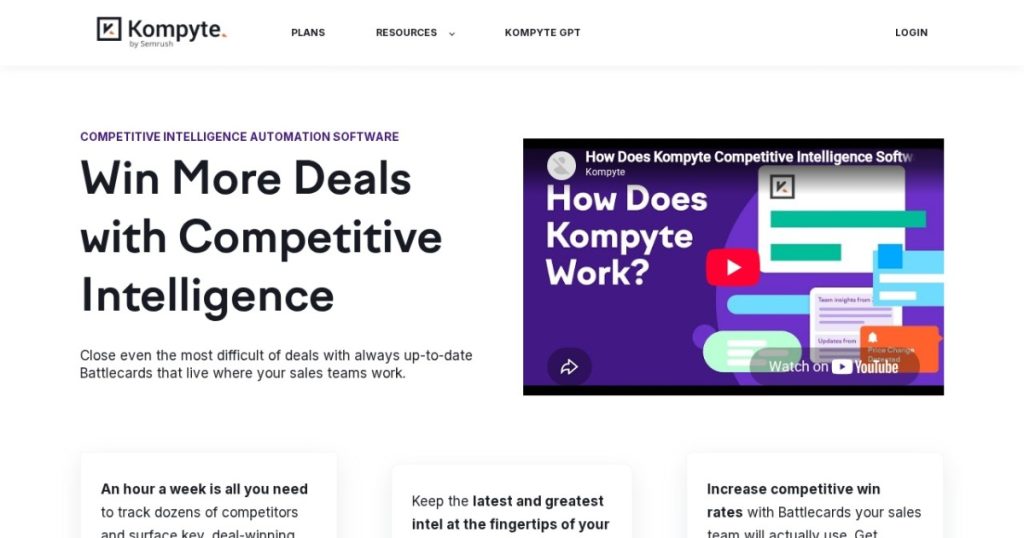
Kompyte is competitive intelligence and sales battlecard software. It watches the companies you sell against across their public digital footprint: website and product page changes, pricing updates, review site activity, blog and content output, social posts, paid ads, app store listings and job postings. An AI layer filters what it collects, scores what matters, and delivers a daily summary. The output that reps actually touch is the battlecard: a living page of positioning, objection handling and proof points that updates itself when a competitor moves. Kompyte’s own claim is that a week of competitive research collapses into about an hour.
The company was founded in 2014 and built its business in Austin, Texas. Semrush acquired it in February 2022, in a deal Semrush explained partly by the fact that 88% of Kompyte’s users sat in sales organisations rather than marketing. That acquisition is the most important thing to understand about the product today. Kompyte is now the sales enablement arm of a large SEO and market intelligence company, which means it is well funded, integrated into a bigger data business, and can be bundled with an existing Semrush contract. We dug into how it stacks up against the two category leaders, and the short version is that Kompyte competes on speed and price rather than on depth. It is not trying to be the most thorough intelligence archive in the market. It is trying to get a working battlecard in front of a rep before the deal closes.
What Are Kompyte’s Key Features?
Automated competitor tracking
Kompyte assigns each competitor a set of tracked sources and then monitors them continuously. It claims coverage across hundreds of source types and millions of data points, including things most teams forget to check manually: job postings that reveal a rival’s roadmap, review site responses that reveal their weak spots, and ad creative that reveals their new messaging. Setup is the standout here. Buyers report Kompyte is usable in one to two weeks, against the seven to eight weeks typically quoted for Crayon and Klue. For a team that needs intel before next quarter’s board meeting, that difference is not cosmetic.
AI filtering and daily digests
Raw monitoring produces junk. Kompyte’s AI layer classifies each detected change, discards trivia and surfaces the updates that plausibly affect a deal, then packages them into a daily or weekly digest delivered to Slack, Teams or email. Kompyte argues its models have the longest training history in the category because the company has been doing this since 2014. In practice the filtering is good on structured content like pricing pages and release notes. Users report it is less reliable on long, unstructured text, where the AI summary can miss the point of a page entirely. Expect to spot check rather than trust blindly. The digest is still the fastest way we have seen to keep a whole sales floor loosely informed without anyone reading a competitor blog.
Battlecards that stay current
This is the reason to buy Kompyte. Battlecards are built once, then wired to the monitoring feed so a competitor’s pricing change flows into the relevant card without anyone rewriting it. Cards are delivered where reps already work through integrations with HubSpot, Salesforce, Slack, Microsoft Teams, Google Drive, OneDrive, Highspot and Showpad, and Kompyte includes those integrations rather than charging separately for them the way buyers report Crayon and Klue do. You can also track card usage, which tells you which competitors your reps are genuinely afraid of.
Win/loss analysis
Kompyte ties competitive intelligence back to revenue with win/loss reporting: how often each competitor shows up in your pipeline, what your win rate against them is, and how much competitive revenue is at stake. It goes further through a partnership with IcebergIQ, which runs actual customer interviews so the win/loss data includes human reasoning rather than only CRM checkboxes. That combination of automated monitoring plus real interview data is unusual at this price point, and it is what makes the platform defensible against cheaper monitoring tools.
How Much Does Kompyte Cost?
Kompyte does not publish a rate card. There is no self serve tier and no public price points, so every deal is a custom annual contract negotiated with sales. Third party procurement sources put entry deals around $3,600 per year, with mid tier deployments landing roughly in the $7,200 to $15,000 range and enterprise contracts going higher. The variables are the number of competitors you track, the number of licences, and whether you need SSO and advanced permission management. Annual billing is standard, and shorter subscription terms carry a premium.
That positioning is the whole pitch. Crayon typically runs $25,000 to $50,000 per year and Klue starts near $16,000 and climbs past $30,000 for a full rollout. Kompyte consistently wins price sensitive procurement because it delivers the same core motion, automated monitoring plus battlecards in the CRM, for a fraction of that. If your company already pays for Semrush, Kompyte can be added onto the existing relationship, which lowers the effective cost further and removes a separate vendor review. For teams already running Semrush for keyword and traffic research, that bundle is the single strongest argument for choosing Kompyte over Klue.
The catch is the shape of the pricing. Users report that Kompyte charges incrementally for additional tracked competitors and for extra people who need battlecard access, so a cheap entry number can grow as adoption spreads. Model the full second year, not the first invoice. Scope how many competitors you will realistically add and how many reps will need to open a card, then get both priced up front rather than discovering them at renewal.
| Plan | Price | Plan Features | Best For |
|---|---|---|---|
| Custom | Contact sales | Annual contract priced by competitors tracked, licences and SSO/permissions; entry deals reported near $3,600/yr | B2B sales and product marketing teams that want battlecards without an enterprise budget |
Who is Kompyte Best For?
Use Kompyte if you have a sales team of roughly 10 reps or more, you sell against a defined set of named competitors, and you want battlecards in the CRM without a five figure commitment and a two month implementation. This is the sweet spot. Mid market B2B software companies with a product marketer who owns competitive intelligence as one of several responsibilities will get more done here than on a heavier platform they cannot maintain.
It is also a strong pick if you already run Semrush, because the commercial conversation is simpler and the data sits in the same family. And it suits teams whose main pain is speed: you can be live in a fortnight. That matters when a new competitor appears mid quarter and your reps are already losing deals to them.
Skip Kompyte if:
- You need multilingual intelligence. Kompyte does not automatically translate non English sources, which is a real blind spot for global programs.
- You need deep, precise search across a large intel archive. Users report filtering and search are not robust, and the taxonomy is shallow enough that relevant updates can get buried.
- You want conversational AI over your intelligence data. There is no chat interface for ad hoc questions, so exploration is manual.
- You expect a contact database or buyer intent data. Kompyte tells you what competitors are doing, not who to call about it. That is a different product.
- Your competitive program needs primary research, analyst commentary or heavy custom automation built by the vendor.
Best Kompyte Alternatives
Crayon
Crayon is the breadth leader. It monitors more than 100 competitor data types and its capture volume is the widest in the category, which makes it the better choice if you want a cross functional intelligence program that product and leadership consume, not just a sales enablement layer. Its win/loss and influenced revenue reporting is more mature too. You pay for it: typically $25,000 to $50,000 a year, plus a reported 15% to 30% for integrations and services, plus a seven to eight week onboarding. Crayon also has a well documented noise problem, so you need someone to curate daily.
Klue
Klue is the battlecard specialist and the strongest direct competitor to Kompyte’s core use case. On G2 comparisons its battlecard quality scores highest among dedicated competitive intelligence tools, and teams that are serious about arming reps mid deal tend to land here. Pricing is quote based and starts around $16,000 a year, rising past $30,000 for a full deployment, so it is roughly four times Kompyte’s entry point. Buy Klue if battlecard quality and rep adoption are worth that premium. Buy Kompyte if the budget has to be justified quarter by quarter.
Contify
Contify goes wider than direct competitors, covering markets, customers, partners and regulatory news, and its business taxonomy for filtering and tagging is stronger than Kompyte’s. If your reported weakness is search and structure across a large intel archive, that is exactly the gap Contify fills. Pricing is custom and quote based, with flat fee models available that can beat per seat pricing when you have a large internal readership. It is much less focused on sales enablement, so battlecards in the CRM are not where it shines.
Final Verdict: Is Kompyte Worth It?
Kompyte earns a 7.8, and the score is about value rather than raw capability. It does the two things that matter in competitive intelligence, continuous automated monitoring and battlecards delivered where reps work, at roughly a quarter of what Crayon and Klue charge. It ships in one to two weeks instead of two months, it includes its integrations instead of billing for them, and the IcebergIQ win/loss partnership gives you human reasoning behind the numbers. Semrush ownership means it is not going anywhere.
The gaps are real and you should go in knowing them: no automatic translation of non English sources, search and filtering that users describe as thin, an AI summary that wobbles on unstructured text, and a pricing model that charges you again for every competitor and viewer you add. None of that is disqualifying for a mid market B2B team with a defined competitive set. Get the second year priced before you sign, and Kompyte is the best value in competitive intelligence right now.
Kompyte Pros & Cons
What We Like
- Roughly a quarter the cost of Crayon or Klue, with entry deals reported near $3,600 per year
- Live in one to two weeks versus the seven to eight weeks buyers report for Crayon and Klue
- Integrations with Salesforce, HubSpot, Slack, Teams, Highspot and Showpad are included rather than billed as extras
- Win/loss analysis is backed by real customer interviews through the IcebergIQ partnership
What Could Be Better
- No automatic translation of non English sources, a real blind spot for global competitive programs
- Search, filtering and taxonomy are shallow, so relevant updates can get buried in long lists
- Pricing charges incrementally for extra tracked competitors and extra battlecard viewers, so the entry number climbs with adoption
- AI summaries are inconsistent on long or unstructured text and need spot checking
Kompyte FAQ
What is Kompyte?
Kompyte is a competitive intelligence and sales battlecard platform owned by Semrush. It automatically monitors competitors across hundreds of public sources including websites, pricing pages, reviews, ads and job posts, then delivers AI filtered updates and self updating battlecards into your CRM.
How much does Kompyte cost?
Kompyte does not publish pricing. Contracts are custom and annual. Third party procurement sources report entry deals near $3,600 per year, mid tier deployments around $7,200 to $15,000, and enterprise contracts higher. Price scales with tracked competitors, licence count and whether you need SSO.
Is Kompyte worth it?
Yes for mid market B2B teams. It covers the core competitive intelligence job at roughly a quarter of Crayon or Klue's price and deploys in two weeks. Just price the second year first, because extra competitors and extra battlecard viewers cost more.
What are the best Kompyte alternatives?
Crayon is the breadth leader with the widest data collection at $25,000 to $50,000 a year. Klue has the best battlecards in the category, starting near $16,000 a year. Contify covers broader market and regulatory intelligence with custom, often flat fee pricing.
Does Kompyte offer a free plan?
No. There is no free plan and no self serve tier. Every Kompyte deal is a sales led annual contract, so you need a demo and a quote to get access. Existing Semrush customers can add it to their current contract.
Who is Kompyte best for?
B2B software companies with roughly 10 or more sales reps, a defined set of named competitors, and a product marketer who owns competitive intelligence part time. It is especially good for teams already paying for Semrush.






