Lexical Review (2026): Pricing, Features & Honest Verdict
TLDR
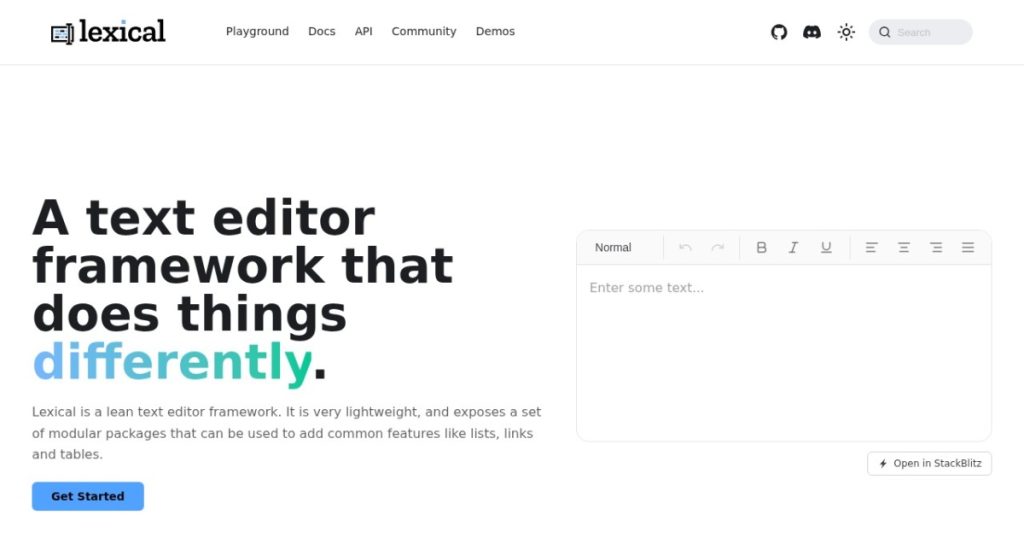
Lexical is Meta’s open-source text editor framework designed for React with a focus on accessibility and extensibility. Best for: React developers building accessible editors. Price: free and open source. Rating: 7.6/10
What is Lexical?
Lexical is an extensible text editor framework created and maintained by Meta (Facebook). It powers editing experiences across Meta’s products and was open-sourced to give the wider developer community access to the same foundation. Unlike older approaches like Draft.js (also from Meta), Lexical was built from scratch with modern patterns, accessibility, and performance as first-class concerns.
The framework provides a minimal core that handles the document model, selection, and input. Everything else, from rich text formatting to tables to collaboration, comes through a plugin system. This keeps the core lightweight while letting developers compose exactly the features they need.
Key Features
React-First Architecture
Lexical was designed with React in mind from day one. It uses React’s reconciliation model and integrates naturally with React components and hooks. If your app is built with React, Lexical fits in without friction. The editor state updates work with React’s rendering cycle rather than fighting against it.
Plugin System
Everything beyond basic text input is a plugin. Lexical ships with official plugins for rich text, lists, links, tables, code highlighting, and more. The plugin API is straightforward: plugins are React components that hook into the editor state. Building custom plugins follows familiar React patterns.
Accessibility
Lexical takes accessibility seriously in ways that most editor frameworks do not. It handles ARIA attributes, keyboard navigation, and screen reader announcements at the framework level. You get accessible editing behavior by default rather than having to bolt it on after the fact.
Collaboration Support
Lexical includes a Y.js binding for real-time collaborative editing. Multiple users can edit simultaneously with conflict-free merging. The collaboration plugin works with any Y.js provider, so you can use hosted solutions or self-host your own sync server.
Markdown Support
Built-in Markdown shortcuts let users type Markdown syntax that converts to rich text automatically. The framework also supports serializing to and from Markdown, making it easy to store content in a portable format while offering a rich editing interface.
Pricing
Lexical is completely free and open source under the MIT license. There is no paid tier, no cloud service, no premium features behind a paywall. Meta maintains it as a public good for the developer community. You are responsible for hosting any collaboration infrastructure yourself.
Pros
- Completely free and open source with no paid tiers or restrictions
- React-first design integrates naturally with React applications
- Accessibility handled at the framework level, not bolted on
- Backed by Meta with active development and production use at scale
- Lightweight core with a clean plugin architecture
Cons
- React-centric design makes it harder to use with other frameworks
- Younger ecosystem with fewer community plugins than Tiptap or CKEditor
- Documentation has gaps, especially for advanced customization
- No hosted collaboration service means you must manage your own infrastructure
| Plan | Price | Plan Features | Best For |
|---|---|---|---|
| Open Source | Free | Full framework, all plugins, MIT license, no restrictions | All developers and teams |
Who Should Use Lexical?
Lexical is the right choice for React developers who want a modern, accessible editor framework with Meta’s engineering backing. If accessibility compliance matters for your product (and it should), Lexical gives you the strongest starting point. Teams already using React will find the plugin system intuitive since it follows familiar React component patterns.
If you are not using React, or if you need a ready-made editor with minimal setup, Lexical is not the right fit. The framework assumes React knowledge and requires real development effort to build a complete editing experience.
Alternatives
Tiptap
Tiptap is a headless rich text editor built on ProseMirror that supports React, Vue, and vanilla JS. It has a more mature ecosystem with a larger extension library. Tiptap also offers a paid cloud service for collaboration, which Lexical does not. Choose Tiptap if you need framework flexibility or want hosted collaboration.
Slate
Slate is another React-focused editor framework that predates Lexical. It offers similar flexibility with its own document model and plugin system. Slate has been around longer and has a larger community, but has gone through major API changes that frustrated some developers.
Draft.js
Draft.js is Meta’s older editor framework, also for React. It is effectively in maintenance mode since Lexical is its spiritual successor. If you are currently using Draft.js, migrating to Lexical is the recommended path forward. New projects should start with Lexical.
Verdict
Lexical is a solid, well-engineered editor framework that benefits from Meta’s resources and production experience. The accessibility-first approach sets it apart from competitors, and the React integration is seamless. The main limitations are its React dependency and younger ecosystem. For React teams building accessible editing experiences, it is a strong choice that will only get better as the community grows.
FAQ
Is Lexical a replacement for Draft.js?
Yes, Lexical is Meta’s next-generation editor framework and the spiritual successor to Draft.js. New projects should use Lexical, and existing Draft.js projects should consider migrating.
Can I use Lexical without React?
Technically yes, Lexical has a vanilla JavaScript core. But the framework is heavily optimized for React, and most plugins assume React. Using it without React means losing much of its value.
Does Lexical support collaborative editing?
Yes, through a Y.js plugin. However, unlike Tiptap’s cloud service, you need to host your own collaboration infrastructure (WebSocket server and Y.js provider).
Lexical Pros & Cons
What We Like
- Completely free and open source with no paid tiers or restrictions
- React-first design integrates naturally with React applications
- Accessibility handled at the framework level, not bolted on
- Backed by Meta with active development and production use at scale
- Lightweight core with a clean plugin architecture
What Could Be Better
- React-centric design makes it harder to use with other frameworks
- Younger ecosystem with fewer community plugins than Tiptap or CKEditor
- Documentation has gaps, especially for advanced customization
- No hosted collaboration service means you must manage your own infrastructure
Lexical FAQ
Is Lexical a replacement for Draft.js?
Yes, Lexical is Meta's next-generation editor framework and the spiritual successor to Draft.js.
Can I use Lexical without React?
Technically yes, but the framework is heavily optimized for React and most plugins assume React.
Does Lexical support collaborative editing?
Yes, through a Y.js plugin, but you need to host your own collaboration infrastructure.
What is Lexical?
Meta's open-source extensible text editor framework for React with accessibility-first design and a clean plugin architecture.
How much does Lexical cost?
Lexical pricing starts at Free (open source). A free plan is available.
Is Lexical worth it?
Lexical is a well-engineered, accessibility-first editor framework from Meta. The React integration is seamless and the plugin system follows familiar patterns. Best for React teams that need accessible editing. The younger ecosystem and React dependency are the main limitations. We rate it 7.6/10.






