Limelight Review (2026): Pricing, Features & Honest Verdict
TLDR
Limelight is a cloud FP&A platform that replaces spreadsheet budgeting with automated forecasts, connected planning models, AI insights, and 800-plus integrations. It is a capable, well-supported mid-market tool, with the usual FP&A downside of sales-only pricing and no true free tier. Best for: mid-market finance teams leaving Excel behind. Price: reportedly from about $1,400/mo. Rating: 7.7/10.
What is Limelight?
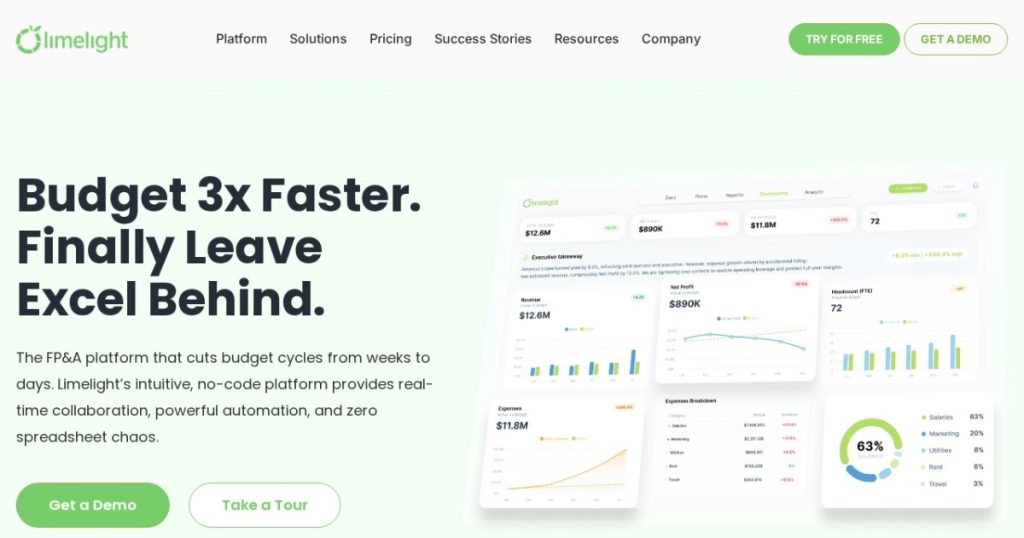
Limelight is financial planning and analysis software built to get finance teams off spreadsheets. Instead of a fragile web of linked Excel files, you plan, budget, forecast, and report inside one connected system where the numbers stay in sync. It handles automated budgeting, rolling forecasts, workforce planning, reporting and dashboards, and narrative reporting that pairs live financial data with board-ready formatting. The company says it cuts budget cycles from weeks to days.
Built by Limelight Software, it targets mid-market finance teams across a wide spread of sectors, including SaaS, healthcare, non-profit, manufacturing, professional services, and insurance. We dug into what it does, and the two things that stand out are the 800-plus pre-built integrations, covering Sage Intacct, Oracle NetSuite, Microsoft Dynamics, and QuickBooks, and the fact that every implementation is led by actual finance professionals rather than generic support staff. That combination is squarely aimed at teams that want a real system without a year-long rollout.
What Are Limelight’s Key Features?
Connected planning models
Limelight keeps budgets, forecasts, and reports on a single data structure, so a change in one place flows everywhere it should. This is the core problem with spreadsheet planning: numbers drift out of sync across files and nobody trusts them by quarter’s end. A connected model fixes that at the source, and it is the main reason to move off Excel in the first place.
Rolling forecasts and automated reporting
Rather than a static annual budget that is stale by March, Limelight supports rolling forecasts that update as actuals come in. Reports and dashboards refresh automatically off the same data. For a finance team, this is the difference between spending the first week of every month rebuilding a report and having it ready when the books close. That time saving is the clearest, most concrete benefit. Rolling forecasts also change how a business plans. A once-a-year budget forces you to pretend you can see twelve months ahead, then spend the rest of the year explaining variances against a guess. A forecast that rolls forward every month keeps the plan honest and lets leadership react to what is actually happening rather than what someone assumed last autumn. For finance teams that want a seat at the strategy table, that shift is the whole point.
800-plus integrations
Limelight ships with more than 800 pre-built connectors, including the major ERPs and accounting systems finance teams actually run: Sage Intacct, NetSuite, Dynamics, and QuickBooks. Strong integrations are what keep an FP&A tool fed with clean actuals without manual exports and imports. The breadth here is a genuine advantage and lowers the risk that your specific stack will not connect.
AI insights and narrative reporting
The platform adds AI for trend detection, variance analysis, and narrative generation, and it can assemble narrative reports that combine live figures with board-report formatting. This is the newer, buzzier layer, and how much value you get depends on how much you trust auto-generated commentary. Used as a first draft that a controller edits, it saves time; used unchecked, it is the part to be careful with.
How Much Does Limelight Cost?
Limelight starts at roughly $1,400/mo according to multiple third-party sources, though the company does not publish prices on its own site. There are two plans: a Starter tier for up to 5 users and an Unlimited tier for unlimited users, and both include all features with no module-by-module upselling. Implementation led by finance professionals is part of the deal, and there is a demo and trial but no permanently free plan.
That price puts Limelight right in the mid-market FP&A band. Vena also starts around $1,400/mo. Cube runs roughly $1,500 to $2,000-plus per month. Planful sits higher, from about $3,000 into the tens of thousands, and is pitched at larger, more complex organizations. So Limelight is competitively priced against its closest peers and clearly cheaper than the enterprise tier, which is exactly where a mid-market buyer wants to be.
The honest friction is the same one every tool in this category shares: you cannot buy it off a page. Getting a real number means a sales conversation, and the all-features-included structure is a plus but does not remove the need to negotiate. For a purchase this size that is normal, but if you want instant, transparent pricing, FP&A software as a whole will disappoint you. One thing that genuinely works in Limelight’s favor is that implementation is bundled rather than sold as a separate five-figure line item, which is how many rivals pad the true cost. When you compare quotes, make sure you are comparing total first-year cost, license plus implementation, because a cheaper-looking license with a heavy setup fee can easily end up more expensive than Limelight’s all-in number.
| Plan | Price | Plan Features | Best For |
|---|---|---|---|
| Starter | From about $1,400/mo | Up to 5 users, all features, FP&A-led implementation | Smaller mid-market finance teams |
| Unlimited | Custom pricing | Unlimited users, all features included | Larger finance orgs rolling out company-wide |
Who is Limelight Best For?
Use Limelight if you are a mid-market finance team still running budgeting and forecasting in Excel and feeling the pain: version chaos, broken links, and a close that drags. The broad integration list makes it a safe bet that it will connect to your ERP, and the finance-led implementation is a real help if you do not have a systems team to run a rollout. Sectors like SaaS, healthcare, and non-profit are explicitly in its wheelhouse.
Skip Limelight if you are a small business or solo operator, because the mid-market pricing will be overkill. Skip it too if you need transparent, self-service pricing before you will engage, or if a simple spreadsheet with a couple of tabs still covers your planning. And if you are a large enterprise with highly complex, multi-thousand-user planning needs, a platform like Planful or Anaplan may fit better. A good gut check is how much pain your current process causes. If your budget season means weeks of chasing department heads, merging spreadsheets, and fixing broken formulas at 11pm, the switching cost is easy to justify. If your planning is still small enough that one careful analyst keeps it clean in Excel, Limelight is a solution ahead of the problem, and you can wait until the spreadsheets start to buckle before making the move.
Best Limelight Alternatives
Vena
Vena is the Excel-native alternative, starting around $1,400/mo, the same entry point as Limelight. It keeps the familiar spreadsheet interface but adds a database and workflow behind it, which suits teams that love Excel and do not want to leave it. The trade-off is that you stay tied to the spreadsheet paradigm rather than moving to a fully connected model. If Excel comfort is a priority, Vena is the natural comparison.
Cube
Cube is a spreadsheet-first FP&A layer that runs $1,500 to $2,000-plus per month and connects your existing Google Sheets or Excel to a central source of truth. It is lighter and faster to stand up than a full platform, which appeals to lean teams that want structure without a big migration. It does less than Limelight on connected modeling and narrative reporting, so it fits smaller, simpler planning needs.
Planful
Planful is the step up in scale, running from about $3,000/mo into the tens of thousands, aimed at larger and more complex finance organizations. It offers deeper functionality and handles bigger, more intricate planning, but with a higher price and more involved implementation. If you are outgrowing mid-market tools or need enterprise-grade breadth, Planful is the alternative to weigh, though most mid-market teams will find Limelight the better value.
Final Verdict: Is Limelight Worth It?
Limelight is a solid mid-market FP&A platform. The connected planning model, rolling forecasts, and automated reporting deliver the core win of getting off spreadsheets, the 800-plus integrations mean it will almost certainly connect to your stack, and the finance-led implementation is a genuine differentiator for teams without a systems group. Priced against Vena and Cube, it holds its own.
It earns a 7.7 rather than more because of the two things that hold back nearly every tool in this space: there is no pricing on the site, so you must go through sales, and there is no true free plan to test-drive. Neither is disqualifying for a mid-market buyer, but both are worth weighing. If you are ready to leave Excel budgeting behind and can commit to a demo, Limelight belongs on your shortlist next to Vena and Cube.
Limelight Pros & Cons
What We Like
- 800+ pre-built integrations, including Sage Intacct, NetSuite, Dynamics, and QuickBooks
- Connected planning model keeps budgets, forecasts, and reports on one data structure
- Rolling forecasts and automated reporting cut budget cycles from weeks to days
- Every implementation is led by finance professionals, not generic onboarding
What Could Be Better
- No pricing on the site, so a formal sales engagement is required to get a quote
- No true free plan, only a demo and trial
- Mid-market cost puts it out of reach for small businesses and solo finance teams
Limelight FAQ
What is Limelight?
Limelight is a cloud-based FP&A platform that replaces spreadsheet-driven budgeting with automated budgeting, rolling forecasts, connected planning models, and automated reporting. It has 800-plus integrations and AI insights, and is aimed at mid-market finance teams.
How much does Limelight cost?
Limelight does not list prices on its site, but multiple third-party sources report it starts around $1,400/mo. It offers a Starter plan for up to 5 users and an Unlimited-user plan, both including all features and finance-led implementation. There is no true free plan.
Is Limelight worth it?
For mid-market finance teams that want to get off Excel and into automated, collaborative planning, yes. The integrations and implementation support are strong. The lack of transparent pricing and any free tier are the main reasons to shop it against rivals first.
What are the best Limelight alternatives?
Vena (from about $1,400/mo) for Excel-native planning, Cube ($1,500 to $2,000+/mo) for a spreadsheet-first FP&A layer, and Planful ($3,000+/mo) for larger, more complex finance orgs.
Does Limelight offer a free plan?
No. Limelight offers a demo and a trial, but there is no permanently free plan. Both paid plans include all features and finance-led implementation.
Who is Limelight best for?
Mid-market finance teams across SaaS, healthcare, non-profit, manufacturing, and professional services that want to replace spreadsheet budgeting with automated forecasts, connected models, and real-time collaboration.






