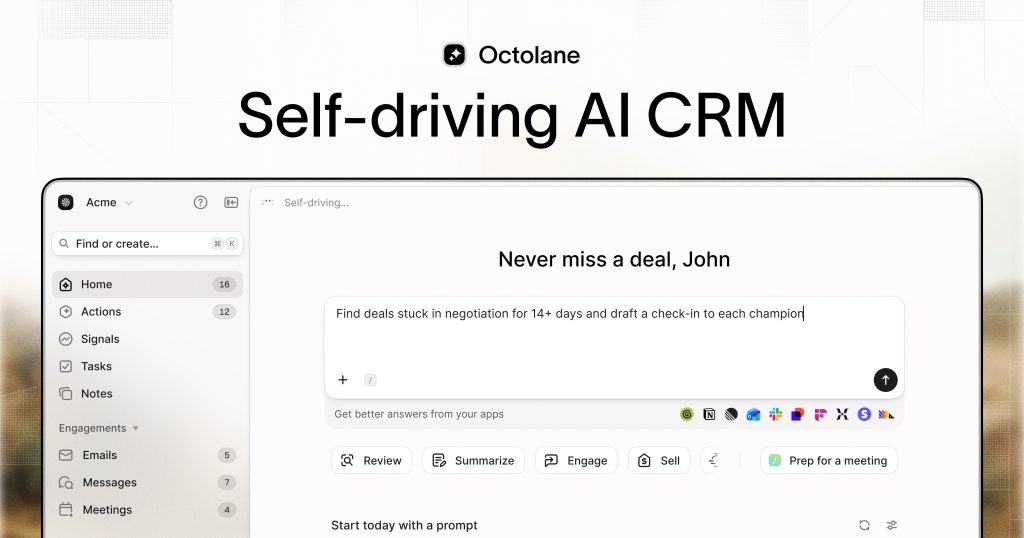
Octolane AI Review (2026): Pricing, Features & Honest Verdict
TLDR
Octolane AI is a self-driving CRM that listens to calls and emails to update records automatically, then runs sales tasks through AI agents you direct in Slack, email, or chat. We found it one of the more convincing AI-native CRMs. Best for: founders who hate manual data entry. Price: Free plan: no, Pro $39/mo. Rating: 7.9/10.
What is Octolane AI?
Octolane AI is a CRM built on a simple bet: nobody actually wants to update a CRM. So Octolane updates itself. It listens to your calls, reads your emails, and populates contact and deal records without you typing them in. On top of that sits a layer of AI agents you can direct in plain language, asking them to draft follow-ups, enrich a contact, analyze the pipeline, or find new deals.
The company is backed by Y Combinator (W24) and raised a seed round in 2025. It reports serving over 1,000 companies, from YC startups to public companies. You interact with it through Slack, Gmail, phone, iMessage, or AI tools like Claude and ChatGPT, and it can run standalone or layer on top of Salesforce and HubSpot. We dug into it and the framing is genuinely different from a normal CRM: the goal is a system of action that does work, not a database you feed. That distinction is the whole bet, and whether it pays off depends on how much you trust software to update your pipeline without you watching.
It arrives at a moment when AI agents have gone from demo to product, and CRMs are an obvious target. The category has a famous problem: reps hate updating them, so the data rots, and a CRM with rotten data is worse than a spreadsheet. Octolane attacks that problem at the root rather than adding another reminder to nag you. If it works as advertised, it removes the human bottleneck that has plagued CRMs since they existed. That is a big if, but it is the right problem to be solving.
What Are Octolane AI’s Key Features?
Self-updating records
This is the headline. Octolane captures calls and emails and writes the relevant details back to contacts and deals automatically. For a founder running sales solo, this removes the daily chore that makes most CRMs go stale within a month. The value is not flashy AI, it is the absence of data-entry guilt: your pipeline reflects reality without anyone maintaining it. The company claims this kind of automation saves users around 25 hours a week on follow-ups, pipeline updates, and prioritization. Treat that figure as a vendor claim rather than a tested number, but the direction is right, and even a fraction of it is meaningful for a founder who is also the entire sales team.
AI agents for revenue tasks
Octolane lets you deploy AI agents to run multi-step sales tasks. You ask, in natural language, for things like drafting follow-ups, enriching contacts, or surfacing stalled deals, and the agents execute. The company frames it as deploying an army of agents for complex revenue work. In practice it means you delegate the busywork that normally eats a rep’s afternoon.
Multi-channel access
You do not have to live in the CRM UI. Octolane is reachable through Slack, Gmail, phone calls, iMessage, and AI assistants like Claude and ChatGPT. That meets salespeople where they already work. Asking your CRM to update a deal from a Slack message is a very different experience from opening a tab, finding the record, and editing fields.
Standalone or on top of your stack
Octolane works as a full standalone CRM or deploys on Salesforce and HubSpot, so you can add its automation without ripping out an existing system. It ships with an MCP server, a REST API, and webhooks, and setup takes under 10 minutes. That dual mode lowers the risk: try it as an automation layer first, switch fully later if it earns it. The MCP server is notable because it lets AI assistants like Claude talk to your CRM directly, which is where a lot of sales tooling is heading. For a technical founder, the API and webhooks mean Octolane can slot into an existing stack rather than becoming yet another island of data.
How Much Does Octolane AI Cost?
Octolane’s Pro plan starts at $39 per month billed yearly, covering up to 3 seats, 250K records, 5 pipelines, and $20 of monthly AI credits. The Business plan is $79 per month for unlimited seats, 1M records, unlimited pipelines, and $40 of AI credits. Team and Enterprise are custom priced, with the Team tier bundling $300 of monthly AI credits and unlimited automations. There is no free plan, only a 7-day trial on Pro.
On the base price, Octolane is competitive. HubSpot’s paid Sales Hub starts around $20 per seat per month but its AI features sit higher up, Attio runs $34 per user per month, and Salesforce starts at $25 per user per month. At $39 flat for up to 3 seats, Octolane is reasonable for a small team, especially given the automation included.
The wrinkle is the credit model. AI usage draws down a monthly credit allowance ($20 on Pro, $40 on Business), and heavy use can exhaust it. Email sends are also capped (200/month on Pro, 500 on Business). Budget for overages and watch your usage during the trial, because the sticker price is not the whole story if your agents are busy.
| Plan | Price | Plan Features | Best For |
|---|---|---|---|
| Pro | $39/mo | Up to 3 seats, 250K records, 5 pipelines, $20/mo AI credits, 1 automation | solo founders and tiny teams |
| Business | $79/mo | Unlimited seats, 1M records, unlimited pipelines, $40/mo AI credits, 10 automations | small growing revenue teams |
| Team | Custom | Unlimited everything, $300/mo AI credits, unlimited automations, dedicated onboarding | scaling sales orgs |
| Enterprise | Custom | Custom infrastructure, SOC2/ISO/HIPAA/GDPR, dedicated deployed engineer | regulated enterprises |
Who is Octolane AI Best For?
Use Octolane if you are a solo founder or a small revenue team of two to five people who run sales yourselves and are tired of CRM admin. The self-updating records and Slack-driven agents are built for exactly that situation: people who sell but do not want to maintain a database. YC-style startups moving fast will appreciate the 10-minute setup and the automation-first design.
Skip Octolane if you need a deep, battle-tested enterprise CRM with years of edge-case handling, heavy customization, and a mature partner ecosystem. It launched in 2025, so it is younger than HubSpot or Salesforce, and large orgs with complex processes should weigh that. If predictable flat pricing matters more than automation, the credit model may also frustrate you. It is also worth being honest about trust: handing a young AI system the keys to your pipeline data takes a leap of faith that not every team will be ready to make, and some sellers prefer the control of updating records themselves. The 7-day trial is short, so go in with a real test plan, feed it a week of genuine sales activity, and judge it on whether your pipeline stayed accurate without you touching it.
Best Octolane AI Alternatives
HubSpot
HubSpot is the mature, friendly CRM with a genuinely useful free tier and AI features layered across its Sales Hub, with paid plans from around $20 per seat per month. It is far more established than Octolane and easier to grow into a full marketing and service suite. The trade-off is that it is more manual: you still maintain a lot of it. Pick HubSpot for maturity and breadth; pick Octolane for hands-off automation.
Attio
Attio is the other AI-native, modern CRM, prized for its flexible data model and clean interface, from $34 per user per month with a free tier. It is more of a build-your-own CRM than an autonomous one, giving you control where Octolane gives you automation. Choose Attio if you want a flexible, fast CRM you shape yourself; choose Octolane if you want one that updates and acts on its own.
Salesforce
Salesforce is the enterprise standard, endlessly customizable and backed by a vast ecosystem, starting at $25 per user per month and climbing steeply. It is the safe choice for large, complex sales orgs that need governance and integrations Octolane cannot match. The cost is complexity and admin overhead. Salesforce suits enterprises; Octolane suits lean teams who want results without the implementation project.
Final Verdict: Is Octolane AI Worth It?
Octolane AI is one of the more believable takes on the AI-native CRM. The core promise, a system that keeps itself current and runs tasks through Slack and email, addresses the real reason CRMs fail, which is that humans stop updating them. For a founder or a small revenue team, that alone can justify the $39 to $79 monthly cost, and the standalone-or-overlay flexibility lowers the risk of trying it.
Be clear-eyed about the caveats. It is a young product from a 2025 launch, the credit-based AI pricing means heavy users should budget for more than the headline price, and there is no free plan to ease in. But if manual CRM upkeep is eating your selling time, Octolane is worth a serious trial. The 7.9 reflects a genuinely useful, well-aimed automation layer, tempered by its youth and the unpredictability of credit-based costs.
Octolane AI Pros & Cons
What We Like
- Records update themselves from calls and emails, killing manual data entry
- AI agents run sales tasks through Slack, email, phone, and chat
- Works standalone or layered on top of Salesforce and HubSpot
- Fast setup, under 10 minutes, with MCP, REST API, and webhooks
What Could Be Better
- Credit-based AI pricing means heavy use can blow past the included credits
- No free plan, only a 7-day Pro trial
- Young product (2025 launch) so depth and edge-case reliability are still proving out
Octolane AI FAQ
What is Octolane AI?
Octolane AI is an AI-native CRM that automates pipeline management. Instead of manual data entry, it listens to calls, reads emails, and updates records itself. You direct AI agents in natural language through Slack, email, phone, or chat tools to handle follow-ups, enrichment, and outreach. It is backed by Y Combinator.
How much does Octolane AI cost?
Octolane's Pro plan is $39 per month billed yearly for up to 3 seats with $20 of monthly AI credits. The Business plan is $79 per month for unlimited seats with $40 of AI credits. Team and Enterprise are custom priced. There is no free plan, only a 7-day Pro trial.
Is Octolane AI worth it?
Yes, if manual CRM upkeep is killing your sales time. A self-updating CRM that runs tasks through Slack is a real time-saver for founders. Watch the credit-based AI pricing, and remember it is a young product, so test it against your workflow during the trial before committing.
What are the best Octolane AI alternatives?
The closest alternatives are HubSpot (a mature CRM with AI features and a free tier), Attio (an AI-native, flexible CRM from $34/user/mo), and Salesforce (the enterprise standard from $25/user/mo). Octolane is more autonomous; the others are more established.
Does Octolane AI offer a free plan?
No. Octolane does not have a free plan. It offers a 7-day free trial on the Pro plan so you can test the self-updating CRM and AI agents before paying. The cheapest paid tier is $39 per month billed yearly.
Who is Octolane AI best for?
Octolane is best for solo founders and small revenue teams of two to five people who run sales themselves and want to stop doing CRM admin. It suits YC-style startups and lean teams that value automation over a deep enterprise feature set.






