Polymer Review (2026): Pricing, Features & Honest Verdict
TLDR
Polymer is an applicant tracking system bundled with a beautiful branded job board, built for startups and growing teams. It nails the basics — distribution, candidate management, and unlimited collaborators — with a clean, fast interface. Best for: startups hiring under 50 roles. Price: From $124/mo, no free plan. Rating: 7.3/10.
What is Polymer?
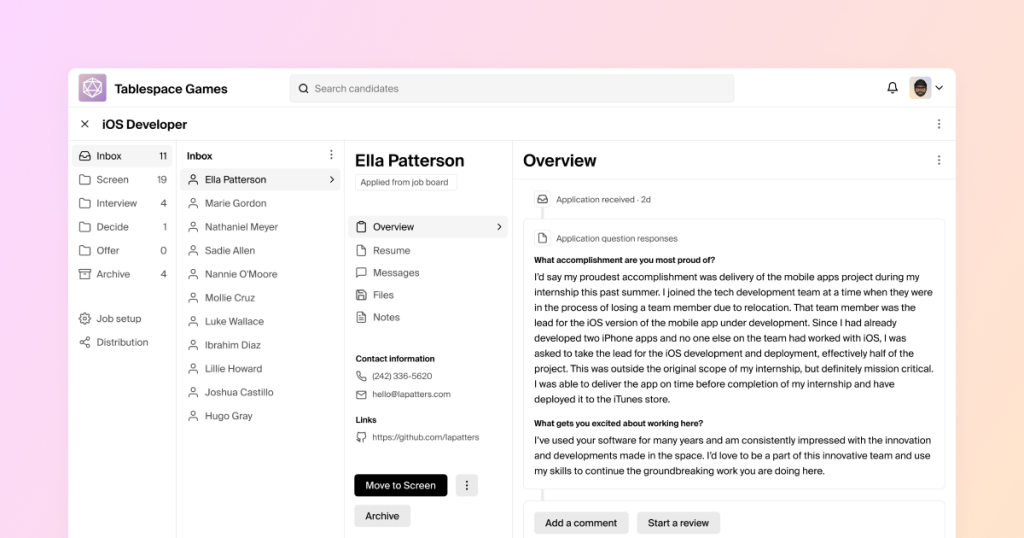
Polymer is a hiring platform that combines a customizable, on-brand job board with a full applicant tracking system (ATS). You publish roles, auto-distribute them to channels like LinkedIn, Google Jobs, and X, then track applicants through custom hiring stages while your whole team collaborates from one dashboard. It is positioned squarely at startups and modern teams rather than enterprise HR departments.
The product is built by A Curious Company and is used by high-growth startups across crypto, fintech, healthcare, and legal services. Its pitch is simplicity: a careers page that looks like part of your website, plus an ATS that does not require training to use. For teams that have outgrown a Notion board or a Google Form but do not want the weight of a legacy recruiting suite, that middle ground is the whole appeal.
What Are Polymer’s Key Features?
Branded job board with custom domains
The job board carries your logo, colors, and a custom domain, with multi-language support so the careers page genuinely looks like part of your site rather than a generic hosted page. There is also a developer API if you want to build your own front-end and use Polymer purely as the backend.
Automatic job distribution
Published roles post automatically to LinkedIn, Google Jobs, and X, plus job board subscriptions, which widens reach without manual cross-posting. X distribution is free and verified orgs can promote roles on their profiles, a nice touch for startups already active there.
Candidate management and workflows
You organize applicants into custom hiring stages with activity feeds, bulk CSV imports, automated email workflows, and built-in candidate messaging including bulk sends. Rich candidate profiles and private notes keep everything in one place rather than scattered across inboxes.
Team collaboration with unlimited users
Flexible roles and permissions control who sees what, and structured feedback collection keeps hiring decisions aligned. The standout here is that collaborators are unlimited within each plan’s user cap — there are no extra per-seat charges, which is rare in this category.
How Much Does Polymer Cost?
Polymer starts at $124/mo for the Starter plan (5 published jobs, 5 users), with Growth at $233/mo (20 jobs, 20 users) and Scale at $415/mo (50 jobs, 50 users). All tiers include the full feature set, and annual billing gives you two months free. There is no permanent free plan — just a 14-day free trial that starts when you publish your first job. By comparison, Workable starts around $189/mo, Recruitee around $290/mo, and Ashby is quote-based and aimed at larger scaling teams. Polymer’s entry price undercuts most of them, though the lack of a free tier means it costs more than free-forever options like Zoho Recruit’s basic plan.
| Plan | Price | Plan Features | Best For |
|---|---|---|---|
| Starter | $124/mo | Up to 5 published jobs, up to 5 users, all features included | Small teams hiring a handful of roles |
| Growth | $233/mo | Up to 20 published jobs, up to 20 users, all features included | Scaling startups running multiple openings |
| Scale | $415/mo | Up to 50 published jobs, up to 50 users, all features included | High-growth companies with heavy hiring volume |
Who Is Polymer Best For?
Use Polymer if you are a startup or growing company that wants a polished, on-brand careers page plus a straightforward ATS, and you value not paying per seat for your hiring team. It is ideal when you are running anywhere from a few to a couple dozen open roles and want everyone — recruiters, hiring managers, founders — in the tool without watching the bill climb.
Skip Polymer if you are a solo founder or tiny team on a tight budget who needs a free tool, or if you are an enterprise that requires deep analytics, structured interview kits, and heavy compliance tooling. The $124/mo floor and the focus on simplicity over depth make it a poor fit at both extremes.
What Are the Best Polymer Alternatives?
Workable
Workable is a more feature-rich ATS with AI-powered sourcing and a large candidate database, better suited to higher-volume hiring. It starts around $189/mo, slightly above Polymer’s Starter, but charges more as you scale seats.
Ashby
Ashby is the data-heavy choice for fast-scaling teams, with powerful analytics and reporting built in. Pricing is quote-based and trends higher, so it makes sense once hiring becomes a core, measured function rather than an occasional task.
Recruitee
Recruitee focuses on collaborative hiring and customizable careers sites, much like Polymer, starting around $290/mo. It offers more advanced automation and reporting but at a noticeably higher entry price.
Final Verdict: Is Polymer Worth It?
Polymer does the hard part well: it makes a startup’s careers page look great and turns candidate tracking into something a non-recruiter can run on day one. The unlimited-users model on every plan is a genuine cost advantage over per-seat competitors, and auto-distribution to LinkedIn, Google Jobs, and X covers the channels most startups actually use.
The honest caveat is the price floor. At $124/mo with no permanent free plan, it is not the tool for a solo founder making one hire, and the job-count caps will push busy teams up tiers quickly. But if you are a funded startup hiring across several roles and you want a clean, on-brand system without enterprise bloat, Polymer is well worth a 14-day trial.
Polymer Pros & Cons
What We Like
- Unlimited team members on every plan with no per-seat fees
- Beautiful branded job board with custom domains and multi-language support
- Auto-distribution to LinkedIn, Google Jobs, and X out of the box
- Clean, fast interface with almost no learning curve
- Developer API lets you build a custom front-end on top of the ATS
What Could Be Better
- No permanent free plan -- only a 14-day trial, and entry price is $124/mo
- Job-count caps (5/20/50) push growing teams up tiers faster than user caps
- Lighter on advanced recruiting features like structured interview kits and deep analytics than enterprise ATS tools
Polymer FAQ
What is Polymer?
Polymer is an applicant tracking system (ATS) combined with a branded job board, built by A Curious Company. It lets teams publish roles, distribute them to channels like LinkedIn and Google Jobs, manage candidates through custom hiring stages, and collaborate -- all from one platform.
How much does Polymer cost?
Polymer starts at $124/mo for the Starter plan (5 jobs, 5 users). Growth is $233/mo (20 jobs, 20 users) and Scale is $415/mo (50 jobs, 50 users). Every tier includes the full feature set and unlimited collaborators within the user cap, and annual billing gives you two months free.
Is Polymer worth it?
For startups and high-growth teams that want a polished, on-brand careers page plus a no-fuss ATS, yes -- the unlimited-users model and clean UX are strong. It is less compelling for solo founders or tiny teams on a tight budget, since there is no free plan and the floor is $124/mo.
What are the best Polymer alternatives?
The closest alternatives are Workable, Ashby, and Recruitee. Workable is more feature-rich for high-volume hiring, Ashby is data-heavy for scaling teams, and Recruitee leans into collaborative hiring with strong careers-site customization.
Does Polymer offer a free plan?
No. Polymer does not offer a permanent free plan. It provides a 14-day free trial that begins when you publish your first job, with no credit card required upfront to explore the product.
Who is Polymer best for?
Polymer is best for startups and growing companies that hire fewer than 50 roles at a time and want a beautiful branded job board paired with a simple ATS, without paying per seat for their hiring team.






