Waitlister Review (2026): Pricing, Features & Honest Verdict
TLDR
No-code waitlist software with landing pages, referral programs, and email broadcasts for product launches. Best for: Makers, indie hackers, and ecommerce drops running pre-launch campaigns. Price: $15/mo. Rating: 8.1/10.
What is Waitlister?
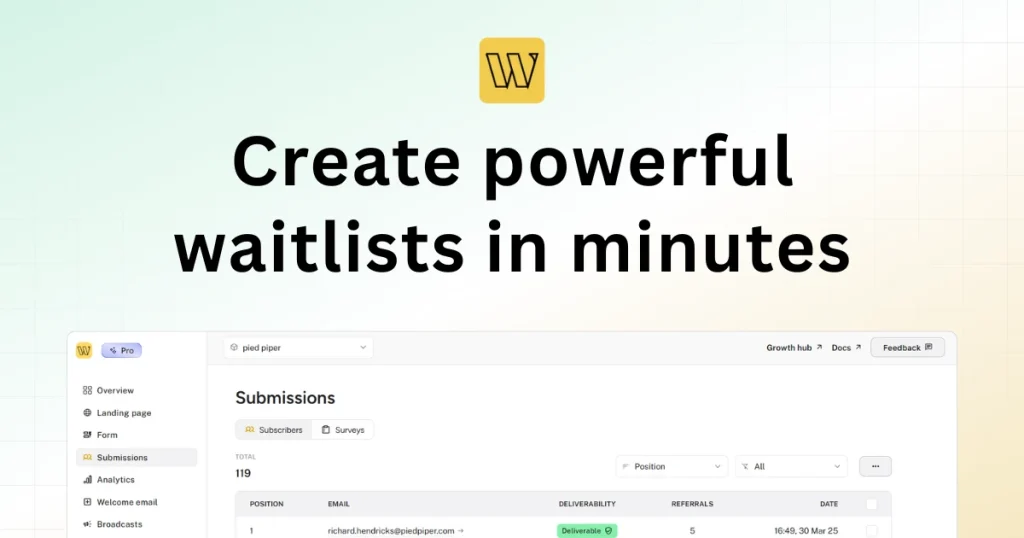
Waitlister is no-code waitlist software for product launches. We found it on Product Hunt where it just shipped its sixth public update. The pitch: spin up a landing page, capture emails, run a referral program, and send launch broadcasts without writing code or wiring up Mailchimp. It is built specifically for makers who want a launch list without stitching together five tools. The product has been live since 2024 and has built a steady user base of indie hackers and ecommerce drops.
Devin Daymore is the maker, and the product has been live since 2024. Waitlister leans into the integration story rather than trying to be a full marketing platform. Drop the embed into Webflow, Framer, Shopify, WordPress, Bubble, or Squarespace, and it works. Push subscribers to Klaviyo, Mailchimp, or Kit when you are ready to graduate to a real ESP. This is the right shape for the job: small, focused, and respectful of the rest of your stack.
Waitlists used to be the cool thing every consumer app launch shipped with. Robinhood famously used a position-based referral mechanic to build a million-name list before launch. The pattern fell out of fashion for a while because building it was a pain, and the tools that did it well were priced for funded startups. Waitlister is a sign that the pattern is back, and it is now within reach of anyone with $15 a month and a Friday afternoon.
What Are Waitlister’s Key Features?
Landing Page Builder and Embeddable Forms
You can host a full landing page on Waitlister or embed a form into a site you already own. The landing page builder is fine for a basic pre-launch page with a hero, a few bullet points, and a signup form. It is not Framer, and it is not trying to be. The embed is the more useful piece: it sits inside your existing site, captures the email, and hands the visitor back to a custom success page. Most makers we know want a real landing page in Framer or Webflow plus a signup widget that does the heavy lifting in the background. Waitlister gives you exactly that.
Viral Referral Program
This is the headline feature. Each subscriber gets a unique referral link. Bring in friends, climb the leaderboard, earn points. This is the same mechanic Robinhood used to grow before launch, and it still works for products with a clear novelty hook. Waitlister gives you the points system, the leaderboard, and the position-based reordering out of the box. Building this from scratch with Supabase and a referral table would take a weekend; here it is a checkbox. The leaderboard is also a nice-to-have for the social-share moment: people post their position to Twitter, which brings in more signups, which moves them up the board.
Email Broadcasts and Welcome Sequences
Send a welcome email when someone signs up, blast updates to the list, segment by referral count or signup date. Email volume is gated by plan: 2,500/month on Launch, 10,000 on Growth, 50,000 on Business. This is enough for most pre-launch lists. If you cross 50K subscribers and need real automation, you graduate to Klaviyo or Kit through the integrations. Treating Waitlister as the capture layer and Klaviyo as the lifecycle layer is the right architecture if your launch goes big.
Anti-Fraud and Double Opt-In
Referral programs attract garbage signups. Waitlister includes CAPTCHA, email validation, and fraud detection to filter out the bots and burner emails. Double opt-in is supported on every plan. This is the unsexy plumbing that actually decides whether your list is useful when you launch, and most DIY waitlist scripts skip it entirely. We have seen launches where 40% of signups were fake referrals from the same IP. Waitlister catches those before they pollute your list.
Custom Domains and Webhooks
The Growth plan at $39/month adds custom domains and webhooks. The custom domain piece is a small but real branding win: you do not want your launch traffic going to a Waitlister subdomain. Webhooks let you fire events into your own backend or into Zapier, which means you can sync subscribers to a custom CRM, Discord, Slack, or anywhere else. This is the difference between Waitlister being “the tool I use for one launch” and “the tool that lives in my stack.”
Surveys and Conditional Capture
You can attach a short survey to the signup flow. Useful for qualifying who is on the list (“are you a designer or a developer?”) so you can segment your launch announcement. Surveys are sometimes overlooked in waitlist tools because the assumption is “just get the email, sort it later,” but for product launches with two buyer personas, having that data on day one is genuinely useful.
How Much Does Waitlister Cost?
Waitlister starts at $15/month for the Launch plan. There is a real Free tier with 100 subscribers, one waitlist, and the landing page builder. Growth at $39/month adds custom domains, REST API, webhooks, and 10,000 emails. Business at $99/month gets you 50,000 emails and priority API limits. Annual billing is 20% off across the board.
For comparison, Prefinery starts at $99/month, KickoffLabs starts at $99/month, and ViralLoops starts at $34/month. Waitlister’s $15 entry plan is the cheapest paid tier in the category by a meaningful margin, and the free tier is more generous than most peers. If you are launching a side project on a $0 budget, this is one of the few options that will let you do real referral marketing without paying upfront. The pricing also makes it cheap enough to keep running between launches, which is when most teams cancel and lose their list.
| Plan | Price | Plan Features | Best For |
|---|---|---|---|
| Free | $0/mo | 100 subscribers, 1 waitlist, landing page, surveys, basic analytics | Validating a launch idea |
| Launch | $15/mo | 2,500 emails/mo, branding removal, referral program, CSV export | Indie hackers and side projects |
| Growth | $39/mo | 10,000 emails/mo, REST API, webhooks, custom domains, advanced analytics | Bootstrapped startups and ecommerce drops |
| Business | $99/mo | 50,000 emails/mo, priority API rate limits | Larger consumer launches |
Who is Waitlister Best For?
Use Waitlister if you are a maker, indie hacker, or early-stage founder running a pre-launch campaign. The Webflow and Framer embeds make it the right fit for the typical “Notion doc plus landing page” pre-launch stack. It is also a good pick for ecommerce drops on Shopify where you want a coming-soon page with a referral component. Course creators and creators with paid communities will find it a clean fit too: capture emails before launch, run a referral program, send updates, hand off to ConvertKit or Kit when the audience graduates to lifecycle email.
Skip Waitlister if you are past launch and need a real CRM with segments, automations, and lifecycle marketing. At that stage you want Klaviyo, Customer.io, or HubSpot. Also skip it if your audience is enterprise B2B, where waitlist mechanics tend to fall flat and a personal-outreach approach works better. A Series A B2B SaaS launching a new module to existing accounts does not need a referral leaderboard.
Best Waitlister Alternatives
Prefinery is the long-running incumbent. Mature feature set, deeper analytics, and ten years of running launches for big consumer brands. Pricing starts at $99/month, so it is a different buyer. Best for funded consumer launches with a real marketing budget.
ViralLoops focuses on the referral program piece and templates it for specific use cases (Robinhood-style waitlist, milestone referral, leaderboard). Starts at $34/month and has stronger campaign templates than Waitlister, weaker integrations. Best for marketing teams that want a templated referral campaign rather than a flexible waitlist tool.
Tally is a free form builder that you can wire up to Mailchimp or Kit for a DIY waitlist. No referral mechanic out of the box, but it is genuinely free and lets you control everything. Best for makers who want to assemble their own stack and have the time to wire it up.
Final Verdict: Is Waitlister Worth It?
Waitlister is the right tool for the right job. If you are building a SaaS, an ecommerce drop, or a community product and want to capture demand before launch, the Launch plan at $15/month gives you everything that matters: landing page, referral program, custom success pages, and email broadcasts. The integration coverage means it slots into a Framer or Webflow site without a custom build. The free tier is generous enough to validate the idea before paying anything.
The product will not impress a marketing director at a Series B company, and it does not need to. It is built for the maker who wants a working waitlist by the end of the day, not a marketing platform. For that audience, this is one of the cleanest options on the market. The fact that the product has shipped six public updates since 2024 is a good signal: solo or near-solo SaaS products either die or compound. Waitlister is compounding.
If you are sitting on a half-built product and waiting for the right moment to announce it, the right moment is the moment you have a working waitlist. Spin up Waitlister, write 200 words of copy, ship the embed to a Framer page, and post the link to Twitter, LinkedIn, and your favorite Slack community. The referral leaderboard does the rest. By the time the product is ready, you will have a list of people who already raised their hand, and that is worth a hundred cold outbound campaigns.
Waitlister Pros & Cons
What We Like
- Lowest paid tier in the category at $15/month
- Referral program with leaderboard and points works out of the box
- Strong integrations with Webflow, Framer, Shopify, WordPress, Bubble, and Squarespace
- Generous free tier with 100 subscribers and full landing page builder
- Anti-fraud filtering and double opt-in included on every plan
- 20% annual discount and custom domain support on Growth plan
What Could Be Better
- Landing page builder is basic compared to Framer or Webflow
- Email volume is gated by plan tier (2,500 to 50,000)
- Not a fit for enterprise B2B audiences where waitlist mechanics fall flat
Waitlister FAQ
What is Waitlister?
Waitlister is no-code waitlist software for product launches. It includes a landing page builder, embeddable signup forms, a referral program with leaderboard, and email broadcasts. It integrates with Webflow, Framer, Shopify, WordPress, and Squarespace.
How much does Waitlister cost?
Waitlister starts at $15/month for the Launch plan. The Free tier supports up to 100 subscribers. Growth is $39/month, Business is $99/month. Annual billing is 20% off.
Is Waitlister worth it?
Yes, for makers and indie hackers. It is the cheapest paid tier in the waitlist category and includes a referral program out of the box. Larger marketing teams will want Prefinery or Klaviyo instead.
What are the best Waitlister alternatives?
The main alternatives are Prefinery (incumbent, $99/month), ViralLoops (referral-focused, $34/month), and Tally combined with a free ESP for a DIY stack.
Does Waitlister offer a free plan?
Yes. The Free tier includes 100 subscribers, one waitlist, the landing page builder, embeddable forms, surveys, and basic analytics. No credit card required.
Who is Waitlister best for?
Makers, indie hackers, and early-stage founders running pre-launch campaigns. It is also a good fit for ecommerce drops on Shopify and course creators capturing demand before launch.






