Zeni Review (2026): Pricing, Features & Honest Verdict
TLDR
Zeni is AI bookkeeping for venture-backed startups, pairing automated categorization with a dedicated human finance team of a controller, bookkeeping manager and analyst. It is excellent and expensive. Best for: funded startups that want daily books and a real finance team without hiring one. Price: From $549/mo. Free plan: no. Rating: 7.9/10.
What is Zeni?
Zeni is a full outsourced finance department delivered as software. It handles bookkeeping, bill payments, employee reimbursements, month-end close and financial reporting, with machine learning doing the categorization and reconciliation and human accountants reviewing the output. On top of the books, Zeni sells business checking accounts, corporate cards with 1.75% cashback, payroll management, tax filing and fractional CFO services, so a startup can run its entire finance function from one vendor.
The company is Zeni Inc., based in Palo Alto, California, and it markets itself as the first AI-powered bookkeeping service. Its packaging is built explicitly around funding stage: pre-seed, seed, Series A, Series B and Series C or later each get a different recommended bundle. That tells you exactly who it is chasing. Zeni is not going after your local plumbing company. It is going after the seed-stage founder who has just closed a round, has an investor asking for a monthly burn number, and does not want to hire a controller at $140,000 a year. We dug into how it actually differs from the older outsourced bookkeeping firms, and the honest answer is cadence: the dashboard refreshes daily rather than showing you a picture of last month.
What Are Zeni’s Key Features?
AI bookkeeping with a daily dashboard
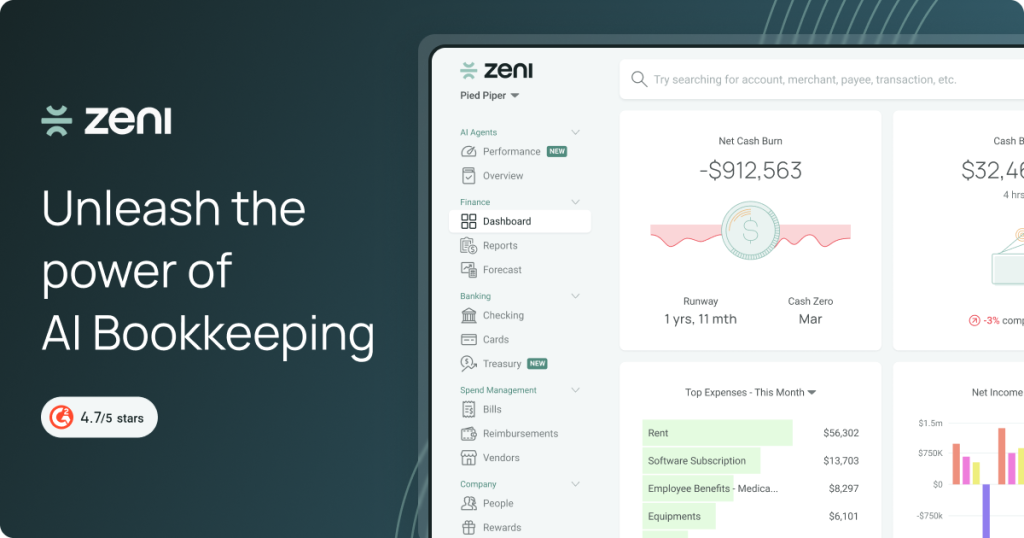
Zeni ingests transactions from your bank accounts, cards and payment processors, auto-categorizes them and reconciles continuously instead of in a monthly batch. The result is a dashboard that reflects yesterday, not last quarter. For a startup burning cash on a fixed runway, that difference is the entire point: knowing your burn rate on the 5th of the month rather than the 20th changes what you can decide. Anomaly detection surfaces transactions that break your normal pattern so miscategorizations get caught before close rather than during an audit. The trade-off is that continuous reconciliation only helps if your source data is connected properly, so the first month of onboarding still involves the usual mapping work with your assigned team.
A dedicated human finance team
Every plan, including the entry tier, comes with named humans: a controller, a bookkeeping manager and an analyst. This is the part that separates Zeni from pure software. The AI drafts, the team reviews, and you have someone to email when a transaction is genuinely ambiguous. It is also why the price is what it is. You are not buying a categorization engine, you are buying a small accounting firm with better tooling in front of it.
Bill pay and reimbursements at no extra charge
AI Bill Payments handles vendor invoices with free ACH transfers, and AI Reimbursements pushes employee expense repayments out same-day by ACH at $0. Both are included in the bookkeeping subscription rather than sold as add-ons, which is worth noting because plenty of competitors meter bill pay per transaction. Wire transfers are supported as well. Everything flows straight back into the books, so an approved reimbursement does not need to be re-keyed anywhere.
AI CFO and AI Accountant agents
Zeni layers two agent products on top of the ledger. The AI Accountant Agent runs automated reconciliations. The AI CFO Agent handles forecasting and scenario work against your live numbers. These are lighter than the fully staffed Fractional CFO service, which starts at $1,599 per month plus a $2,000 setup fee, but they cover the common case of a founder wanting to model a hiring plan against runway without booking a call. Banking sits alongside it: business checking with FDIC coverage up to $3 million, plus a card returning 1.75% cashback.
How Much Does Zeni Cost?
Zeni starts at $549 per month for the Starter plan, or $494 per month if you pay annually, which is a 10% discount. Starter is aimed at pre-revenue companies. The Growth plan is $799 per month, or $719 billed annually, and is the tier for companies with actual revenue. Enterprise is custom, priced on bookkeeping complexity, monthly expense volume and annual revenue. There is no free plan and no self-serve trial, so every path runs through sales.
The add-ons stack up fast. Fractional CFO service is $1,599 per month plus a $2,000 setup fee for CFO Lite, $2,990 per month plus $6,000 setup for CFO Premium, and $4,990 or more per month plus $6,000 setup for the enterprise tier. Tax is separate again: $2,499 per year for pre-revenue companies, $3,899 per year for companies up to $500,000 of revenue, custom above that. Payroll management starts at $199 per month on an annual contract. One more cost people miss: all plans require you to be on QuickBooks Online Plus, which you pay Intuit for separately.
Against the market, Zeni sits at the premium end. Pilot’s entry Essentials tier is $99 per month for AI-first bookkeeping without a dedicated human, and its Core plan with a US-based bookkeeper is $499 or more per month billed annually. Fondo advertises $399 per month, down from a $499 list price. Puzzle has a free Starter tier and a Core plan around $30 per month billed annually, though that is software only with no accountant attached. So Zeni’s $549 floor is roughly five times Pilot’s cheapest option and infinitely more than Puzzle’s free tier. What you are paying for is the staffed team plus the daily cadence, and whether that is worth $6,588 a year depends entirely on whether you would otherwise be doing the books yourself at 11pm.
| Plan | Price | Plan Features | Best For |
|---|---|---|---|
| Starter | $549/mo | Basic AI bookkeeping for pre-revenue companies, dedicated finance team, free ACH bill pay and reimbursements, $494/mo billed annually | Pre-revenue and pre-seed startups |
| Growth | $799/mo | Advanced AI bookkeeping for revenue-generating companies with the same dedicated team, $719/mo billed annually | Seed to Series A startups with revenue |
| Enterprise | Custom pricing | Priced on bookkeeping complexity, monthly expenses and annual revenue | Series B and later or multi-entity companies |
| Fractional CFO | From $1,599/mo | CFO Lite adds budgeting, 12-month cash flow forecasting and a monthly strategy call, plus a $2,000 setup fee | Founders needing board-ready financial strategy |
Who is Zeni Best For?
The sweet spot is a company with between five and fifty employees, a bank balance that came from investors, and a board that expects a monthly reporting pack. Below that, the price is indefensible. Above it, you will hire in-house and Zeni becomes a supplement rather than the whole function.
Use Zeni if you are a funded startup between pre-seed and Series C with a real investor reporting obligation, a founder whose time is worth more than $549 a month, and no finance hire yet. It is a particularly good fit if you want bookkeeping, bill pay, reimbursements, payroll, tax and eventually a fractional CFO from one vendor rather than stitching four together. The daily-refreshed numbers are a genuine advantage when your runway is the number that matters most.
Skip Zeni if any of these are true:
- You are bootstrapped or pre-funding. $6,588 a year is a bad trade when Puzzle is free and Pilot Essentials is $99 per month.
- You are not on QuickBooks Online Plus and do not want to be. That is a hard requirement.
- You want to try before you talk to anyone. There is no free trial and no self-serve signup.
- You already employ a controller. Zeni’s staffed team is the expensive half of the product and you would be paying twice.
- You are a non-US business or an agency with simple cash-basis books. This is built for US startup accrual accounting.
Best Zeni Alternatives
Pilot
Pilot is the closest direct competitor and the one most founders compare Zeni against. Its Essentials tier is $99 per month for AI-first bookkeeping with no dedicated human bookkeeper, and Core is $499 or more per month billed annually for accrual-basis books with a US-based bookkeeper. Pilot also sells CFO services from $1,875 per month. Pilot is the safer, more established name with deep venture credibility. Zeni is more aggressive on automation and refreshes daily rather than monthly. If your priority is a recognisable brand your investors already know, take Pilot. If you want fresher numbers, take Zeni.
Puzzle
Puzzle is the cheap software-first option and a good reality check on Zeni’s price. It has a free Starter tier and a Core plan around $30 per month billed annually, with higher tiers for automation and scale. Puzzle gives you AI-driven accrual books, high auto-categorization rates and unlimited bank connections, but no dedicated accountant doing the work for you. For a pre-seed team with a technical founder willing to own the ledger, Puzzle does 80% of the job for roughly 5% of the price. The moment you want someone else responsible for close, you have outgrown it.
Fondo
Fondo is the Y Combinator favourite and undercuts Zeni directly, advertising $399 per month against a $499 list price, with quarterly bookkeeping from $1,198 per quarter and annual bookkeeping from $950 per year for the earliest stage teams. You get a dedicated accountant, a shared Slack channel, monthly close and a finance dashboard, plus tax credit work that startups routinely leave on the table. Fondo is the better value pick if you want a human accountant and do not need Zeni’s daily cadence or its banking and card stack.
Final Verdict: Is Zeni Worth It?
Zeni is one of the better-executed finance products we have looked at, and the 7.9 reflects that. The combination of daily-refreshed books, free ACH bill pay and same-day reimbursements, a named human team on every plan, and the option to add tax, payroll and a fractional CFO later means a startup can hire one vendor at seed and not switch again until Series C. That continuity has real value, and the automation is genuinely doing work rather than decorating a dashboard.
The problems are price and lock-in. At $549 per month before add-ons, plus a mandatory QuickBooks Online Plus subscription, plus $2,499 a year if you want tax handled, the true annual cost for a seed-stage company clears $9,000 quickly. There is no trial, so you cannot evaluate it without a sales conversation, and the plan price is quoted against your expense volume, which means it moves as you grow. Our recommendation: if you have raised money and your founders are still doing reconciliations, Zeni is worth the call. If you are bootstrapped, run Puzzle or Pilot Essentials for a year and come back when the books are complex enough to justify the bill.
Zeni Pros & Cons
What We Like
- Books refresh daily rather than monthly, so your burn rate and runway are always current
- Every plan includes a named human team: a controller, a bookkeeping manager and an analyst
- Free ACH bill pay and same-day $0 employee reimbursements are bundled, not metered per transaction
- One vendor covers bookkeeping, banking, cards, payroll, tax and fractional CFO as you scale
What Could Be Better
- Starts at $549/mo, roughly five times Pilot's $99/mo Essentials tier, and add-ons push the real annual cost past $9,000
- Requires a QuickBooks Online Plus subscription you pay Intuit for separately
- No free plan, no free trial and no self-serve signup, so every evaluation goes through sales
Zeni FAQ
What is Zeni?
Zeni is an AI-powered bookkeeping and financial operations platform for startups, built by Zeni Inc. in Palo Alto. It automates transaction categorization, reconciliation, bill pay and reimbursements, then puts a dedicated human finance team on top to review the output and run month-end close.
How much does Zeni cost?
Starter is $549 per month, or $494 billed annually. Growth is $799 per month, or $719 billed annually. Enterprise is custom. Fractional CFO service starts at $1,599 per month plus a $2,000 setup fee, tax filing runs $2,499 to $3,899 per year, and payroll management starts at $199 per month.
Is Zeni worth it?
If you are funded and your founders are still doing reconciliations, yes. The daily-refreshed books and the included human team justify the price when the alternative is a $140,000 controller hire. If you are bootstrapped, it is far too expensive next to Puzzle or Pilot Essentials at $99 per month.
What are the best Zeni alternatives?
Pilot is the established rival, from $99 per month for AI-first books and $499 or more for a human bookkeeper. Puzzle is the cheap software-only route with a free tier and roughly $30 per month for Core. Fondo undercuts Zeni at $399 per month with a dedicated accountant and startup tax credit work.
Does Zeni offer a free plan?
No. Zeni has no free plan and no advertised free trial. The cheapest way in is the Starter plan at $549 per month, or $494 per month billed annually, and you have to go through a sales conversation to get onboarded.
Who is Zeni best for?
Venture-backed US startups from pre-seed to Series C that have investor reporting obligations and no in-house finance hire. It is a poor fit for bootstrapped businesses, teams not using QuickBooks Online Plus, companies that already employ a controller, or anyone with simple cash-basis books.






