Imejis.io Review (2026): Pricing, Features & Honest Verdict
TLDR
Imejis.io is a template image API with a drag-and-drop editor and a hosted MCP server, so Claude or ChatGPT can design and render graphics. It is the cheapest serious option we priced, but it stops dead at its quota. Best for: indie developers automating social and OG images. Price: from $14.99/mo, free plan yes. Rating: 7/10.
What is Imejis.io?
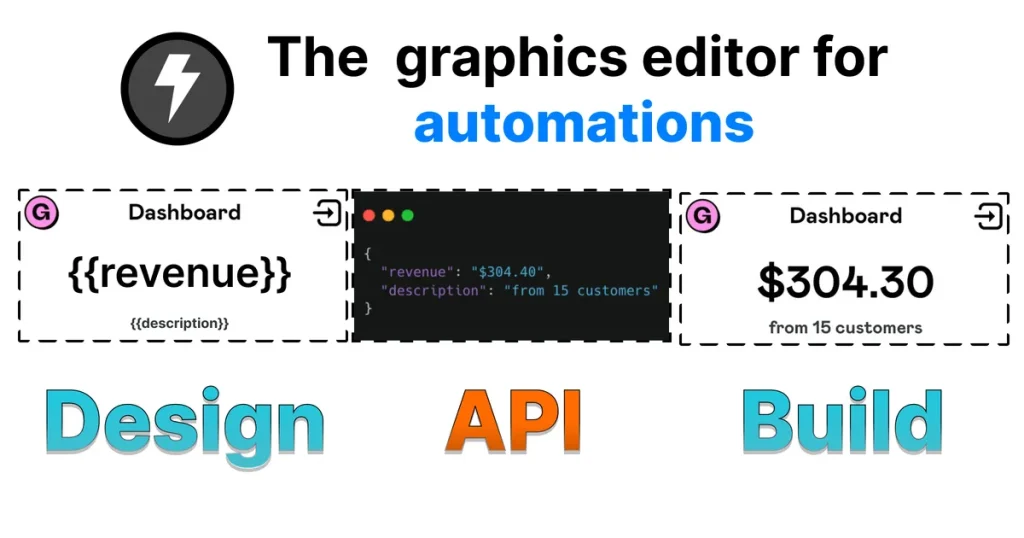
We found Imejis.io on Product Hunt, where it launched on 29 September 2026 with its agents release, pitched as a design studio your AI assistant can drive to automate marketing graphics. Underneath the new pitch sits a template image API. You design a template once in a browser editor, flag some fields as dynamic, then send values to a single endpoint and get the finished image back in the same response.
The product is older than the launch suggests. Its changelog starts in July 2023, goes quiet for most of 2024, then picks up sharply through 2025 and 2026 with a rebuilt editor, an MCP server in July 2026 and more than a dozen new chart types. The terms name JAGODANA LLC, a US company under Delaware law, as the operator. The same domain also hosts a long list of free image and developer tools.
What Are Imejis.io’s Key Features?
A synchronous render API
You POST a JSON body of field overrides to render.imejis.io with your design ID and a render key in a header, and the image bytes come back in the reply. There is no webhook to wire up and nothing to poll. Output defaults to JPEG, and a format parameter switches to PNG, WebP or a single-page PDF. The quality setting only affects JPEG. The docs claim renders return in under two seconds.
Two delivery options return a URL instead of bytes. Hosted delivery stores the file publicly on Google Cloud Storage, and signed delivery returns a private link that lasts up to seven days. Both count as one render. Bulk generation means looping one call per record: we found no batch endpoint in the docs.
A hosted MCP server for AI assistants
This is the part the launch is about. You add one endpoint, api.imejis.io/api/mcp, as a connector in Claude or ChatGPT and approve access over OAuth. We probed it without a login and got a proper 401 pointing at OAuth metadata, so it is live and gated. The server exposes 12 tools, including create_design, update_design, preview_design, export_design, get_render_url and get_credit_balance.
The flow is sensible. The assistant reads a catalog of components with their properties and defaults, builds a design as JSON, previews it to check its own work, then exports. Because the catalog comes from the same registry the renderer validates against, the assistant should not invent properties that fail at render time.
Charts and data cards, not only text on a photo
Most template image APIs stop at text, images and shapes. Imejis.io adds 22 chart types, including bar, line, pie, sankey, treemap, candlestick and Gantt, plus country and state maps for seven regions. There are QR codes, 13 barcode symbologies, data tables, star ratings and KPI stat tiles that draw a sparkline from a trend series. For weekly metric cards or a price chart in a newsletter, that saves a separate charting service.
Public links with their own quota
Any template can become a shareable form. Someone opens the link, fills in the dynamic fields and downloads a PNG without an account, and they cannot change your layout. Each link logs views, downloads and a visitor history with IP, device and referrer. Renders from these links come out of a separate allowance, so a popular form never eats your API quota. We could not find the size of that allowance published anywhere.
What Is It Like to Use Imejis.io?
Sign-up at app.imejis.io needs no card, and every paid card on the pricing page carries the same Start free button. There is no trial: you begin on the Free plan and upgrade from inside the account. We did not run renders on a paid account, so this section draws on the docs, the public endpoints and the pricing code.
The docs are short and practical. The help centre has seven articles covering templates, dynamic fields, the API, public links, quota and troubleshooting, with the common failures spelled out: case-sensitive field names, images behind a login rendering blank, and fonts that must be uploaded before the renderer can use them. Native integrations cover Zapier, Airtable, Google Sheets, Webflow, WordPress and monday.com, and n8n works through the plain HTTP API.
Agent billing needs care. The agents page says each finished export or render URL request draws from your quota, and that get_render_url returns a permanent link that renders fresh per request. The help centre says hosted URLs count once because the file is stored. Those are two different mechanisms. If you put a fresh-per-request link in a public page, test how many renders a day of crawler traffic costs you before you rely on it.
Where Does Imejis.io Fall Short?
Quota is a hard stop. When you hit your monthly allowance, the API returns a 429 quota exceeded error until the period resets or you upgrade. The pricing page sells no top-up packs and no overage, even though the agents page mentions credits alongside quota. For a scheduled pipeline, a surprise spike means failed renders, not a bigger invoice.
The Unlimited plan is not unlimited. It is 100,000 API renders a month, and anything above that goes to an enterprise quote by email. The name is a marketing choice, and buyers comparing plans should read the number, not the label.
The numbers drift between pages. The marketing site counts 27 components, while its own list adds up to 30. The FAQ says agents export PNG or SVG, but the docs list PNG, JPEG, WebP and PDF with no SVG. The changelog promises code snippets in six languages and the enterprise page says 30 or more. Even the social preview image sends $304.40 in its JSON sample and shows $304.30 in the rendered card.
Reliability claims do not match the contract. The marketing site shows a 99.9% uptime counter, but the terms say plainly that Imejis does not commit to any uptime level outside a signed enterprise deal. The same counters show 100,000 images generated and 1,500 users in total. That lifetime total equals one month of the top plan, a sign of how few customers it has so far.
The refund policy has fine print. Refunds are prorated and must be requested within 30 days, renewals only within 48 hours, and promotional or discounted plans are excluded. The yearly plan is sold as 17% off, and the policy does not say whether that counts as discounted. Ask before paying annually. There is also no SOC 2 or similar certification claimed, and the storage provider is listed as US-based even though render endpoints exist in the EU, Singapore and Australia.
How Much Does Imejis.io Cost?
Paid plans start at $14.99 a month for Basic, which includes 1,000 API renders, unlimited designs and 10 GB of storage. Pro is $24.99 for 10,000 renders, and Unlimited is $69.99 for 100,000. That works out to $15, $2.50 and $0.70 per 1,000 images. Yearly billing costs $149.99, $249.99 and $699.99, or roughly $12.50, $20.83 and $58.33 a month.
The Free plan gives 100 API renders a month, 50 designs, starter templates and 500 MB, and the pricing page says free renders carry no watermark. One render is one image whatever the format. Bannerbear charges one credit per format and multiplies by scale, so a JPEG and PNG pair at 2x costs four credits there.
Against rivals, the gap is large at volume. Bannerbear starts at $49 a month for 1,000 credits and charges $149 for 10,000, with a 30-credit trial instead of a free plan. Placid starts at $19 for 500 credits and charges $249 for 100,000. APITemplate.io’s image and PDF plans start at $35 a month for 1,500 renders, or $29 billed yearly. At 10,000 images, Imejis.io costs $24.99 where Bannerbear costs $149.
Imejis.io publishes its own rival table, dated July 2026. We checked it against each rival’s pricing page. The Bannerbear, APITemplate.io and Placid rows match. The RenderForm row is off: RenderForm shows prices in euros, from 9 euros for 250 credits, and its free account gets 50 credits once, with a watermark, not 50 a month.
| Plan | Price | Plan Features | Best For |
|---|---|---|---|
| Free | $0 | 100 API renders/month, 50 designs, starter templates, limited public links, 500 MB storage | Testing the editor, API and MCP server |
| Basic | $14.99/mo ($149.99/year) | 1,000 API renders/month, unlimited designs, all templates, 10 GB storage | Solo builders with light automation |
| Pro | $24.99/mo ($249.99/year) | 10,000 API renders/month, unlimited designs and storage | Growing products and agencies |
| Unlimited | $69.99/mo ($699.99/year) | 100,000 API renders/month, unlimited designs and storage | High-volume image pipelines |
Who is Imejis.io Best For?
Use Imejis.io if you are a solo developer or small team generating OG images, social cards, certificates or metric cards from code or a spreadsheet, and price per image matters. It also suits anyone who already works in Claude or ChatGPT and wants the assistant to produce the finished graphic, not just the copy. The chart components are a real edge for data-heavy cards.
Skip Imejis.io if you need a contractual uptime guarantee, a compliance certification or overage billing that keeps renders flowing through a spike. Skip it too if you need animation, video or multi-page PDFs. Bannerbear and Placid cover those, and both have a longer track record with larger customers.
Best Imejis.io Alternatives
Bannerbear
The established name in template image APIs, now with PDF, animation and video APIs, its own MCP server and signed Instant URLs for OG images. Plans start at $49 a month for 1,000 API credits, with Scale at $149 for 10,000. Choose it for breadth and maturity, and accept paying roughly six times more per image at 10,000 a month.
Placid
A creative automation tool from Nifty Software GmbH with image, PDF and video APIs, shareable Studio forms and unlimited watermarked previews. Plans run from $19 a month for 500 credits to $249 for 100,000, and unused credits carry over up to double the monthly amount. Choose it for video and a gentler quota model.
APITemplate.io
Stronger on documents than on graphics, with an HTML editor and PDF-only plans alongside image and PDF plans. The image and PDF tier starts at $35 a month billed monthly for 1,500 renders, and the free plan gives 50 renders a month on three templates. Choose it if invoices and reports matter as much as social images.
Final Verdict: Is Imejis.io Worth It?
Yes, for the right buyer. Imejis.io undercuts the category on price, returns images in a single call and ships an MCP server that lets an assistant design, check and export a graphic without you opening an editor. The chart and barcode components go further than most rivals, and the free plan is large enough to build a real integration before paying.
The weak points are maturity rather than capability. The quota wall, the misleading Unlimited name, the missing uptime commitment and the numbers that disagree across pages all point to a small team shipping quickly. Start on the free plan, test your real volume and how render URLs are billed, and pay monthly until the product proves itself. We rate it 7 out of 10.
Imejis.io Pros & Cons
What We Like
- Far cheaper at volume than rivals: 10,000 renders for $24.99 a month against $149 at Bannerbear
- Synchronous API returns the image in one call, with PNG, JPEG, WebP or single-page PDF output
- Hosted MCP server with OAuth lets Claude or ChatGPT design, preview and export a graphic
- 22 chart types, maps, barcodes, tables and KPI tiles go far beyond text on a photo
- Free plan with 100 renders a month and no watermark, plus public link forms on a separate quota
What Could Be Better
- Renders stop with a 429 error at the monthly quota, with no overage or top-up packs on sale
- The Unlimited plan is limited to 100,000 renders a month
- No uptime commitment in the terms despite a 99.9% uptime counter on the marketing site
- Counts and formats disagree across pages, and it is unclear whether discounted yearly plans are refundable
Imejis.io FAQ
What is Imejis.io?
Imejis.io is a template image generation API run by JAGODANA LLC. You design a template in a browser editor, then send field values to one endpoint and get the finished image back. A hosted MCP server lets Claude or ChatGPT design and render images too.
How much does Imejis.io cost?
There is a free plan with 100 renders a month. Paid plans are Basic at $14.99 a month for 1,000 renders, Pro at $24.99 for 10,000 and Unlimited at $69.99 for 100,000. Yearly billing costs $149.99, $249.99 and $699.99.
Is Imejis.io worth it?
For developers who care about price per image, yes. It costs far less than Bannerbear or Placid at volume and adds chart components and an MCP server. The trade-offs are a hard quota stop, no uptime commitment and a young customer base.
What are the best Imejis.io alternatives?
Bannerbear starts at $49 a month for 1,000 credits and adds animation and video. Placid starts at $19 a month for 500 credits and carries unused credits over. APITemplate.io starts at $35 a month for 1,500 image and PDF renders.
Does Imejis.io offer a free plan?
Yes. The Free plan includes 100 API renders a month, 50 designs, starter templates and 500 MB of storage, with no credit card. Paid plans have no trial: you start free and upgrade.
Who is Imejis.io best for?
Solo developers and small teams generating OG images, social cards, certificates or metric cards from code, spreadsheets or an AI assistant. Teams that need an uptime guarantee, compliance certification or video should look at Bannerbear or Placid.






