Outship Review (2026): Pricing, Features & Honest Verdict
TLDR
Outship is an AI-native technical assessment platform that records how engineering candidates work with AI coding agents, then shows you who actually engineers a solution and who just rubber-stamps AI output. We think it is one of the smartest rethinks of the coding interview in years. Best for: teams hiring AI-native developers. Price: Custom, no free plan. Rating: 7.7/10.
What is Outship?
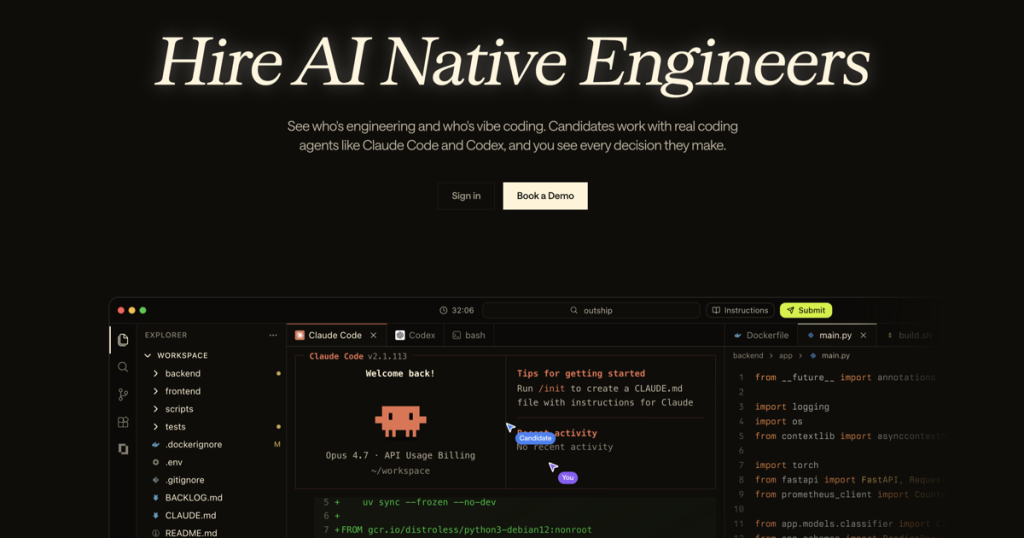
Outship is a technical screening platform built for a specific, very current problem: how do you assess an engineer when the job now involves working with AI coding agents all day? Instead of asking candidates to solve algorithm puzzles on a whiteboard, Outship gives them a real coding task in a cloud workspace with VS Code and AI agents available, then records everything. Every prompt, every edit, every command, every decision is captured and analyzed so the hiring team can see the candidate’s actual process.
The platform was built by a three-person team out of Y Combinator’s Winter 2025 batch, founded by Saner Cakir and Kayla Lee, both formerly at Berkeley AI Research. Their argument is that the skills separating great engineers from average ones have shifted. It is no longer about whether you can write a binary search from memory. It is about how you break down work, steer the agent, make tradeoffs, and recover when things break. Outship is designed to surface exactly those behaviors, which traditional coding tests miss entirely.
There is a candidate-experience angle too, and it is underrated. Outship reports that candidates consistently prefer building a real project that matches the scope of actual work over grinding algorithm puzzles they will never use on the job. That matters in a tight market for engineering talent: a screening process that feels relevant and respectful of a candidate’s skills is a recruiting advantage, not just an internal efficiency win. A test that mirrors the real job tends to attract the people who are good at the real job.
What Are Outship’s Key Features?
Real tasks in isolated cloud VMs
Candidates work on a genuine coding task inside an isolated virtual machine running VS Code with AI agents wired in. This mirrors how engineers actually work in 2026, rather than the artificial constraints of a timed puzzle. You import a task repo from GitHub and send an invite link for a take-home or a live interview. There is also a local mode if you want candidates to use their own setup, including their own MCP servers, CLIs, and custom skills.
Full session capture and process analysis
This is the core of Outship. The platform records the entire session and analyzes how the candidate decomposed the problem, what they prompted, what they accepted or rejected, and how they handled failures. The result is a view of the candidate’s reasoning, not just a final diff. That is a fundamentally richer signal than a green test suite, because two candidates can produce the same passing code while having wildly different judgment.
Engineer versus vibe-coder analysis
Outship explicitly tries to answer one question: is this person engineering, or vibe coding? It does comparative analysis to flag candidates who direct the AI deliberately versus those who paste whatever the agent generates and hope it works. For teams that have been burned by hires who look productive but cannot reason about their own code, this is the headline value, and it is something no traditional assessment tool measures.
Secure key proxying and ATS integration
You provide AI access through your own Anthropic or OpenAI keys, or via cloud providers like AWS Bedrock, Google Vertex AI, and Azure, and Outship proxies the keys so candidates never see them. It supports virtually any language and framework and integrates with GitHub plus ATS platforms including Ashby, Greenhouse, and Workday. That keeps the tool inside your existing hiring stack instead of becoming a side process.
The key-proxying detail is more important than it sounds. It means you control which models candidates can use and you keep your API costs and credentials private, while still letting the candidate work with the exact agents your team uses. For a security-conscious engineering org, that is the difference between adopting the tool and rejecting it outright. It also future-proofs the setup: as your team switches models or providers, the assessment environment can follow without re-architecting anything.
How Much Does Outship Cost?
Outship does not publish pricing, which is the first practical hurdle. There is no pricing page, no free plan, and no self-serve signup tier. You book a demo and get a custom quote, presumably scaled to how many assessments you run. The company says most customers are ready to send their first assessment the same day they onboard, so the sales cycle is light, but you still have to talk to someone to learn the cost.
For comparison, the established players give you a clearer sense of the market. CoderPad, which runs live collaborative coding interviews, starts around $50/mo for small teams. HackerRank and CodeSignal, the assessment incumbents, both sell mostly on custom enterprise contracts that typically run into four or five figures annually. Outship’s sales-led model puts it closer to that enterprise tier than to the cheap self-serve tools, though without a public number we cannot say exactly where it lands.
The honest take: the lack of transparency is annoying and it is a barrier for a small team that wants to try before committing. But the value proposition is specific enough that the teams who need it will likely find the cost defensible, because a single bad senior engineering hire costs far more than any assessment subscription.
| Plan | Price | Plan Features | Best For |
|---|---|---|---|
| Custom | Contact sales | Remote VM with VS Code and AI agents, full session capture, vibe-coder vs engineer analysis, ATS sync | Engineering teams hiring AI-native developers |
Who is Outship Best For?
Use Outship if you hire software engineers who will spend their days working with AI coding agents, and you have felt the gap in traditional interviews. If your team uses Claude Code, Codex, or similar tools in production, testing candidates on the exact skill of directing those agents is far more predictive than a LeetCode round. It is a strong fit for engineering teams and technical recruiters who care about real problem-solving over puzzle performance.
Skip Outship if you are hiring for non-engineering roles, since the whole product is built around code, or if you need a tool with a long track record and deep integrations today. As a brand-new, three-person company, Outship is betting on a thesis that is clearly right but is still early in proving itself at scale. Risk-averse buyers may want to wait a cycle or run it alongside an incumbent.
Best Outship Alternatives
CoderPad
CoderPad is the go-to for live, collaborative coding interviews where you and the candidate write code together in real time. It is mature, well integrated, and affordable, starting around $50/mo for small teams. What it does not do is Outship’s deep session analysis of how candidates work with AI agents; it is a shared editor, not an AI-behavior microscope. Pick CoderPad if you want a proven, cheap live-coding tool; pick Outship if AI workflow assessment is the point.
HackerRank
HackerRank is the incumbent in automated technical assessments, with a huge question bank and broad enterprise adoption. It is the safe, established choice, but its model is still largely the traditional one: solve the problem, pass the tests. Pricing is custom and enterprise-oriented. Choose HackerRank if you want scale and a long track record; it does not, however, evaluate AI-assisted engineering the way Outship does.
CodeSignal
CodeSignal offers standardized technical assessments and a skills framework used by large companies for consistent, comparable scoring. Like HackerRank it sells on custom plans and focuses on traditional coding ability. It is excellent for high-volume, standardized screening. But it answers a different question than Outship: how good is the candidate at coding, versus how good is the candidate at engineering with an AI agent. For AI-native teams, that distinction is the whole game.
Final Verdict: Is Outship Worth It?
Outship is one of the most clear-eyed products we have come across in technical hiring. It identifies a real and growing problem, that the coding interview no longer matches the job, and answers it directly by watching how candidates collaborate with AI agents. The session capture and engineer-versus-vibe-coder analysis are genuinely novel, and the secure key proxying plus ATS integrations show the team understands how hiring teams actually operate.
The reservations are about maturity and access, not the idea. Hidden pricing, no free tier, and a three-person company shipping a brand-new category mean you are buying into a thesis as much as a product. But it is the right thesis, and for engineering teams already living in AI-assisted workflows, Outship tests the skill that matters more than anything an algorithm puzzle measures. That combination of a sharp concept and early-stage rough edges is why it earns 7.7 out of 10.
Outship Pros & Cons
What We Like
- Captures every prompt, edit, and command so you see how a candidate actually thinks, not just the final code
- Tasks run in isolated cloud VMs with real AI agents, mirroring how engineers work day to day
- Distinguishes engineers who direct AI from those who blindly accept generated code
- Integrates with GitHub and ATS tools like Ashby, Greenhouse, and Workday
What Could Be Better
- No public pricing and no free plan, so you must contact sales to evaluate it
- Narrow focus on AI-assisted engineering hiring means it is irrelevant for non-technical roles
- Very new (YC W25, three-person team) so the track record and integration depth are still thin
Outship FAQ
What is Outship?
Outship is an AI-native technical assessment platform from a Y Combinator (W25) startup. It gives engineering candidates a cloud VS Code workspace with AI coding agents, records every prompt and decision, and shows hiring teams who genuinely engineers a solution versus who passively accepts AI output.
How much does Outship cost?
Outship does not publish pricing. Access is sales-led with custom quotes, and there is no free plan listed. You book a demo to get a figure based on your assessment volume.
Is Outship worth it?
If you hire engineers who work with AI coding tools daily, yes. Outship tests the exact skill that now matters: steering an AI agent well. The hidden pricing and brand-new status are the risks, but the concept is one of the smartest takes on technical hiring we have seen.
What are the best Outship alternatives?
CoderPad offers live collaborative coding interviews from around $50/mo, HackerRank is the established assessment incumbent with custom enterprise pricing, and CodeSignal provides standardized technical assessments, also on custom plans.
Does Outship offer a free plan?
No. Outship has no free plan or free tier. Evaluating it requires a sales conversation, and pricing is custom based on usage.
Who is Outship best for?
Outship is best for engineering teams and technical recruiters hiring software developers who will code alongside AI agents like Claude Code or Codex, and who want to assess real-world problem solving instead of algorithm puzzles.






