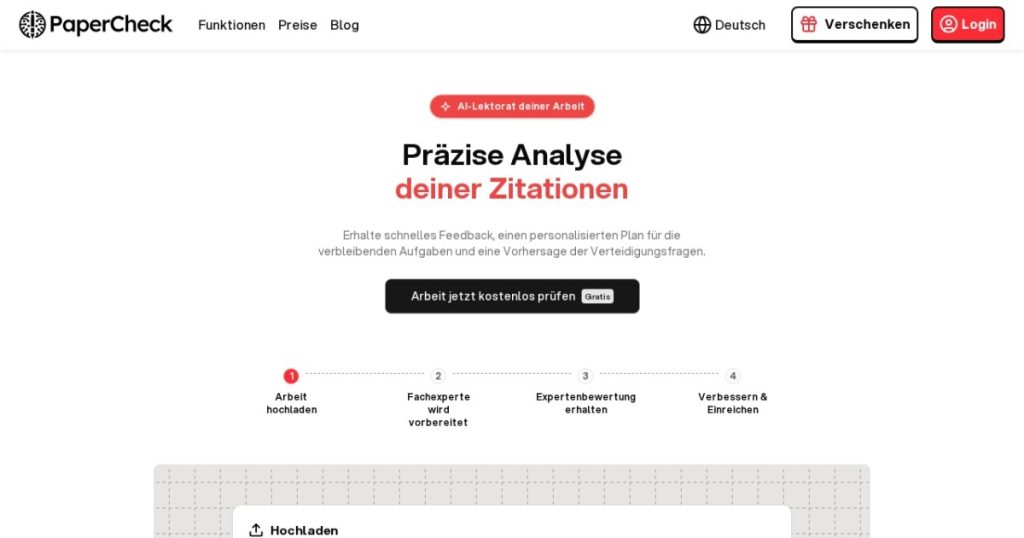
PaperCheck Review (2026): Pricing, Features & Honest Verdict
TLDR
PaperCheck is an AI paper supervisor that reviews academic theses for grammar, citations, plagiarism, and logic, then preps you for your defense. It is one of the few tools that critiques your argument, not just your spelling. Best for: students finishing a thesis. Price: from EUR 19 one-time / Free plan: no. Rating: 8.1/10.
What is PaperCheck?
PaperCheck is an AI editing and review platform built specifically for academic writing. You upload a paper, a bachelor’s essay, a master’s thesis, or a full dissertation, and within roughly five minutes it returns highlighted feedback on grammar, punctuation, citation consistency, plagiarism, and logical structure. It is not a general writing assistant. Every check is tuned for the kind of document a student submits to a committee, which is a narrower and more useful focus than the broad grammar tools most people reach for.
The tool is made by PaperCheck GmbH, a Swiss startup backed by Microsoft for Startups and Venture Kick. We dug into the privacy stance because it matters for unpublished research, and the company states it does not train its models on user submissions. The pitch is timely. Students already lean on AI to write, so a tool that reviews academic work against citation rules and logic, rather than just generating more text, fills a real gap. The framing of an AI supervisor, rather than an AI writer, is a deliberate and smart positioning choice in a market full of essay generators.
What Are PaperCheck’s Key Features?
Logic and argument analysis
This is the feature that separates PaperCheck from a grammar checker. It flags contradictions, unclear arguments, weak source density, and structural problems across your cover, abstract, and body. A spell checker tells you a sentence is wrong. PaperCheck tells you a section of your reasoning does not hold up, which is closer to what an actual supervisor would say. In our read of the output, this is the part students will find most uncomfortable and most valuable, because it surfaces the gaps you talked yourself into ignoring at 2am.
Citation verification
PaperCheck checks that citations are consistent and correctly formatted across styles like APA 7. On the Plus and Ultimate plans it can also auto-cite sources during the plagiarism check, which saves the tedious manual cleanup that usually happens the night before submission. For a thesis where a single inconsistent reference list can cost marks, this is one of the more practical checks in the tool. It will not magically format a messy bibliography from scratch, but it catches the inconsistencies a tired human eye glides past.
Plagiarism check and Defense Studio
The plagiarism check compares your work against a large source index and surfaces matches and originality signals, plus an AI text detection pass for English papers, which is increasingly relevant given how many students now draft with AI. Defense Studio is the standout extra. It predicts the questions a committee is likely to ask and lets you practice answering with real-time feedback. We have not seen many tools attempt defense prep at all, and for anyone facing an oral examination it is a genuine reason to choose PaperCheck. Both features are locked to the Plus tier and above, so the cheapest plan does not include them.
Custom rule checks and task planning
You can upload your university’s or journal’s guidelines and PaperCheck generates personalized checks against them. Basic includes none of these, Plus allows up to 18 custom checks, and Ultimate allows up to 45. If your department has a strict rubric, this is the reason to pay for a higher tier. The tool also generates an automated to-do list from its feedback, tied to your submission deadline, which turns a wall of corrections into an ordered plan. It is a small touch but it is the kind of thing that keeps a stressed student moving instead of freezing.
How Much Does PaperCheck Cost?
PaperCheck starts at EUR 19 for the Basic package, and the most important thing to understand is that it is not a subscription. You buy a one-time credit bundle and spend it whenever you need a review, with no recurring charge hanging over you after submission. Basic gives 150 credits, Plus is EUR 39 for 500 credits and is the most popular tier, and Ultimate is EUR 59 for 1000 credits. Credits are consumed at 1 per 100 words, so a 10,000 word thesis costs roughly 100 credits per full pass, and plagiarism plus Defense Studio draw from the same balance.
That model is genuinely fair for a tool you use in concentrated bursts near a deadline, rather than every day. Compare it to the alternatives. Grammarly Premium runs about USD 12 per month whether you use it or not, which adds up if you forget to cancel. Scribbr’s human proofreading is priced per 1000 words and climbs fast on a long document, easily into the hundreds for a full thesis. PaperCheck sits in between, cheaper than human editing and free of a standing monthly bill. There is also a money-back guarantee, and the company claims fewer than 0.5 percent of users invoke it.
The catch is the credit math on long papers. A dissertation that needs several full revision passes will eat through a Basic or even a Plus bundle quickly, because every pass and every extra check spends from the same pool. If you only run one careful review near the end, a single bundle is plenty. If you want to iterate, you will be topping up. Budget for the Plus tier at minimum if you want the full feature set including plagiarism and Defense Studio, and Ultimate if your paper is long or your rubric is strict.
| Plan | Price | Plan Features | Best For |
|---|---|---|---|
| Basic | EUR 19 one-time | 150 credits, grammar, citations, logic and source-density checks | short papers and first-pass edits |
| Plus | EUR 39 one-time | 500 credits, adds plagiarism check, AI text detection, up to 18 custom checks, Defense Studio | most students finishing a thesis |
| Ultimate | EUR 59 one-time | 1000 credits, adds up to 45 custom checks aligned to university guidelines | long dissertations and strict rubrics |
Who is PaperCheck Best For?
Use PaperCheck if you are a student finishing a bachelor’s, master’s, or doctoral thesis and you want a structured second opinion before you submit. It is strongest for anyone whose grade depends on clean citations and a coherent argument, and the Defense Studio is a real advantage if you have an oral defense coming up. It also suits students at institutions with detailed formatting rubrics, since the custom rule checks let you encode those guidelines directly.
Skip PaperCheck if you mainly need everyday grammar fixes or you write short, casual pieces. For that, a monthly tool like Grammarly is cheaper over time and always on in your browser. PaperCheck is also a harder sell if you cannot stomach paying before you see full output, since there is no free plan, only a compatibility trial that confirms your document is supported. And if your work is highly technical with heavy equations or non-text content, treat the word-count feedback as guidance rather than a complete review.
Best PaperCheck Alternatives
Scribbr
Scribbr is the human-editor route. Real academic proofreaders edit your document, priced per 1000 words, which means deeper, more nuanced feedback than any AI but a much higher bill on a long thesis, often well over a hundred euros. Choose Scribbr if you want a person, not a model, and your budget allows it. Choose PaperCheck if you want fast, repeatable checks at a fraction of the cost and you are comfortable acting on AI feedback yourself.
Trinka
Trinka is a grammar and language tool built for academic and technical writing, with a premium plan around USD 80 per year and a usable free tier. It is cheaper than PaperCheck over a single year and strong on academic phrasing and journal-style corrections, but it does not match PaperCheck’s logic analysis or Defense Studio. It is the better pick if you want continuous grammar support across many documents rather than a focused one-off thesis review.
Grammarly Premium
Grammarly Premium, about USD 12 per month, is the broad all-rounder: grammar, tone, rewriting, and a basic plagiarism scan across everything you write. It is not academic-specific and will not check your citation style against APA 7 or prep you for a defense. It is the most polished day-to-day writing assistant of the three. Use it for daily writing and PaperCheck for the thesis itself, since they solve different problems.
Final Verdict: Is PaperCheck Worth It?
PaperCheck earns its 8.1 because it does the thing most student writing tools skip. It reviews the substance of an academic paper, the citations, the logic, the originality, and your defense readiness, not just the surface grammar. The one-time credit model is honest for a tool you reach for around deadlines, the five-minute turnaround is fast enough to fit a panicked revision night, and the Swiss privacy stance is reassuring for unpublished work you do not want feeding a model.
It is not perfect. The absence of a true free plan means you pay before seeing the full picture, and long dissertations burn credits faster than the headline prices suggest once you start iterating. But for a student about to submit or defend a thesis, paying EUR 39 for a Plus bundle is a small price for catching a citation mess or a weak argument before a committee does. We would recommend it for exactly that moment, and point everyone who just needs light daily editing toward a cheaper monthly tool instead.
PaperCheck Pros & Cons
What We Like
- Checks logic, argument structure, and citation consistency, not just spelling
- One-time credits instead of a subscription, so you only pay when you actually need a review
- Defense Studio generates likely defense questions and lets you practice
- Swiss company that says it does not train on your submissions, which matters for unpublished research
What Could Be Better
- No real free plan, only a compatibility trial, so you commit money before seeing full output
- The 1 credit per 100 words model makes long dissertations burn through credits fast
- Plagiarism and Defense Studio are locked to the Plus and Ultimate tiers
PaperCheck FAQ
What is PaperCheck?
PaperCheck is an AI paper supervisor for academic writing. It reviews bachelor's, master's, and thesis papers for grammar, citation consistency, plagiarism, and logical structure, then returns feedback in about five minutes. It is built by PaperCheck GmbH, a Swiss startup.
How much does PaperCheck cost?
PaperCheck uses one-time credit packages, not a subscription. Basic is EUR 19 for 150 credits, Plus is EUR 39 for 500 credits, and Ultimate is EUR 59 for 1000 credits. Credits are spent at 1 per 100 words.
Is PaperCheck worth it?
For a student about to submit a thesis, yes. It catches citation and logic issues most grammar checkers miss, and paying once for a package beats a monthly subscription you would barely use. Skip it if you only need light grammar fixes.
What are the best PaperCheck alternatives?
Scribbr offers human academic proofreading priced per 1000 words, Trinka is a cheaper subscription grammar tool tuned for academic writing, and Grammarly Premium at about USD 12 per month is the broad all-rounder for everyday writing.
Does PaperCheck offer a free plan?
No. There is no free plan, only a free compatibility trial so you can confirm your document works before buying credits. Every real review draws from a paid credit package.
Who is PaperCheck best for?
It is best for students finishing a bachelor's, master's, or doctoral thesis who want a structured review of citations, logic, and originality before they submit or defend. It is less useful for casual or short-form writing.






