Working Async Review (2026): Pricing, Features & Honest Verdict
TLDR
Working Async is a niche job board for remote, async-first roles, the kind where written updates replace standups and results beat hours logged. We found it useful precisely because it filters out the meeting-heavy jobs that clog general boards. Best for: async-first remote teams hiring globally. Price: free to browse, custom pricing to post. Rating: 7.8/10.
What is Working Async?
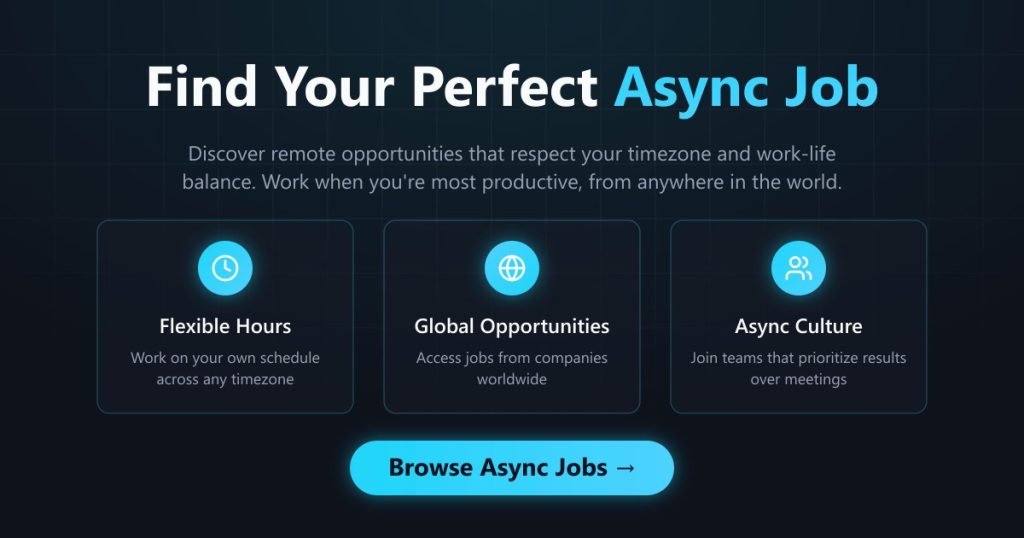
Working Async is a job board built around one idea: not all remote work is created equal. Plenty of remote jobs still expect you online from 9 to 5 in a specific timezone, with daily standups and back-to-back calls. Working Async filters for the opposite. Every listing is meant to be a role where teams prioritize results over meetings, work flexible hours across any timezone, and communicate in writing first.
The site launched in 2026 and keeps its scope deliberately tight. Job seekers can browse and apply without creating an account. Employers post through a Post a Job flow. There are no aggregated scraped listings padding the feed, which is common on bigger boards. The pitch is curation: fewer jobs, but the right kind of jobs for people who genuinely want async work and the companies that run that way.
The timing makes sense. Async work has moved from a niche preference to a real operating model for distributed teams, especially ones spread across continents where there is no shared business day. General job boards have not caught up; they still treat remote as one bucket and leave you to guess whether a role means real flexibility or just working from home on a fixed schedule. Working Async exists to remove that guesswork, and for the slice of the market that wants it, that clarity is the whole point.
What Are Working Async’s Key Features?
Async-only curation
The core feature is what is missing. Working Async only lists roles that are async-first, so you do not wade through hybrid jobs or remote jobs with hidden timezone requirements. For candidates, that means every result is relevant. For employers, it means applicants already understand and want written, meeting-light collaboration, which cuts down on mismatched hires.
Global, timezone-independent listings
Listings are not locked to a single country. The board pulls in companies worldwide and frames every job around working across any timezone. That is a real differentiator from boards that quietly restrict roles to US hours or a single region. If you are in a timezone that usually gets filtered out of remote hiring, this is built for you, and that reach is hard to replicate on boards that quietly default to a single region’s working day.
No-friction browsing and applying
You do not need an account to search or view jobs. The interface is fast and uncluttered, with clear listings and a direct apply path. There is no paywall between you and the job descriptions, and no aggressive upsell to a premium candidate plan. It is the simplest part of the product and one of its best. Plenty of job boards bury listings behind signups or push you into a resume-builder funnel before you can apply; Working Async skips all of that and just shows you the jobs, which is a small thing that says a lot about its priorities.
Employer job posting
Companies post via the Post a Job flow, which gives them a single async-first listing and a place to receive applicants. The pricing for this is not published on the site, so employers have to inquire. Compared to general boards that charge a flat fee per post, the lack of upfront pricing is the main friction point on the employer side.
Self-selecting candidate pool
This is less a button you click and more a property of the board. Because Working Async only lists async roles, the people who apply through it are already opting into async work. They expect written communication, documentation over meetings, and accountability without someone watching the clock. For a hiring manager, that pre-filtering is worth as much as any feature, since the cost of a candidate who quietly hates async work is a failed hire three months later. The board does the cultural screening before you ever read a resume.
How Much Does Working Async Cost?
For job seekers, Working Async is free. You can browse, search, and apply to every listing without paying or even registering. There is no premium candidate tier gating better jobs, which is how it should be and how the best boards operate.
For employers, the cost is not published. The site routes you to a Post a Job flow rather than a public price list, so you have to inquire before you know what a listing costs. That is worth weighing against the alternatives. We Work Remotely charges a flat $299 per post with predictable, advanced reporting included. Remote OK uses dynamic pricing that shifts with posting volume and can climb past $4,000 once you add features. Himalayas, by contrast, lets you post some roles for free.
Without a published number, we cannot tell you whether Working Async undercuts or matches those. What we can say is that the value is in the audience, not the price tag: a smaller, self-selecting pool of candidates who already want async work. If that fit saves you a few bad hires, the posting fee pays for itself regardless of where it lands.
| Plan | Price | Plan Features | Best For |
|---|---|---|---|
| Browse jobs | Free | Search and apply to all listings, no account required to view | Job seekers |
| Post a Job | Custom pricing | Single async-first listing, employer dashboard, applicant inbox | Companies hiring async talent |
| Featured listing | Custom pricing | Pinned placement, longer run time, more visibility | Teams competing for senior candidates |
Who is Working Async Best For?
Use Working Async if you run a genuinely async team and you are tired of remote candidates who expect daily calls. Distributed startups, agencies, and small SaaS teams hiring across timezones get the most value, because the board pre-filters for people who want written, meeting-light work. Job seekers who specifically want async roles and live outside the usual US-hours bubble should also bookmark it.
Skip Working Async if you need high listing volume, salary benchmarking, company-review data, or a full applicant-tracking system. A bigger board like We Work Remotely or Remote OK will surface far more jobs and more employer tooling, simply because their scale and traffic dwarf a focused niche board like this one. Also skip it if you are hiring for an in-office or strict-hours remote role, since that is exactly the kind of job this board is built to keep out.
Best Working Async Alternatives
We Work Remotely
We Work Remotely is the high-traffic general remote board. It charges a flat $299 per job post with predictable pricing and includes activity reporting plus ATS feed integrations. You get far more eyeballs and more employer tooling, but you also lose the async-only filter, so you will field applicants who expect synchronous schedules.
Remote OK
Remote OK runs one of the largest raw remote job feeds online. Its pricing is dynamic and changes with weekly posting volume, and add-ons can push a single listing past $4,000. It is the volume play: enormous reach, but a noisier feed and unpredictable cost compared to Working Async’s tight, curated approach.
Himalayas
Himalayas is a polished remote job board with richer company profiles, timezone filters, and the ability to post some roles for free. It sits between Working Async and the big boards: more features and data than Working Async, but without the strict async-only curation that makes Working Async’s feed so focused. If you want salary transparency, detailed company pages, and timezone filtering without committing to a paid post, Himalayas is the strongest all-rounder of the three, though you will still sort async from non-async roles yourself.
Final Verdict: Is Working Async Worth It?
Working Async does one thing and does it cleanly. It strips remote hiring down to the roles that are actually async, which saves both candidates and employers from the mismatch that plagues general boards. For job seekers it is free and frictionless, easily worth a bookmark, and the timezone-agnostic listings open doors that US-hours-only boards keep shut. For async-first teams, the curated audience is the real product, and it can pay for itself by reducing bad hires.
We would like to see published posting prices and a deeper feed, and over time a board like this lives or dies by how many quality listings it can attract. But the concept is sound and the execution is clean. If async is genuinely how you work or how you want to work, Working Async is the most focused way to find the other side of that match.
The two holdbacks are listing volume and hidden employer pricing. This is a small, focused board, not a firehose, and the lack of a published posting price is an unnecessary friction point. If those do not bother you, Working Async earns its 7.8: a sharp, well-built tool for a specific job. If you need scale, depth, or upfront pricing, pair it with We Work Remotely or go bigger.
Working Async Pros & Cons
What We Like
- Tightly filtered to genuinely async roles, so you skip the meeting-heavy remote jobs that flood general boards
- Free and frictionless for job seekers, with no account needed just to browse
- Global focus means listings are not gated to a single country or timezone
- Clean, fast interface with no clutter or aggregated spam listings
What Could Be Better
- Job-posting pricing is not published, so employers have to inquire before they know the cost
- Listing volume is small compared to general boards like We Work Remotely or Remote OK
- No salary data, company reviews, or applicant-tracking depth that bigger platforms offer
Working Async FAQ
What is Working Async?
Working Async is a job board dedicated to remote, asynchronous roles. It lists jobs from companies worldwide that prioritize results over meetings and let people work across any timezone on their own schedule.
How much does Working Async cost?
Browsing and applying to jobs is free for candidates. Employer job-posting pricing is not published on the site, so companies need to use the Post a Job flow to get a quote. For reference, We Work Remotely charges $299 per post and Remote OK uses variable pricing.
Is Working Async worth it?
For teams that actually run async and want to avoid candidates expecting daily standups, yes. The curation saves real screening time. If you need high listing volume or rich employer tools, a bigger board fits better.
What are the best Working Async alternatives?
We Work Remotely is the high-traffic general remote board at $299 per post, Remote OK offers a huge raw feed with dynamic pricing, and Himalayas adds free postings plus richer company profiles.
Does Working Async offer a free plan?
It is free for job seekers to search and apply. There is no free employer tier confirmed on the site; posting a job requires contacting Working Async for pricing.
Who is Working Async best for?
It is best for async-first remote teams, distributed startups, and agencies hiring across timezones who want self-selecting candidates that already prefer written, meeting-light work.






