Zeeg Review (2026): Pricing, Features & Honest Verdict
TLDR
Zeeg is a European scheduling platform with an AI voice agent built in, so calls get answered, leads get qualified and meetings get booked without a human. The free plan is real and the paid tiers undercut Calendly. Best for: teams that lose leads on missed phone calls. Price: free plan, paid from 12 euro/user/mo. Rating: 8.4/10
What is Zeeg?
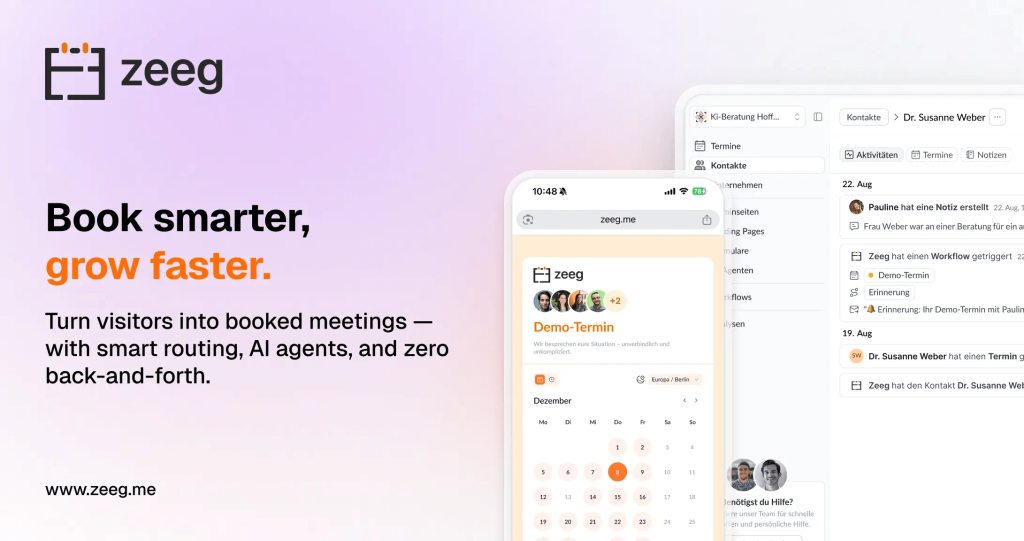
Zeeg is scheduling software from Zeeg GmbH, a German company, and it is the only platform we have found that natively combines an AI voice agent with a full booking system. The scheduling half is what you expect: booking pages, calendar sync, buffers, reminders, team routing. The voice half is an AI receptionist that picks up your inbound calls around the clock, understands what the caller wants, qualifies them, and books the appointment into the same calendar your booking page writes to. No callback, no voicemail, no missed lead.
The two halves being one product is the whole point. Plenty of tools do scheduling and a growing number do AI voice agents, but stitching them together usually means a Zapier chain, two vendors and a fragile handoff. Zeeg detects booking intent mid-call and writes the appointment immediately. The other differentiator is compliance. Zeeg is built and hosted in Germany, is GDPR compliant by default with a signed DPA, and does not require configuration gymnastics to be legal for a European business. For a lot of EU buyers that alone rules Calendly out of the evaluation.
What Are Zeeg’s Key Features?
AI Voice Agent for Inbound and Outbound
The voice agent answers inbound calls end to end: it works out intent, qualifies the caller, books the appointment and logs the contact. There is no rigid phone menu, and it pulls from a knowledge base you supply so it can answer common questions rather than deflecting everything to a human. It also runs outbound campaigns. You upload a contact list, define the goal, and it dials. Calls are transcribed, and recording and data storage can be switched off for privacy. It currently speaks seven languages: English, German, Spanish, Russian, French, Turkish and Italian, each with several voice options. In testing terms, the thing to check is whether it handles your specific jargon, because a knowledge base that is thin will produce an agent that politely stalls.
Scheduling With Real Meeting Types
Zeeg supports one-on-one, group, collective, round-robin and flexi meetings, which covers everything from a discovery call to a four-person panel interview. Routing forms on the Business plan qualify inbound leads and send them to the right person by territory, language or availability. Calendar support is unusually broad: Google Calendar, Outlook, Exchange, Apple Calendar and Proton Calendar, with Zoom, Google Meet, Teams and Webex for the meeting itself. Proton Calendar support is a small detail that tells you who this product is built for: privacy-conscious European buyers who are not on the default Google stack.
Built-in CRM Layer
Every call and booking creates a contact record with transcripts and history attached, and the Scale plan adds 5 custom CRM objects and 10 custom CRM attributes so you can model your own pipeline inside Zeeg rather than syncing everything out. If you already run a CRM, native integrations cover HubSpot, Pipedrive and Salesforce. This is more than most scheduling tools attempt and it means a small team can genuinely run inbound off Zeeg alone. That said, do not mistake it for a real CRM. Five custom objects will not replace HubSpot once you have a pipeline with stages, forecasting and reporting attached.
European Hosting and Compliance
German servers, GDPR compliance by design, a signed DPA, plus SSO and SCIM user provisioning on the Scale plan. If you are a European company that has been quietly uncomfortable about where your prospect data goes, or you have had a legal review block a US scheduling tool, this is the reason to look at Zeeg before anything else. It is a positioning choice rather than a feature, but it is the one that closes deals for them.
How Much Does Zeeg Cost?
Zeeg has a genuine free forever plan called Starter: 2 scheduling pages, 1 calendar connection, one-on-one events only, video conferencing integration, basic customisation and email support. Professional is 12 euro per user per month billed monthly or 10 euro annually, and adds 4 scheduling pages, 2 calendar connections, group events, workflow automation, webhooks, Zapier, analytics and chat support. Business is 20 euro per user per month, 16 euro annually, and unlocks unlimited scheduling pages, 6 calendar connections, multi-user meeting scheduling, team and organisation features, white-label branding, advanced integrations and routing forms. Scale is 40 euro per user per month, 30 euro annually, adding custom CRM objects and attributes, SSO, SCIM and priority support. Enterprise is custom pricing. Annual billing saves 20% across the board.
The AI voice agent is billed separately, per minute of usage. Packages start at 49 euro for 250 minutes and the rate falls to 0.111 euro per minute once you are past 9,000 minutes a month. There is no minimum contract and no base platform fee for the voice product, so you can bolt 250 minutes onto a free Starter account and see whether an AI receptionist actually converts calls before committing to seats. That unbundling is the smartest thing about the pricing. Most AI voice vendors want a platform fee before you have proved anything.
On scheduling alone Zeeg is cheaper than the incumbent. Calendly’s Standard plan is $12/user/mo monthly or $10 annually and its Teams plan, where round-robin and collective events live, is $20/user/mo. Zeeg’s Business plan at 20 euro covers the same team features plus white-label branding and routing forms. Cal.com’s paid team tier is $15/user/mo with a much more generous free plan. On the voice side, Synthflow’s pay-as-you-go rates start around $0.08 per minute for the voice engine, but real all-in costs with the language model and telephony usually land between $0.13 and $0.20 per minute, which puts Zeeg’s 0.111 euro at volume in the same territory while including the scheduling stack.
| Plan | Price | Plan Features | Best For |
|---|---|---|---|
| Starter | Free | 2 scheduling pages, 1 calendar connection, one-on-one events, video conferencing, email support | Solo users testing the platform |
| Professional | 12 euro/user/mo | 4 scheduling pages, 2 calendar connections, group events, workflow automation, webhooks, Zapier, analytics | Freelancers and consultants |
| Business | 20 euro/user/mo | Unlimited scheduling pages, 6 calendar connections, team features, white-label branding, routing forms | Sales and service teams |
| Scale | 40 euro/user/mo | Custom CRM objects and attributes, SSO, SCIM provisioning, priority support | Larger organisations with IT requirements |
Who is Zeeg Best For?
Use Zeeg if you lose money on unanswered phone calls. Clinics, law firms, agencies, recruiters, home services and any sales team fielding inbound calls all bleed leads at the same point: the phone rings while everyone is busy and the caller goes to a competitor. An AI agent that answers, qualifies and books is a direct fix, and having it write into the same calendar as your booking link means no reconciliation work.
Use it if you are a European business with GDPR exposure. German hosting and a signed DPA remove an argument you would otherwise have with legal every renewal.
Use it if you want to start free. The Starter plan is not a trial, and 2 scheduling pages is enough for a solo consultant indefinitely.
Skip Zeeg if:
- You only need internal scheduling and will never use the voice agent. Cal.com’s free plan is more generous and Calendly has the deeper integration catalogue.
- Your callers speak a language outside the seven supported. The voice agent is the reason to buy and it will not help you in Portuguese, Dutch, Polish or Japanese.
- You need unlimited booking pages on the cheapest paid tier. Professional caps at 4 pages and 2 calendar connections, where Calendly Standard gives unlimited event types.
- You want fully predictable billing. Per-minute voice pricing means a busy month costs more than a quiet one.
Best Zeeg Alternatives
Calendly
Calendly is the market default with the deepest integration ecosystem and the most name recognition, at a free plan, $12/user/mo Standard and $20/user/mo Teams. It gives you unlimited event types on Standard where Zeeg caps you at 4, and no procurement team will ever question it. What it has no answer for is the phone. If your inbound comes through a booking link and never through a call, Calendly is still the safer choice. If calls matter, Zeeg does something Calendly does not attempt.
Cal.com
Cal.com is the open source alternative and it has the best free tier in scheduling: unlimited event types, unlimited bookings and some team features at zero cost, with a paid team plan at $15/user/mo. You can self-host it, which beats even German hosting for data control, and the API is fully open. It has no AI voice agent and setup is more technical. For an engineering-led team that wants scheduling and nothing else, Cal.com is better value than any of these.
Synthflow
Synthflow is a dedicated AI voice agent platform and is the better tool if voice is the entire project. It runs pay-as-you-go from roughly $0.08 per minute on the voice engine, with realistic all-in costs of $0.13 to $0.20 per minute once the language model and telephony are added, and no licence fee. It is far more configurable than Zeeg’s agent and handles complex call flows better. What it does not include is scheduling, a CRM layer or booking pages, so you would be buying two products and wiring them together.
Final Verdict: Is Zeeg Worth It?
Zeeg is the rare tool that is genuinely doing something its competitors are not. Scheduling software has been a commodity for years, and Zeeg’s answer is not another integration but the realisation that half of inbound demand still arrives as a phone call nobody picks up. Putting an AI receptionist and a booking engine in one product, on one calendar, with one contact record, is the right design. The pricing backs it up: a real free plan, 20 euro per user for team features that Calendly charges the same for without white labelling, and voice minutes you can buy in a 49 euro block to test the idea before you commit.
The caveats are honest but small. Scheduling page limits on the lower tiers are stingy, the voice agent covers seven languages so plenty of markets are out, and per-minute billing makes budgeting less tidy than a flat seat price. None of that outweighs what you get. At 8.4 this is one of the strongest tools we have looked at in productivity this year, and if you are a European business fielding inbound calls, we would put it at the top of your shortlist. Start on the free plan, buy 250 minutes of voice, and measure how many of those calls turn into booked meetings.
Zeeg Pros & Cons
What We Like
- Only scheduling platform that natively includes an AI voice agent, booking appointments mid-call with no callback
- Genuine free forever plan, not a trial, with 2 scheduling pages and calendar sync
- German hosting, GDPR compliance by default and a signed DPA, which clears European legal review
- Business plan at 20 euro/user/mo matches Calendly Teams pricing while adding white-label branding and routing forms
What Could Be Better
- AI voice minutes are billed separately from 49 euro for 250 minutes, so budgeting is less predictable
- Professional plan caps at 4 scheduling pages and 2 calendar connections where Calendly Standard is unlimited
- Voice agent supports only seven languages, so many markets are unserved
Zeeg FAQ
What is Zeeg?
Zeeg is a European scheduling platform from Zeeg GmbH that combines appointment booking with an AI voice agent. The agent answers inbound calls, qualifies callers, books appointments into your calendar and logs contacts, all hosted in Germany under GDPR.
How much does Zeeg cost?
Zeeg has a free Starter plan. Professional is 12 euro per user per month, Business is 20 euro and Scale is 40 euro, with 20% off annual billing. The AI voice agent is billed per minute, starting at 49 euro for 250 minutes and falling to 0.111 euro per minute above 9,000 minutes.
Is Zeeg worth it?
Yes if inbound phone calls are part of how you get customers. Nothing else bundles an AI receptionist with a booking engine on one calendar, and the pricing beats Calendly Teams. If you only need booking links, Cal.com's free plan is better value.
What are the best Zeeg alternatives?
Calendly from $12/user/mo is the default with the deepest integrations, Cal.com is the open source option with the best free plan and $15/user/mo teams, and Synthflow is the dedicated AI voice platform at roughly $0.08 to $0.20 per minute if you only want voice.
Does Zeeg offer a free plan?
Yes. The Starter plan is free forever and includes 2 scheduling pages, 1 calendar connection, one-on-one events, video conferencing integration and email support. AI voice minutes can be bought separately without upgrading.
Who is Zeeg best for?
European businesses that field inbound calls: clinics, law firms, agencies, recruiters, home services and sales teams. It suits anyone whose legal team has blocked a US scheduling tool over GDPR, and anyone losing leads to unanswered phones.






